M09 Delivery: from the request to verifiable hand-over evidence
Choose a logistics method from the recipient and the resources, then review the whole-kit mass, centre of gravity, energy and handover history, with a three-role KSEC.
Who needs what, and when is it considered arrived under the conditions
A logistics request starts with the person who needs the goods. It states the items, quantity, condition, time and the persons in the receiving role. The desired result is goods matching the code/quantity/condition, with handover evidence that can be reviewed. Flying to the destination or sending a message is not enough to close the job.
Choose B Beginner to make a brief and read the unknowns, O Operator/planner to organise resources, loading, energy and the recipient, or D Developer/tuner to propose a contract and tests. This lesson is pending_field_review; specialist=not_assigned; the P3 readiness gate remains open There are no flight results, deliveries, authorizations, handovers or real learner results.
Before starting, read the whole UAS, mass and balance, the payload mission plan and brief/roles together with system integration, testing, law and airspace, the logistics chain and handover data Worksheet readiness is separate from the readiness of a real kit.
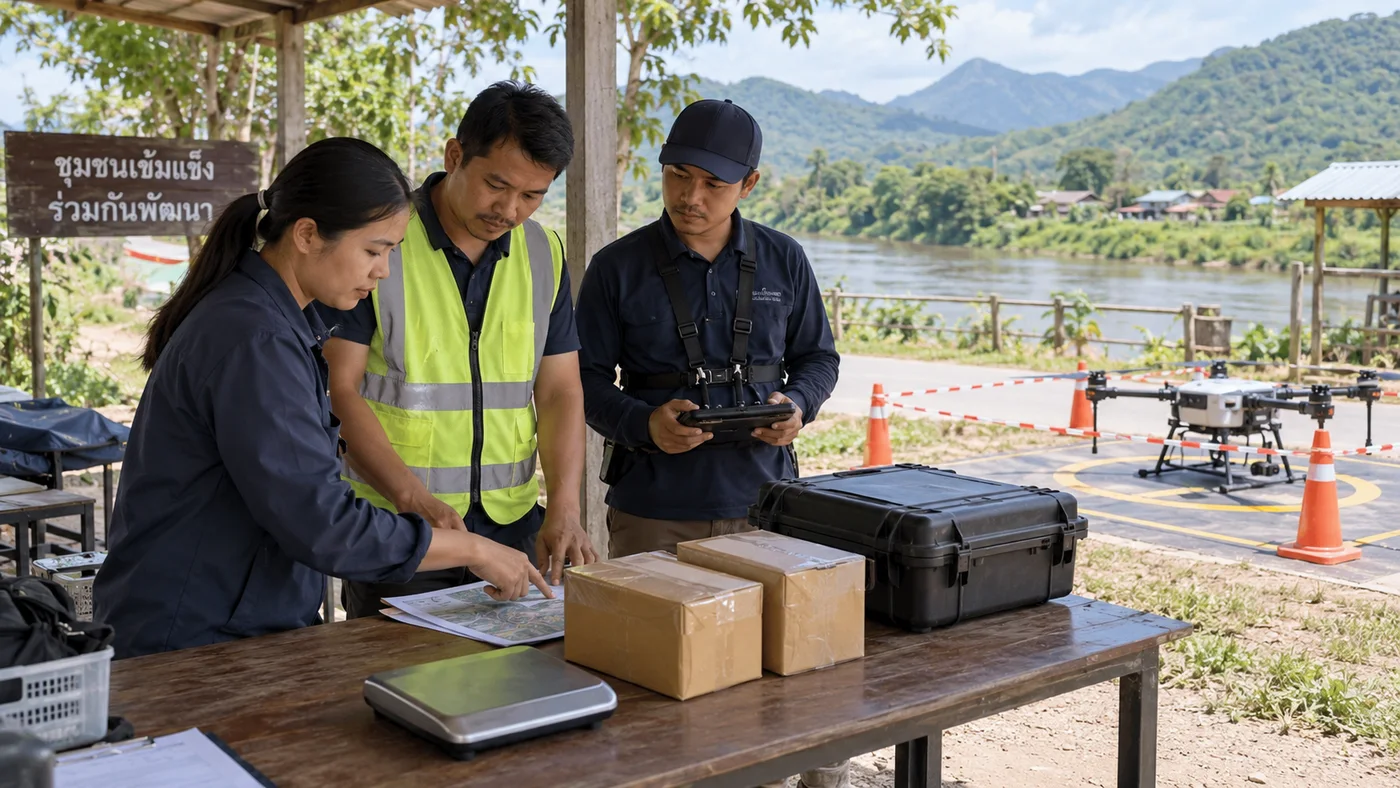
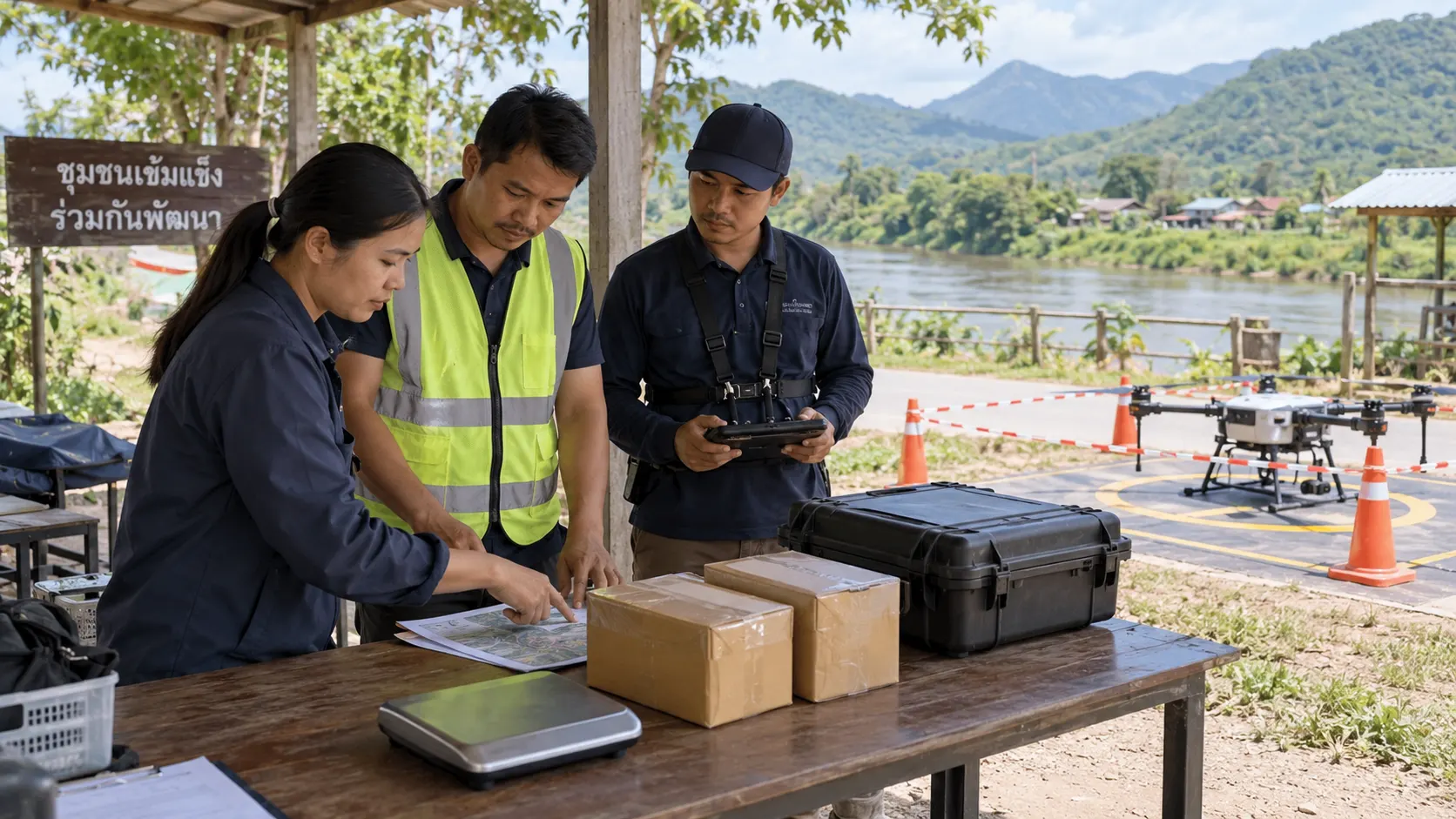
The image was created with AI to explain the context. It is not a real TRAIN-LOG-01 or evidence of delivery. Open the full-size context image
Start from the recipient and the logistics gap
A request must state the items, quantity, acceptable condition, time of use, persons in the receiving role, and the problem with the transport network. Examples are general non-hazardous tools or supplies at an island, mountain or hard-to-reach site, including sealed supplies to support disaster response. Also compare vehicles, boats, service networks and holding the job. Do not decide that a drone must be used from the moment the request is received.
Separate the choice into three axes, then check the combined kit:
Scroll the table horizontally to see every column. When it has keyboard focus, use the left or right arrow keys.
| Axis | Options | What must be reviewed |
|---|---|---|
| Aircraft type | Payload-carrying multirotor / VTOL or fixed-wing that supports a payload system | The real kit's manual and take-off/landing method must fit the task; do not infer payload position, range or time from the type name |
| System owner and service | Use your own kit / use shared resources / contract a service provider | People, kit, service conditions and confirmation evidence; a service provider is not an aircraft type |
| Delivery method to the recipient | Landing / winch system / release system | A suitable system, method, area and recipient approved according to the real kit are required; the exercise gives no cargo-release procedure |
Apply the same criteria to every option set and to the ground alternative:
Scroll the table horizontally to see every column. When the table has keyboard focus, use the left or right arrow keys.
| Shared criterion | Data to request and who confirms | When data are insufficient |
|---|---|---|
| Goods and container | Mass, size, packing, preservation and the payload definition from the goods owner/manual | Request real data or choose a service/ground option that supports it |
| The assembled kit as a whole | Mass, centre of gravity, power, mounting points and interfaces from the technical reviewer | Hold the readiness claim and review the whole kit |
| Route and energy | Outbound, delivery, return, alternatives when continuing is not possible, usable energy and the current condition | Do not derive flight range from Wh; ask the responsible person to re-plan |
| Both endpoints | Area, airspace, link, authorizations and the receiving method confirmed by the coordinator | If rights or the recipient are unclear, hold; do not send |
| People and resources | Stock, packers, team, kit, battery/charging, recipient and record owner | requested is not yet confirmed; the owner's reply is needed |
| Custody of goods | Who holds the goods in transit, security, quality and time | Identify the persons responsible for outstanding items and the evidence requested |
| Cost and service | Equipment, people, container, maintenance, energy, service and total handling burden | Do not invent prices or ROI, and do not treat a service as ready just because it has a name |
| Ground and holding | Vehicles, boats, service networks or holding under the same conditions | State the option, the follow-up owner and the review conditions |
An example comparing methods from the same request
The fictitious recipient needs two parcels of general tools at an agreed time. The following option set is a draft whose resources are not yet confirmed The option numbers are not shipment A/B/C, and performance is not ranked by aircraft type. Learners should treat unknown cells as evidence-request tasks.
Scroll the table horizontally to see every option. When it has focus, use the left or right arrow keys.
| Same criteria | 1 Own-kit payload-carrying multirotor, proposing landing delivery | 2 A service provider proposes a payload-carrying VTOL kit and a receiving method | Vehicle/boat/service network or holding |
|---|---|---|---|
| Mass, size and container | The cargo custodian asks for the real value of the goods/box; the fixture numbers do not stand in for the real thing | Send the goods specification to the provider to review the kit and the conditions for accepting the job | Review the size, mass, packing and the goods-acceptance terms of that service |
| The whole kit and the connections | The technical reviewer requests the manual and the baseline mass/CG/power/mount | Ask the provider to confirm the supported kit and the approval basis; a service does not replace reviewing the aircraft | Review the vehicle/boat/container and the custody limitations; do not apply a drone CG to a vehicle |
| Route, return/alternatives and energy | The responsible person requests a plan according to the real kit and the current conditions | Request the service's limits, the return/alternatives and the plan evidence of the real kit | Request the route, continuity and resources for when access is not possible |
| Both endpoints and rights | The landing method, area, airspace, link and recipient still need confirmation | The receiving method and the system the provider uses still need rights review at both endpoints | Access rights and the recipient also still need confirmation |
| People, stock and readiness | Team/item names in the draft are not yet confirmed | Asking for a price/requesting the job is not an acceptance of the service or a ready recipient | The transport slot and stock still need the owner's reply |
| Condition, time and chain of custody | Agree the cargo custodian and the evidence for each leg up to the recipient | Agree the responsible person between services and the quantity/condition evidence | Use the same goods and recipient criteria, with evidence in transit |
| Total cost / service readiness | Request equipment, people, care, container and handling costs | Request conditions, price, time limits and the handling team's costs | Request costs, time limits and network constraints |
| Reason to choose anew or hold | If the kit, people, rights or recipient do not support it, review another method/hold | If the service does not accept, or the kit does not support it, review other options/hold | If access is not possible or conditions are incomplete, the task owner reviews and keeps the hold |
Model answer for the choice: this draft information is not enough to choose a winner or dispatch. The planner sends a data request to the owner of each cell and states the time/review conditions. If a fixed-wing aircraft that supports the goods is proposed in place of the VTOL, every row must be reviewed again against the real kit and a suitable launch/recovery method; do not derive answers from the type name or from being a service provider.
Special goods, such as medical supplies, hazardous materials or temperature-controlled goods, require their own experts, handling methods and legal evidence. The general-supplies check in this kit does not confirm the suitability of special goods.
UNICEF Guidance on the Use of Drones in Supply Chains is used as a basis for asking about the need, the transport bottlenecks and the people concerned before considering feasibility. Only the cover/table of contents and sections 1–3 (PDF pages 4–7) were read. Distances, cargo coordinates, medical procedures and cost-effectiveness results are not carried over as our requirements. The option tables in this lesson are teaching work designed by the author.
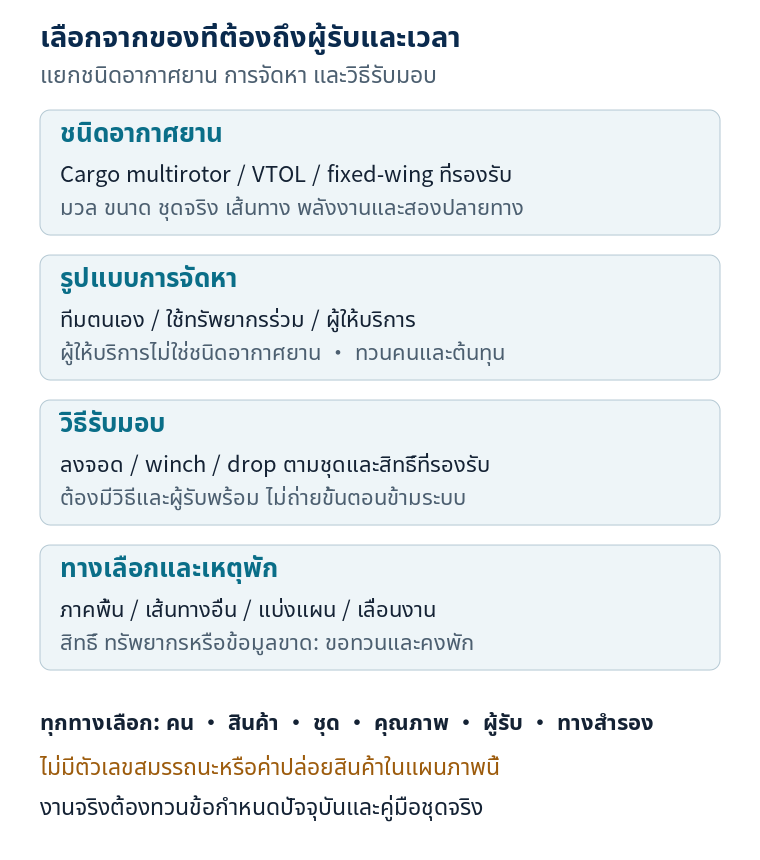
The diagram is teaching design work based on fabricated data, not an SOP or field evidence. Open the full-size diagram
The pickup point determines the delivery method, not just a coordinate on a map
The practice card TRAIN-M09-DEST-01 is separate from the manifest A/B/C and S5 Q-A/Q-B/Q-C: a fictitious coordinator must send two boxes of a general connector kit to a communications repair team, but the pickup point, the recipient and the delivery method each have separate answers. The map points to a location that proposes it can; it does not confirm that the area is usable, safe, has a recipient, or fits the available kit. Start from what must reach people and the evidence of receipt, then compare ground methods, landing, lowering goods with a dedicated system, and holding the job.
UNICEF checklist Annex 1 asks to survey the destination, the nature of the goods, the receiving capacity at both ends, the recipient and the activity owner before choosing a service (LOG03). That document was prepared for the health supply chain; we use it only as a framework for asking questions and do not borrow medical-goods requirements for the fictitious kit. Logistics Operational Guide: Before Distribution asks to consider access, security and the people at the handover point; Goods Flow Management separates preparing to receive from counting/condition and the evidence of actual receipt (LOG04). These sources do not certify areas or flying methods in Thailand.
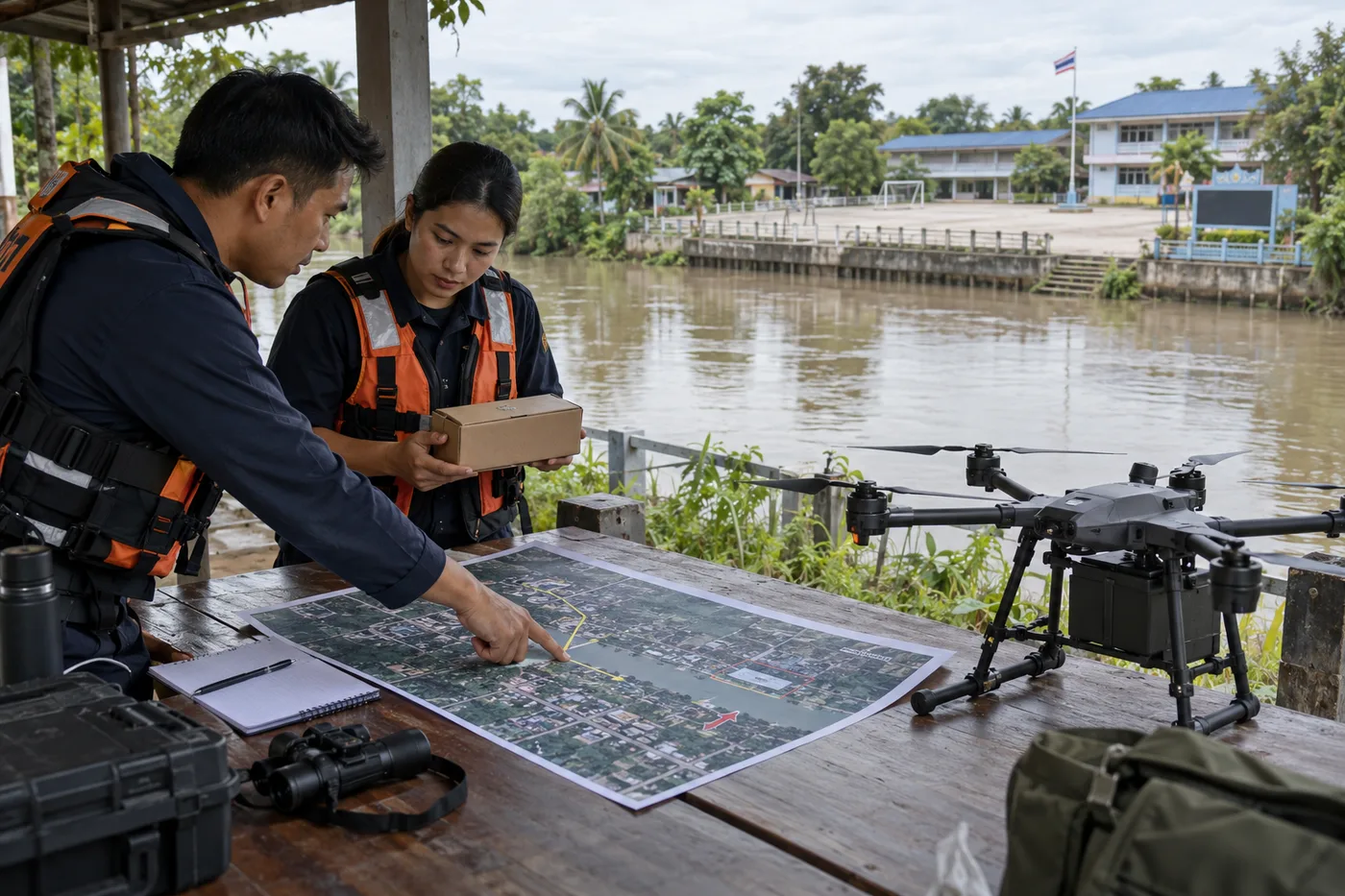
A teaching image conveys that one must talk with the recipient and the area owner before choosing a kit. What is seen in the distance is not an inspection of the yard or the access. Open the full-size context image
Scroll the table horizontally to read every column. Use the left or right arrow keys when it has keyboard focus.
| Proposed method | Must be confirmed at the destination and in the system | If still unknown |
|---|---|---|
| Ground vehicle/boat or service | Access, time window, provider/recipient, goods/container, rights and the delivery–receipt documents | Remains an option to review; do not assume a vehicle/boat exists from a service name |
| Land then hand over | Area owner, the conditions/people around at that time, the area available for the method, the real kit/people/manual, route/airspace/rights, and the recipient of the goods | hold_site or hold_method; a map or a distant image is not a survey/authorization |
| Lower the goods or release with a dedicated system | Equipment/goods compatibility, the people responsible, an area separated from people, the control/receiving-check method and task-specific rights | hold_method; do not switch from landing merely because the landing area is unclear |
| Hold and arrange alternatives | The request owner tells the recipient what is missing and sets an evidence follower and a review time | Keep the original request/version; do not claim the goods arrived or the job closed |
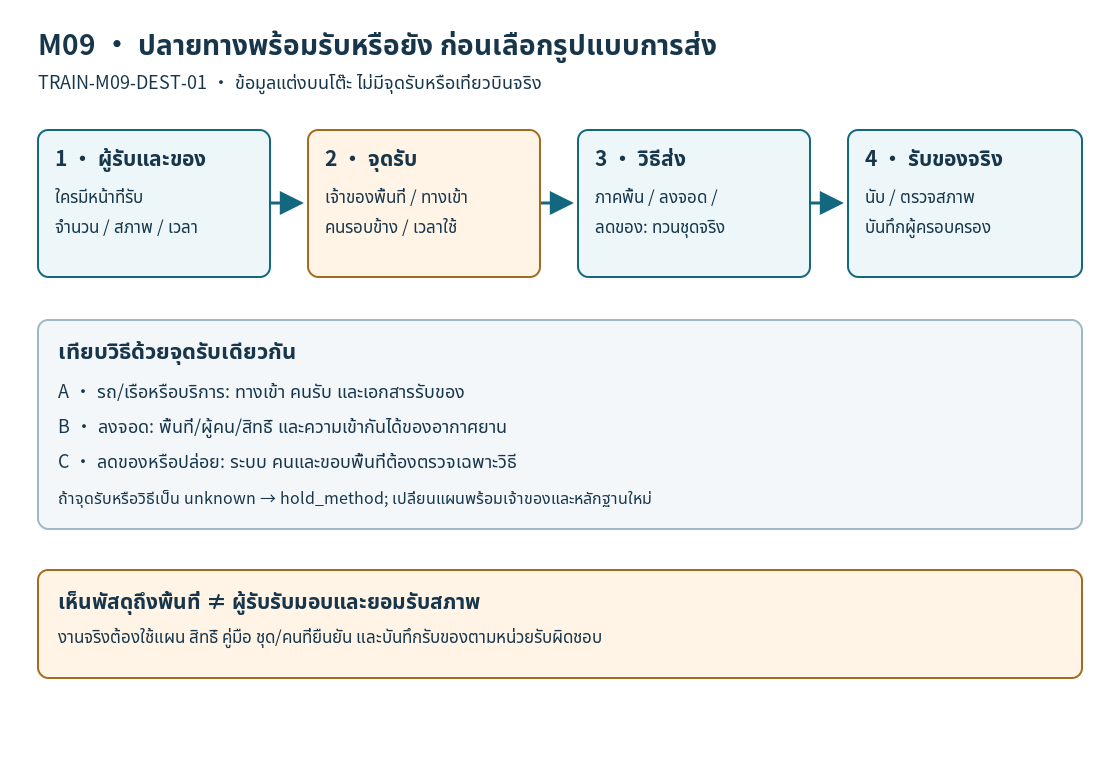
Diagram description: the pickup point and the delivery method must fit and be confirmed separately. Seeing the parcel reach the area is not evidence that the recipient has taken possession or accepted the condition. Open the full chart
Before proposing any method, enter site_owner, the time of the condition/access check, the receiver and receiving authority, goods/container/acceptable condition, the kit and people that support the method, rights/airspace, a plan for when the destination cannot be used, and the receiving documents. Record requested, confirmed, expired according to the evidence of each part's owner. Confirming the recipient does not confirm the pickup point; confirming the pickup point does not confirm the flying method. If the destination changes, a new version of the plan must be opened and both the method and the chain of custody reviewed; this lesson does not change any in-flight command.
Practise KSEC with the same M09 codes from the pickup-point and delivery-method card together with rubric M09: B separates the proposed coordinate/inspected site/recipient/receipt; O builds a ledger of rights owners, resources and alternatives; D proposes a contract with negative tests by actual=NOT_RUN.
Scroll the table horizontally to read every column. Use the left or right arrow keys when it has keyboard focus.
| Group and baseline before starting | K · Knowledge | S · Skills/work product | E · Ethics | C · Observable personal characteristics |
|---|---|---|---|---|
| B Beginner: can separate a coordinate from the recipient | Separates a point on the map from the real pickup point (APP-M09-B-K01) |
Makes a brief A–D with owners of the unknowns (APP-M09-B-S01) |
Withdraws the claim 'there is a yard so we can deliver' (APP-M09-B-E01) |
Accepts comments and keeps the reason for the fix v0→v1 (APP-M09-B-C01) |
| O Planner: knows requested/confirmed | Explains that destination/method/recipient are separate gates (APP-M09-O-K01) |
Compares ground, landing, lowering goods and holding, with a fallback plan (APP-M09-O-S01) |
Does not skip area rights or the recipient to speed up delivery (APP-M09-O-E01) |
Follows expired evidence and notifies holders of the old plan (APP-M09-O-C01) |
| D Developer: separates versions from expected/actual | Explains the contract of the site, the method and the receipt (APP-M09-D-K01) |
Proposes a test for when a site expires or the recipient changes (APP-M09-D-S01) |
Does not create receipt results or approvals from coordinates (APP-M09-D-E01) |
Keeps the baseline/reason for the fix and the retest plan (APP-M09-D-C01) |
This activity is an extension of understanding and does not replace the manifest A/B/C calculation, events L01–L08, work products D01–D20 or the M09 rubric review. This card has no real area, recipient, goods or test results; P3 not_assigned/pending_field_review, P5 learners B/O/D = 0/0/0 NOT_RUN, field NOT_RUN, CLO/PLO pending_design.
An eight-step plan from request to handover
Scroll the table horizontally to see every column. When the table has keyboard focus, use the left or right arrow keys.
| Step | Outputs to prepare and the responsible role | Reasons to hold and follow-up work |
|---|---|---|
| 1 Receive the request | The requester and planner agree the goods, time, recipient, quantity/condition criteria and the limits of disclosure | If the recipient or conditions are unclear, ask for confirmation before choosing a method |
| 2 Choose the method | The planner compares the three axes with vehicles/boats/services using the shared criteria | If the kit or service does not meet the need, review the alternatives |
| 3 Assemble the resources in the plan | The stock owner, the packer/cargo custodian, the drone team/load reviewer, the area-airspace coordinator and the recipient accept their duties | A request is not evidence of readiness; outstanding items have an owner, requested evidence and review conditions |
| 4 Review the whole kit, route and energy | The technical reviewer reviews the mass/CG, loading and interfaces of the whole kit against the manual; the responsible person reviews the plan version, route, return/alternatives, energy, link and current condition | If mass, position, energy or conditions are missing, hold/re-plan; do not derive readiness from toy results |
| 5 Confirm rights, both endpoints and the recipient | The coordinator confirms the area, airspace, authorizations at both endpoints, the receiving method and the persons in the receiving role, with the rights to send goods/data and the confirming evidence | A draft may be prepared, but do not dispatch or share until the recipient/rights and the conditions just confirmed are complete and confirmed by the person with authority |
| 6 Proceed under the plan that was reviewed and authorized | In real work, the responsible operator uses the reviewed and authorized plan/kit version, with a record of time, version and chain of custody; this worksheet proposes what to record and involves no real mission | If the goods, conditions, people, kit, recipient or version change, hold/re-plan/return/use ground transport under the operator's authority; do not create automatic flight commands |
| 7 Hand over and review quantity/condition | The recipient reviews the code, cumulative quantity, condition and outstanding items against the criteria; the cargo custodian keeps evidence of the recipient's possession, separating arrival of the goods, acknowledgement and acceptance of condition | If the code, quantity or condition does not match, or receipt evidence is missing, keep the outstanding item with an owner; do not close the job from a send log or an ack |
| 8 Keep corrections, history and notify of the replacing version | The record owner keeps the original, time, version, correction report and superseded version; notify the recipient of the replacing version, with the outstanding items and the followers | Do not overwrite history, do not add cumulative totals twice, and do not let an old version close the current plan; state the evidence to request and the review conditions |
Resource ledger fields that learners must fill in: what is requested / requester / the owner with authority to confirm / reply and evidence / time limit or version / status requested or confirmed / work that depends on it / follow-up owner / alternatives and review conditions. Keep every unknown field as unknown; do not assume that stock or the recipient is available.
If the goods, container, battery, mounting point, firmware, control system or delivery method changes, keep the baseline version, input/config and interface boundary before reviewing the manual, compatibility, time, power, and the mass/CG of the whole kit and its effects. If a version must be restored, restore the version that was previously reviewed and supports the data, or keep the hold, with the reviewer and the recheck proposal; do not derive earlier numerical results as readiness.
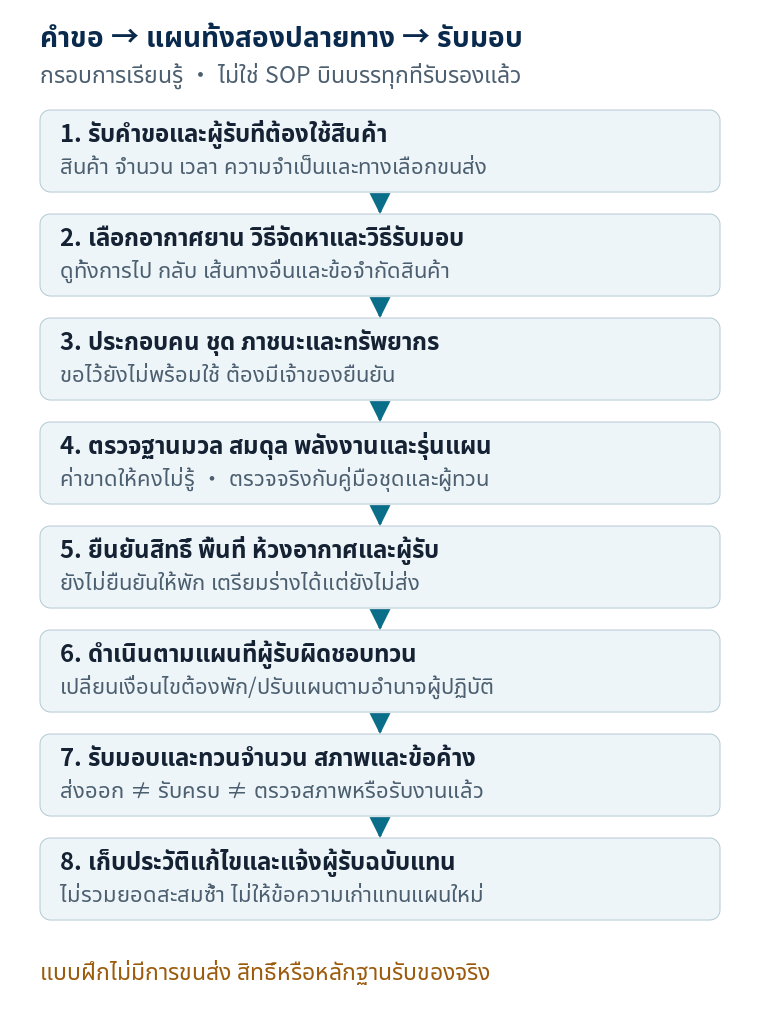
The diagram is teaching design work based on fabricated data, not an SOP or field evidence. Open the full-size diagram
Complete numbers help raise questions; they do not confirm the real kit
Terms and examples, part by part
- Mass is in kilograms (kg) in this exercise. The aircraft with its battery is a single item and the original battery must not be added again.
- The payload mass as defined in the scenario includes the empty box, packaging and the goods, and excludes the aircraft with its battery. A real manufacturer's definition may differ, so the manual of the real kit must be opened.
- The total mass of the kit includes all five items, so it covers the aircraft, battery, box, packaging and goods.
- The centre of gravity in a one-axis model is a mass-weighted average of positions. It uses the symbol x_CG. This static point-mass model does not check vibration, swinging or real approval limits.
- Energy is in Wh (watt-hours) as the quantity of energy set by the scenario. It is not a mass in kg or a position in m, and it does not tell flight range.
- The sum of known parts adds only the values that exist. When an item is still blank, this sum is not the complete total. A blank is different from zero.
- A receipt report states the quantity and condition the recipient reports, while an acknowledgement says the message was received, and acceptance of the goods' condition needs separate criteria and evidence. An acknowledgement does not add goods and does not approve the condition.
Example for kit A: the aircraft with battery 4 kg, a box 0.5 kg, packaging 0.3 kg and two parcels of 1.5 and 1 kg. The payload mass as defined is therefore 0.5+0.3+1.5+1 = 3.3 kg and when the aircraft is counted, the total mass of the kit is 7.3 kg All values are fabricated; no goods were weighed and no real aircraft was assembled.
DJI FlyCart 30 manual v1.1 page 33/79 of a 98-page file checked on 14 October 2026 shows the weight/CG check and the precautions when loading goods. It is therefore an example that the manual of the real kit and mode must be reviewed. The values or procedures of this model are not used for every aircraft, it is not a purchase recommendation, and the winch manual was not read to give any cargo-release procedure.
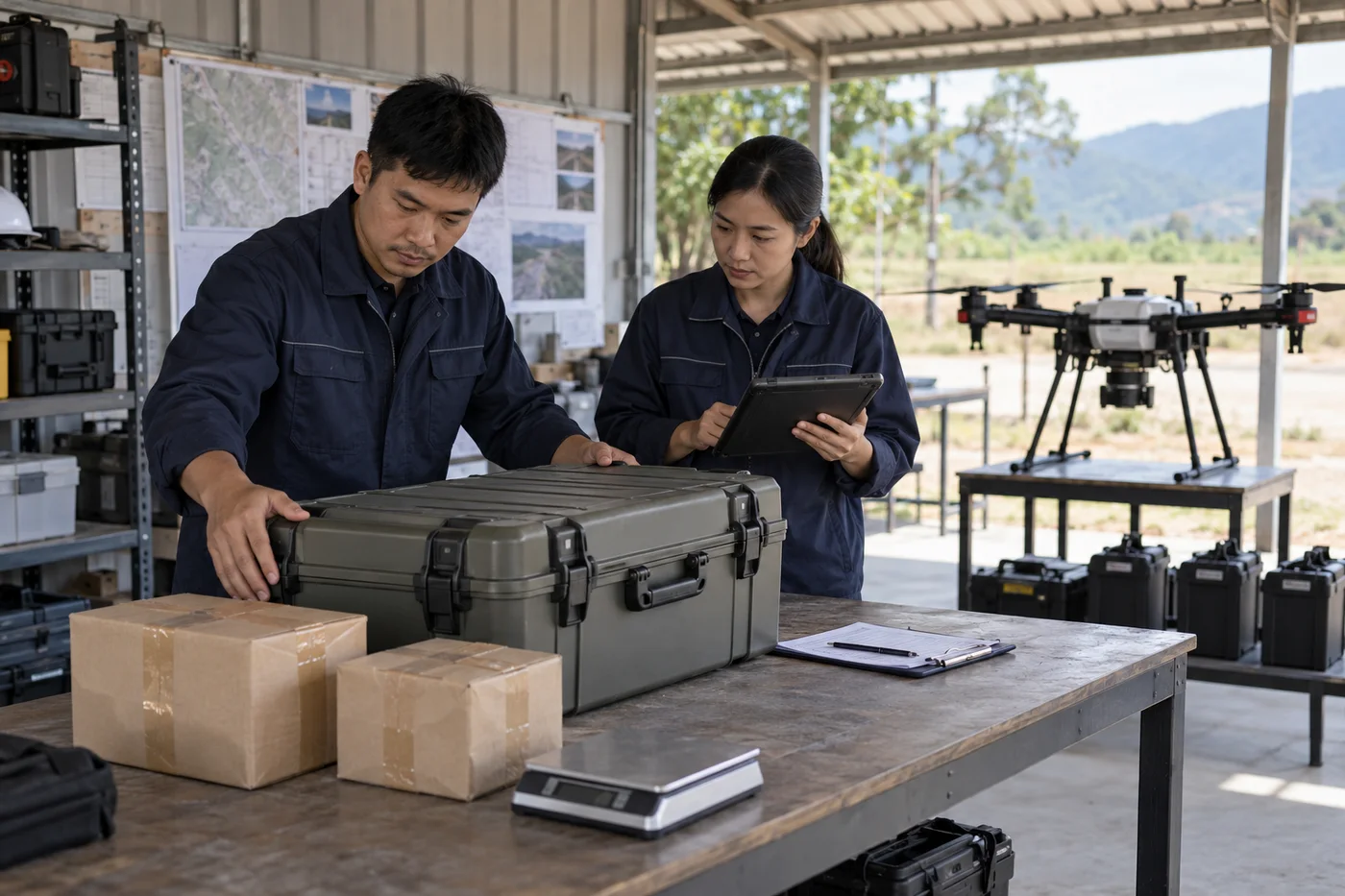
The image was created with AI; it is not a weighing, a CG review, or certification of a kit in the manifest. Open the full-size review-list image
TRAIN-LOG-01 is TABLETOP ONLY All numbers, positions, example margins, energy, roles and events are data written by the author. There are no measured parts, no manufacturer-approved kit, and no route, place, flight date, transport, authorization, real recipient, handover evidence or learner results. Positions are metres relative to a reference point of the fictitious aircraft, and the event order is a composed order, not real time.
Every row is pending_field_review a field-specific reviewer specialist=not_assigned and the P3 readiness gate remains open. Completing the worksheet or being able to calculate does not confirm people, kit, current condition, rights, flight readiness or receipt of goods.
The manifest has 15 rows / 15 fields Each shipment has an aircraft with battery, an empty box, all the packaging and two parcels of goods. Values complete with schemas are in readme C03 packaging mass and C05 parcel-2 position are blank and must stay blank.
Model answers for mass, centre of gravity and energy
For this scenario only: declared_payload = empty box + packaging + two parcels of goods; assembly_gross = aircraft with battery + declared_payload; moment = Σ(mass_kg × x_m); x_CG = moment / assembly_gross when masses and positions are complete, the total mass is positive and all values are finite. A real manufacturer's definition may differ, so the actual approved kit must be reviewed.
The assumed margins set by the author are assembly_gross ≤ 8 kg and x_CG within [−0.02,+0.02] m These are used only to explain the inequalities; they are not manufacturer requirements or flight approval limits. The model is a one-axis static point mass, with no measurement and no review of dynamics, cargo securing and real movement.
Scroll the table horizontally to see every column. When it has keyboard focus, use the left or right arrow keys.
| Shipment | declared payload | Whole-kit gross | moment | x_CG | Answer for this scenario only |
|---|---|---|---|---|---|
| A | 3.3 kg | 7.3 kg | −0.05 kg·m | −0.05/7.3 = −0.006849315 m | Within the two fictitious inequalities only; real readiness is not confirmed |
| B | 4.3 kg | 8.3 kg | −0.25 kg·m | −0.25/8.3 = −0.030120482 m | Exceeds the mass and is outside the fictitious CG range; propose re-planning/service/ground transport |
| C | unknown | unknown; the known mass is 7.0 kg | unknown | unknown | The packaging and the parcel-2 position are blank; request the data, and do not use 7.0 against 8 as a complete total |
A worked part by part: the moment of the goods = 1.5×0.1 + 1×(−0.2) = −0.05 kg·m, while the other three items are at x=0 so their moment is zero. Dividing the moment by the total kit mass of 7.3 kg gives the x_CG above. Do not divide by the payload of 3.3 kg or add the original battery again.
Energy is a fictitious table separate from the manifest: total_energy = outbound + service + return + reserve when complete; headroom = usable_energy − total_energy when both sides are known. The numbers do not come from a real battery's voltage or current, a wind model, range or flight performance. A reserve of 20 Wh is a teaching assumption only, not a recommendation for reserve energy or a reserve percentage.
Scroll the table horizontally to see every column. When the table has keyboard focus, use the left or right arrow keys.
| Shipment | usable (Wh) | Outbound / delivery / return / reserve (Wh) | Total energy | headroom |
|---|---|---|---|---|
| A | 120 | 30 / 5 / 35 / 20 | 90 Wh | 30 Wh as set by the scenario; flight not confirmed |
| B | 120 | 60 / 10 / 60 / 20 | 150 Wh | −30 Wh; propose re-planning/another method |
| C | unknown | 30 / 5 / blank / 20 | The known parts total 55 Wh; the complete total is unknown | unknown because the return leg and the usable energy are missing |
There is no shipment pass ratio, no real payload coordinate, flight range or automatic flight command. A still needs real kit evidence, people, the current condition and rights. B has problems in both the numbers and the authorization, separately. C must have data and authorization requested before it is reviewed again.
Send and receive evidence must preserve versions and corrections
Handover 8 rows / 17 fields is a separate register, not an aircraft status field. All data are fabricated; both authorization_basis values are also assumptions. execution_status=not_performed and receipt_evidence_status=not_supplied in every row. The current plan of A/B/C is PLAN-1 from the manifest.
Model answers for chain of custody and receipt reports
Scroll the table horizontally to see every column. When the table has keyboard focus, use the left or right arrow keys.
| Event | Correct reading of the fictitious status | Outstanding work |
|---|---|---|
| L01 | prepared but authorization is not yet confirmed | hold dispatch; a draft may be made, there is no sending |
| L02 | Assume the sending is authorized and dispatched | sent/pending receipt only within the fictitious story; no real sending |
| L03 | Cumulative receipt reported 1 out of declared 2 | quantity discrepancy; the quantity cannot yet be closed |
| L04 | Correct the L03 report to cumulative 2 and keep L03 | The quantity matches only within the fictitious story; condition unknown, so the condition is not yet fully accepted |
| L05 | Acknowledge the current report with cumulative 2 | An ack does not add another 2 parcels and does not confirm the condition |
| L06 | B requests authorization but it is not yet confirmed | hold dispatch; the mass/CG/energy problems must be reviewed separately |
| L07 | C has only a proposed dispatch | Not dispatched/receipt; hold the rights and the kit/energy data |
| L08 | C reports from PLAN-0 but the current plan is PLAN-1 | Keep the history and quarantine the old data; do not update the receipt or the readiness of PLAN-1 |
received_packs is a cumulative count report so 1+2+2 of L03/L04/L05 must not be added up to 5. The current report for A is 2 of 2 within the fictitious story only, with the condition still outstanding. The original, the correction and the superseded version must be kept. Do not fill a blank received as 0, and do not treat a send log as evidence that the recipient holds the goods.
A real record must have the sender/recipient with authority, time, plan/kit version, goods code, quantity, condition and verifiable chain-of-custody evidence, separating arrival of the goods, acknowledgement of the message and acceptance of condition. The record owner keeps the access-controlled original and purpose-specific copies, reducing names, addresses and stock details to what is necessary. Do not share or dispatch while the recipient/rights are not confirmed. The term pending receipt is used only after a sending that was really authorized; in this register, L02 is an assumption, not evidence of that sending.
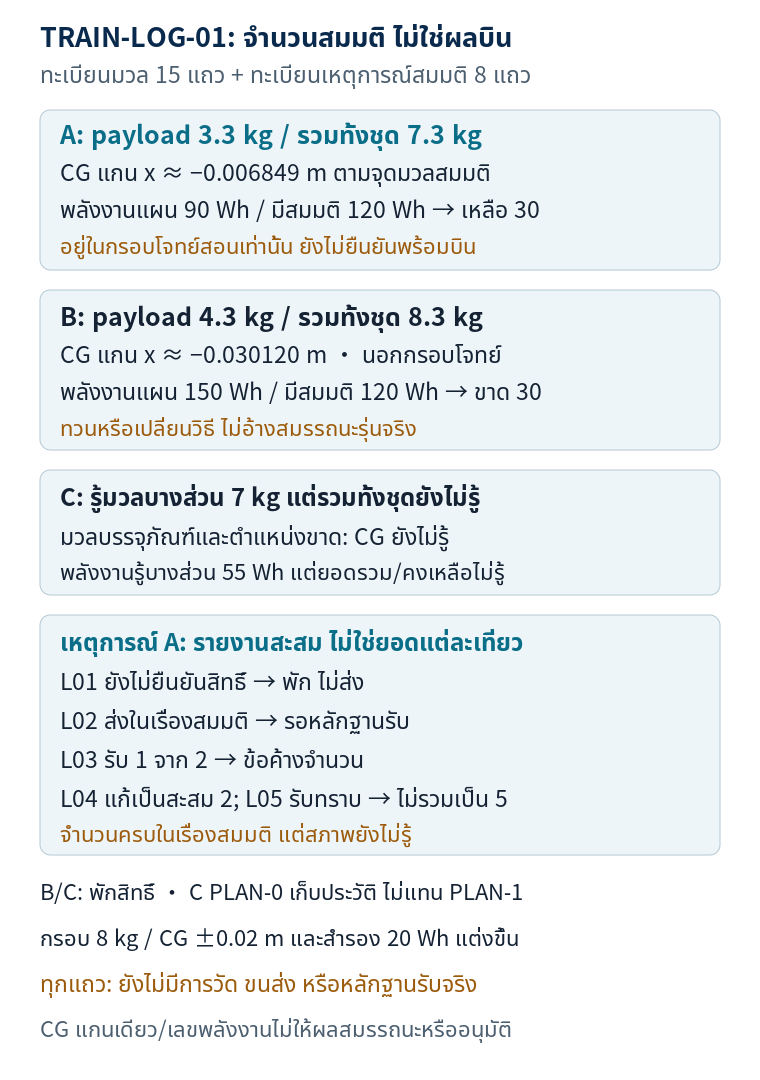
The diagram is teaching design work based on fabricated data, not an SOP or field evidence. Open the full-size diagram
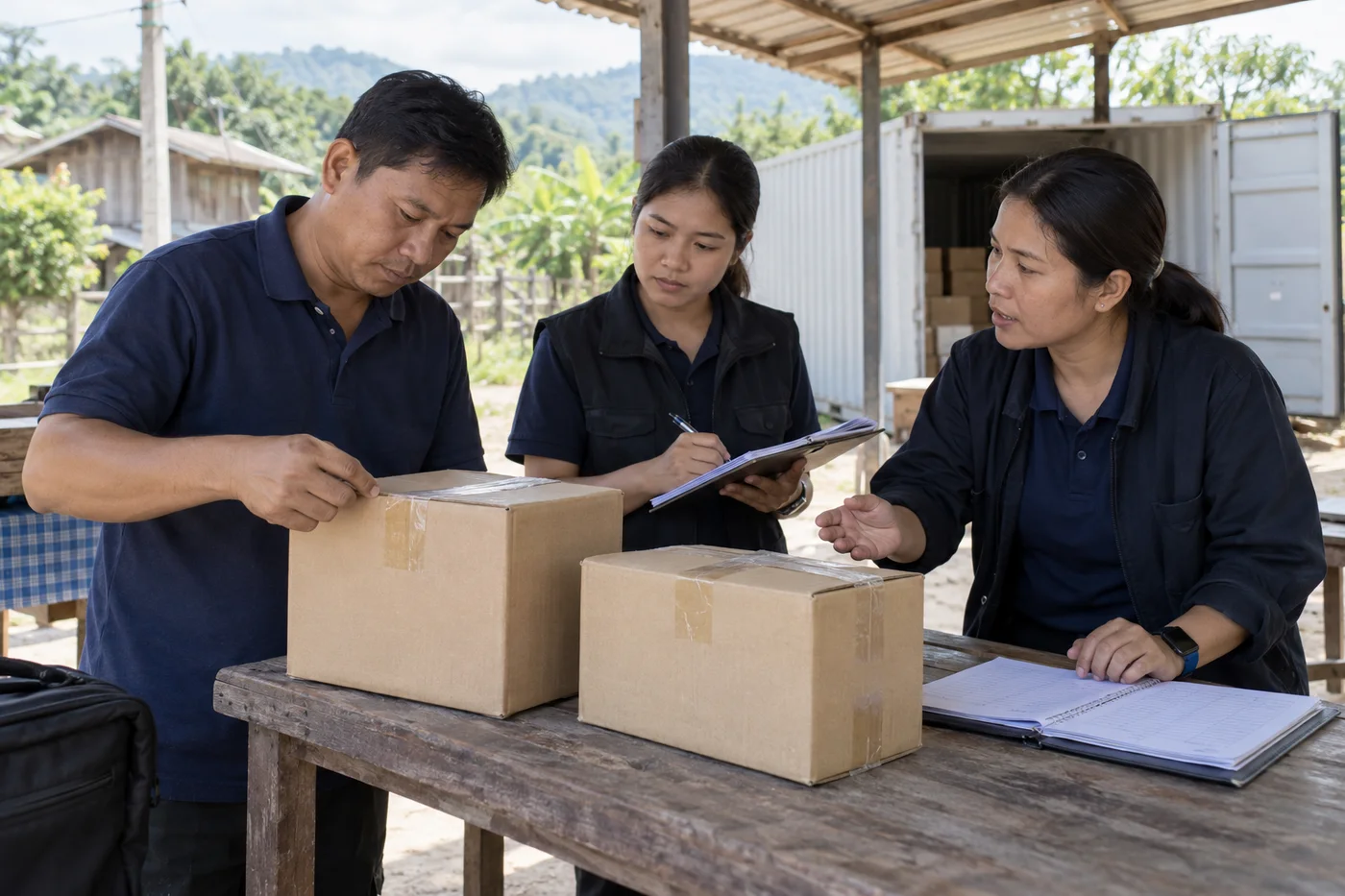
The image was created with AI; it is not a receipt or chain of custody of TRAIN-LOG-01. Open the full-size handover image
B Beginner: write the request and choose the method
Do Worksheet B: a one-page brief, a three-axis table with the ground alternative, A part by part, the reasons for B/C, and L01–L08 with before/after claims and B-v0/B-v1. Keep the reply to every comment. Each unknown has an owner, requested evidence and review conditions.
Scroll the table horizontally to see every column. When the table has keyboard focus, use the left or right arrow keys.
| ID / dimension | Baseline and supplementary work before starting | Goal / activity and evidence | Criteria to demonstrate |
|---|---|---|---|
| APP-M09-B-K01 / K | Knows the UAS and can separate the recipient from the system type; review the UAS system then write the three-axis differences before starting. | Explain the request, the handover result and the options using the shared criteria; a brief with the three-axis table and ground transport | The reason for the choice ties together the recipient, time, goods, kit, resources and outstanding items |
| APP-M09-B-S01 / S | Can read mass, units and blanks; review mass and balance then calculate one example of payload differing from gross. | Make a brief and read A/B/C and the cumulative received count while preserving unknowns; the formula for A, the disposition of B/C, and the answers for L01–L08 | A 3.3/7.3; B out of margin; C unknown; A cumulative received fictitious 2, condition outstanding |
| APP-M09-B-E01 / E | with limited claims, and asks about rights before sending; review handover data and rights then correct the statement 'ready to fly and share everything'. | Give the reason for holding and reduce data according to the recipient/rights; before/after claims and an answer for the case where the recipient or rights are missing | Do not send when rights/the recipient are missing; do not call a toy pass readiness, or an ack acceptance of condition |
| APP-M09-B-C01 / C | and can keep versions, accept comments and follow outstanding items; review roles and follow-up work then name one owner and one piece of evidence to request. | Adjust the brief and track outstanding items in a traceable way; B-v0/B-v1, comments, replies, issue owner/evidence/review conditions | Answer every comment and do not close a request that has no reply |
O Operator/planner: plan through to the recipient
Do Worksheet O: an eight-step plan, a requested/confirmed ledger for both endpoints, a loading/energy matrix, the chain of custody and corrections of the two registers, purpose-specific copies, and O-v0/O-v1. A draft may be prepared, but do not send goods/data while the recipient or rights are not confirmed.
Scroll the table horizontally to see every column. When the table has keyboard focus, use the left or right arrow keys.
| ID / dimension | Baseline and supplementary work before starting | Goal / activity and evidence | Criteria to demonstrate |
|---|---|---|---|
| APP-M09-O-K01 / K | Knows the whole assembly and the roles at both endpoints; review the payload mission plan then use the mission summary and roles to separate requested from confirmed. | Explain the method, people and evidence before delivery to the recipient; an eight-step plan, a three-axis table and a resource/manual ledger | Complete roles: stock, packer, technical team, area, recipient, data and alternatives |
| APP-M09-O-S01 / S | Can read the schema/key and calculate kg·m/Wh; review mass and balance then do A and state what the assumed margins cannot prove. | Make a loading/energy/handover plan that preserves versions and unknowns; the A/B/C math, the energy matrix, L01–L08 and a correction/custody proposal | A 90/30, B 150/−30, C 55 subtotal; the correction does not add cumulatively and L08 is quarantined |
| APP-M09-O-E01 / E | Ready to hold when rights, the recipient or the condition are not confirmed; review law and authorizations then use handover data and rights to write a reduced-data copy. | Give the reason for hold/replan/ground/service and control data to what is necessary; the reason for holding, a recipient-rights plan, redaction and the limits of accepting condition | prepared is not an authorization; pending receipt only after an authorized send |
| APP-M09-O-C01 / C | Ready to keep the original and follow requests/corrections; review roles and follow-up work then name the person who notifies of stale data and a reviewer for one case. | Preserve a verifiable chain of custody and version corrections; O-v0/O-v1, issue, resource/correction/recipient logs | Do not overwrite history; every outstanding item has an owner/evidence/conditions, and the replacing version is notified |
D Developer/tuner: design margins that a contract can prove
Do Worksheet D: fix a v0 that forgets packaging, fills blanks with 0, omits the mass definition, adds cumulative totals, and takes condition acceptance from an ack, so that v1 has R01–R08/D01–D20 complete, actual=not_run in every case. No parser/validator/runtime/payload control/backend is delivered. Keep the input/schema/rules/config/output before and after, with a change/rollback/recheck proposal.
Scroll the table horizontally to see every column. When the table has keyboard focus, use the left or right arrow keys.
| ID / dimension | Baseline and supplementary work before starting | Goal / activity and evidence | Criteria to demonstrate |
|---|---|---|---|
| APP-M09-D-K01 / K | Knows the schema/key/null and the interface margins; review system integration then use testing to separate blank from zero. | Explain the R01–R08 contract and the reasons for the fix D-v0→D-v1; an input/output contract, the mass definition and a requirement map | Separate data/mathematics/real evidence; do not infer an SOP or approval |
| APP-M09-D-S01 / S | Can tie a requirement to input/expected; review testing then propose one test for the blank-cell case without citing a run result. | Design 20 tests through the interface and a recheck plan; D01–D20 requirement, input, expected, actual and a rollback proposal | All 20 complete with actual not_run, covering units, missing, duplicate, version, cumulative and status |
| APP-M09-D-E01 / E | Ready to report expected separately from actual and not to execute the data; review handover data and rights then correct the claim 'tested' and state the sending channel according to rights. | Limit claims and propose inert data/minimum sharing; a status/claim/export policy and the limits of recipient authorization | No parser/runtime/auto-approval; the CSV does not run formulas/commands/paths |
| APP-M09-D-C01 / C | Ready to keep a baseline, accept comments, and name who holds/restores/reviews; review system integration then identify the trigger for changing a container or firmware. | Control changes and version rollback with a responsible person; D-v0/D-v1, input/schema/rules/config/output, and a change/rollback/recipient log | A change to the whole kit requires re-review; known-reviewed or hold, and notify of stale data |
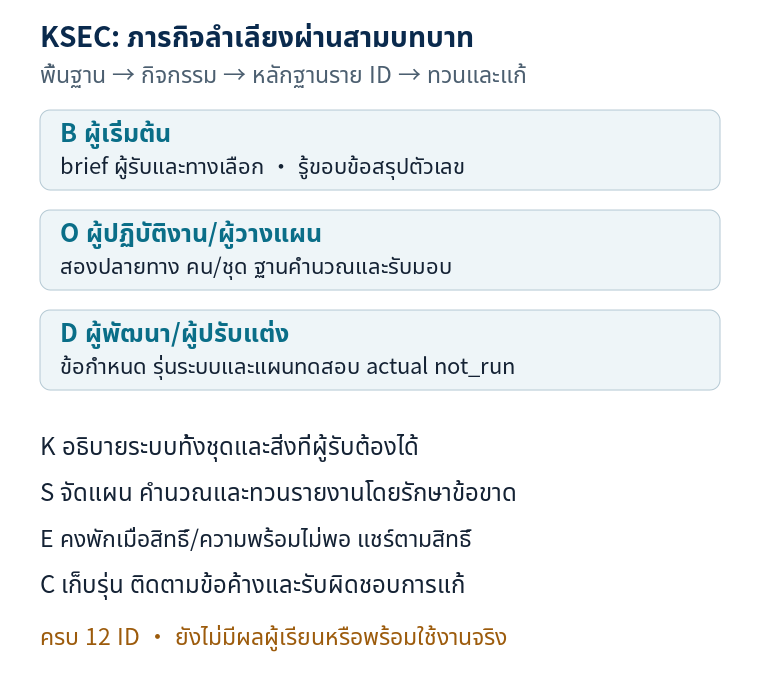
The diagram is teaching design work based on fabricated data, not an SOP or field evidence. Open the full-size diagram
Work-product criteria, corrections and evidence levels
Use rubric 12 ID with learning record to record results per K/S/E/C as has evidence per the criteria / needs more practice / no evidence yet stating the evidence, version, reviewer, reason and supplementary work. Keep the original together with the corrected version. E uses the reason for holding / claims / minimum sharing; C uses replies to comments, correction history and follow-up work. Do not announce a certification from reading.
Curriculum mapping adds APP-M09-{B,O,D}-{K,S,E,C}01, 12 IDs in all, with the CLO/PLO fields blank and pending_design. This kit prepares the worksheets and records; there are not yet any learner results or field-specific reviewers.
The seven standalone files: B, O, D, rubric, readme, manifest and handover Every MD has schemas, data, definitions, formulas, model answers and criteria for use as a separate file.
If a search request and situation imaging occur in the same period, review the practice card for three shared-resource requests before promising any kit for a logistics job: a boat that has only been requested and a drone with an RGB camera are not yet a confirmed delivery method.
Sources, reading scope and rights
- UNICEF Guidance on the Use of Drones in Supply Chains, PDF: the cover/table of contents and sections 1–3 (PDF pages 4–7) of a 16-page document dated 12 October 2026 were checked; it is not claimed that the procurement annex or the medical-goods procedures were read in full.
- DJI FlyCart 30 downloads, User Manual v1.1 (download page dated 9 July 2025; the PDF cover says 2024.06): the cover and PDF/printed pages 33 and 79 of 98 pages were checked on 14 October 2026. The winch manual was not read. No numbers, procedures or properties of this model are carried over as general criteria.
- UNICEF drone planning checklist Annex 1 (LOG03) and Logistics Operational Guide: Before Distribution / Goods Flow Management (LOG04): used only for the destination framework, access and receipt of goods; see the M09 source register and the limits of claims
- The KSEC baseline and the OBE boundary use the KSEC overview K=Knowledge, S=Skills, E=Ethics, C=Character; C is not experience competency. It uses behaviour in the work product, does not label personality, and does not certify KSEC/OBE from reading.
The scenarios, teaching process, numbers, formulas, requirements/tests tables and rubric are design work of PK-Research / Drone-Hub and are not an SOP of UNICEF or any manufacturer. Worksheets and fixtures that were newly composed use CC BY 4.0 crediting the author, the kit/model, the source and the corrections. External documents, images, logos and media remain the rights of their original owners; external PDFs are not included and the licence is not extended to that media.
Practise C03, the synthetic payload kit to calculate the one-dimensional mass, CG and energy before reviewing missing data and restoring the baseline parameters. Every coordinate is a fabricated datum, not mounting advice or a flight permit.
If a request for supplies starts from a disaster report, review S1: the M06 → M07 → M09 handoff chart before using S5: multiple requests and handover evidence. When the destination recipient changes, practise the hold point for plan corrections and the chain of custody in S5 before treating a replacement recipient as confirmed. The two main cases and the sub-scenario of changing the recipient are separate practice datasets; confirmation of the need, the recipient and the resources must occur in a new request.