Documentation and presentation
UAT 494 Unmanned Aircraft Systems and Automation Technology Capstone Project II
Lesson
By the end of this module you will be able to
- Organise an evidence dossier that traces from conclusions to source data
- Summarise the verification status of every requirement honestly, including open items
- Write a user manual and a project report for the committee and the users
- Prepare the presentation and demonstration for the committee
Why this matters
The committee has little time and will judge on the conclusions, the evidence and the demonstration. The drone knowledge base’s exercise on dossier review stresses that a good dossier starts from the conclusions and lets the reader trace straight to the source evidence, that every document carries a version and change log, and that open issues must not be hidden to make it look complete.
The evidence dossier
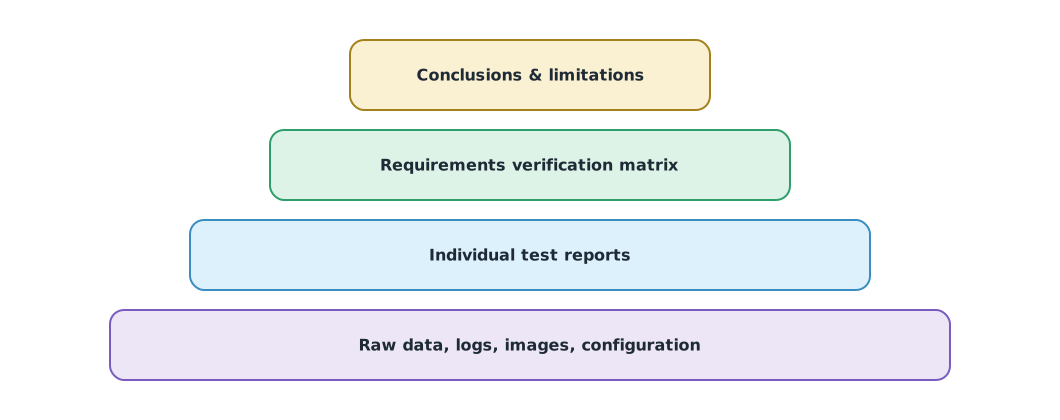
The dossier is layered: conclusions and limitations, then the requirements verification matrix (RVM), then each test report, then the raw data and configuration. Every layer cites the one below with clear identifiers and versions, following the configuration management principles of ISO 10007.
Example 1 Final RVM status
Requirements from UAT 493 with the results from Modules 3–4 (hypothetical data).
rvm = {   # requirement: (status, evidence)
    "R1 crack recall >= 0.90": ("met on sample, not demonstrated", "T1 report v2, test set TS-03"),
    "R4 round <= 15 min": ("verified", "T2 flight log set FL-11..20"),
    "R6 coordinates within 3 m": ("verified", "T3 GCP survey v1"),
    "R5a store images": ("verified", "A1 storage analysis v1"),
    "R5b send report": ("verified", "D1 walkthrough with office"),
    "R8 web dashboard": ("not started (Could)", "-"),
    "R2 usability SUS >= 68": ("verified", "SUS survey n=5"),
}
counts = {}
for req, (status, ev) in rvm.items():
    key = status.split(" (")[0].split(" on ")[0]
    counts[key] = counts.get(key, 0) + 1
    print(f"{req:<28} {status:<34} {ev}")
verified = sum(1 for s, _ in rvm.values() if s == "verified")
print(f"verified {verified}/{len(rvm)} = {verified / len(rvm):.0%}; open items must appear in the conclusions")
R1 crack recall >= 0.90 met on sample, not demonstrated T1 report v2, test set TS-03
R4 round <= 15 min verified T2 flight log set FL-11..20
R6 coordinates within 3 m verified T3 GCP survey v1
R5a store images verified A1 storage analysis v1
R5b send report verified D1 walkthrough with office
R8 web dashboard not started (Could) -
R2 usability SUS >= 68 verified SUS survey n=5
verified 5/7 = 71%; open items must appear in the conclusionsR2 is the requirement rewritten in UAT 493 so that it is measurable with a SUS score. Five of seven requirements are verified. R1 is met on the sample but not yet demonstrated with confidence, and R8 was cut in priority order. Both must appear in the conclusions with reasons and a plan. This kind of disclosure makes the committee trust the verified parts more.
Manuals and reports
- The project report puts conclusions before details (Markel and Selber, 2025) and covers the problem, requirements, architecture, testing, results, limitations and recommendations
- The user manual is written for irrigation staff, not for the development team, covering pre-flight preparation, flying, reading the report, and what to do when something goes wrong
- The handover package contains software versions, configuration files and operating limits so that others can continue the work
Presentation and demonstration
A 15–20 minute presentation should answer three questions: what problem was solved, how far it was achieved with evidence, and what remains. A live demonstration is risky, so prepare a backup video and logged data, and obtain permission for the demonstration flight area.
Example 2 Overall project score
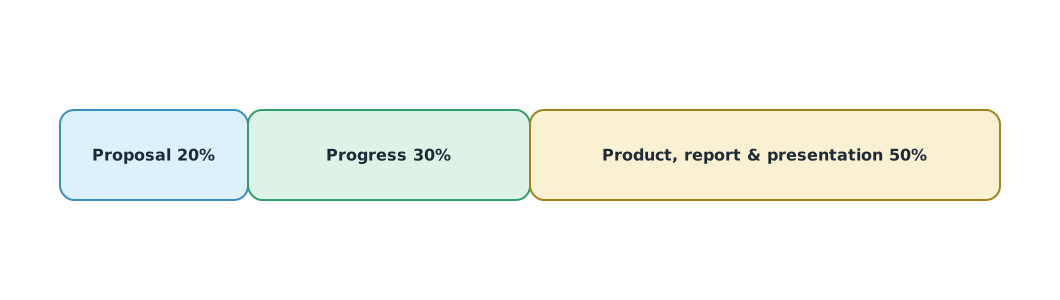
Course weights: proposal 20%, progress and advisor meetings 30%, product, report and presentation 50% (hypothetical scores).
weights = {"proposal": 0.20, "progress & advisor meetings": 0.30, "product, report & presentation": 0.50}
scores = {"proposal": 82, "progress & advisor meetings": 75, "product, report & presentation": 88}
assert abs(sum(weights.values()) - 1) < 1e-9
total = sum(weights[k] * scores[k] for k in weights)
for k in weights:
    print(f"{k:<32} {scores[k]:>3} x {weights[k]:.2f} = {weights[k] * scores[k]:5.1f}")
print(f"final {total:.1f}")
gain = weights["progress & advisor meetings"] * 10
print(f"10 more points on progress would add {gain:.1f} to the final score")
proposal 82 x 0.20 = 16.4
progress & advisor meetings 75 x 0.30 = 22.5
product, report & presentation 88 x 0.50 = 44.0
final 82.9
10 more points on progress would add 3.0 to the final scoreThe product and presentation carry half the weight, but steady progress still counts for almost a third, so meeting the advisor every two weeks with progress numbers, as in Module 1, pays off.
Module lab
Lab: dossier and presentation
- Organise the dossier as in Figure 1; every document has a version, date and change log
- Summarise the RVM with Example 1 and write conclusions that include open items
- Write the user manual, have real users read and follow it, and note where they got confused
- Rehearse the presentation with the advisor and prepare a backup video of the demonstration
- Hand over the software, configuration and documents to the users or the next team
Common mistakes
Watch out
- Conclusions citing evidence that cannot be found
- Hiding requirements that failed
- Writing the manual in the development team’s jargon
- No backup plan for the live demonstration
- Submitting only the report without handing over software and configuration
Summary
- The evidence dossier traces from conclusions to source data at every layer
- The final RVM states the status of every requirement honestly, including open items
- The report is for the committee, the manual is for users, and the handover package is for whoever continues
- The presentation answers what was solved, how far, and what remains, with a backup plan
Check your understanding
- 6 of 8 requirements are verified. What percentage is that?
- Proposal 70, progress 80, product 90. What is the overall score (20/30/50)?
- Why should failed requirements not be hidden?
- How does a user manual differ from a project report?
- What main questions should the presentation answer?
Answers
- The committee would stop trusting the whole dossier, and users might operate the system beyond its capability
- A manual lets users carry out tasks; a report shows the committee the problem, method, evidence and limitations
- What problem was solved, how far it was achieved with evidence, and what remains
Key formulas
| Share of requirements verified | |
| Overall project score |
Key references
- National Aeronautics and Space Administration. (2016). NASA systems engineering handbook (NASA/SP-2016-6105 Rev 2). link
- INCOSE. (2023). INCOSE systems engineering handbook: A guide for system life cycle processes and activities (5th ed.). Wiley. link
- Dym, C. L., Little, P., & Orwin, E. J. (2013). Engineering design: A project-based introduction (4th ed.). Wiley. link
- Markel, M., & Selber, S. A. (2025). Technical communication (14th ed.). Macmillan Learning. link
- International Organization for Standardization. (2017). Quality management — Guidelines for configuration management (ISO 10007:2017). link
Further reading
Study the assigned knowledge units in advance, review media and take the module quiz
In class / field
Team project work, advisor meetings and progress presentations
Learning evidence: Project milestone deliverables