S5 Delivery and hand-over: when requests exceed confirmed resources
A tabletop case study linking M09/M06/M10 with 16 rows of constructed data, practicing separating requests, resource confirmation, delivery plans, and handover evidence, with KSEC for three roles.

Many requests, but confirmed resources have limits

Teaching illustration shows planning; it is not evidence of an area, a flood, an approved aircraft, or an actual transport. Open the full-size context image
In the hypothetical exercise TRAIN-CSL-01 there are three requests for general connector kits Q-A/Q-B/Q-C. The stock owners respond at different times, some recipients are still unclear, and the planner must make a proposal as of 09:05+07 on which item should be reviewed first for a drone method, a ground method, or a hold. The exercise set has no world coordinates, real incident, cargo/aircraft weight, energy, weather, or permissions. “Three kits” means the number of goods on paper, not the payload rating of a drone.
The result this lesson requires is a proposed plan with outstanding items and owners , not a flight order or a receipt. scenario.csv has 16 rows; expected.csv is the author's row-by-row answer guide. Read the dictionary and CSL-RULE-v1 before comparing; the illustrations were not taken from the CSV rows.
Linked foundation lessons and why the options must be compared
M09 Logistics explains requests, method selection, mass/balance, and receiving goods for a single exercise set; S5 adds several requests competing for the same resource and expired confirmations. M06 Situation Assessment helps read freshness and unknowns; M10 Communications helps separate queued, sent, received, and acknowledged. The mission brief lesson and Law and Airspace are the foundation, but this lesson does not interpret flight rights in specific cases
Before using the Q-A/Q-B/Q-C proposals as a plan for choosing a transport method, practice M09 Receiving Points and Handover Methods: a confirmed recipient does not confirm that the receiving point supports landing or lowering of goods, and a site seen on a map does not confirm the recipient or evidence of receipt. The card TRAIN-M09-DEST-01 is separate from the 16 rows of S5.
If you start from a flood report, first follow the M06 → M07 → M09 handoff chart in S1 : the assessment results and survey requests are starting information, not an order to carry goods. Q-A/Q-B/Q-C in S5 are another set of constructed exercises and did not arise from R07 in S1; a responsible person must confirm the need and open a new logistics request before the S5 reasoning is applied.
UNICEF Supply Division describes use cases, service models, and planning factors for drone delivery (L-01); WFP Drones emphasizes safety, privacy, law, and coordination (L-02). We use them as questions for comparing boat/vehicle or service, drone, and putting the work on hold using the same recipient, time, goods, evidence, risks, and constraints; no data or performance figures were copied from those sources.
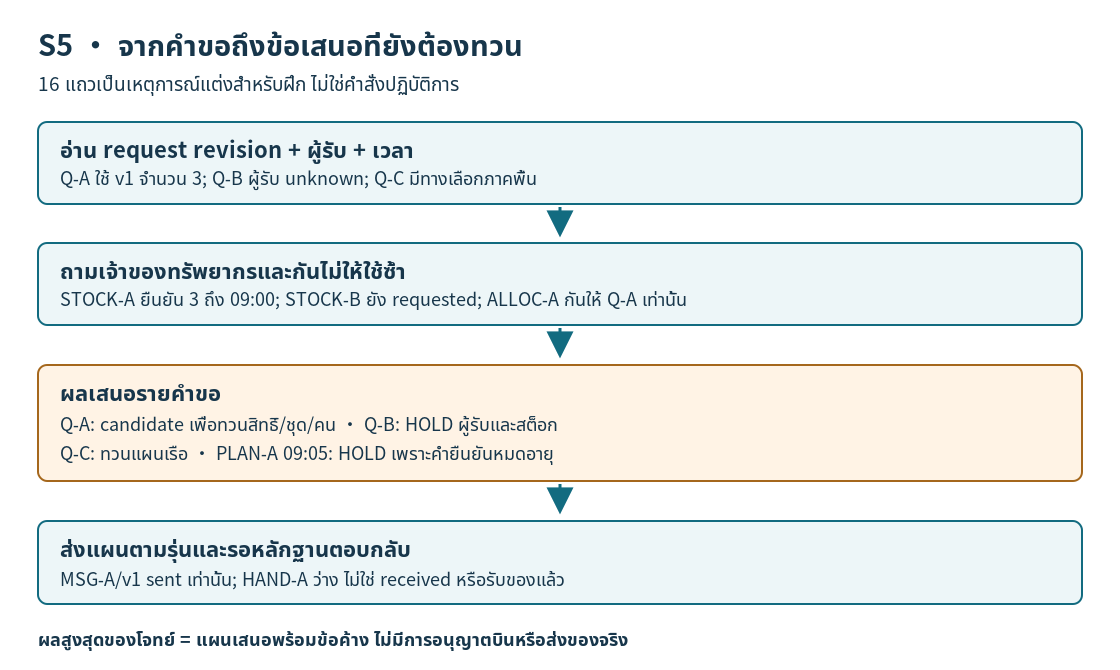
Diagram description: the end point of the exercise is a proposal that still needs review, not a dispatch. Open the full-size decision chart
Read the versions and the owner's confirmation before queuing
Q-A revises v0 four kits to v1 three kits; STOCK-A/v0 is only requested and in v1 the owner confirms only within the exercise that there are three kits until 09:00. ALLOC-A reserves three sets for Q-A on paper so that they are not counted again for Q-B; STOCK-B is still requested. Q-B does not yet have a confirmed recipient; Q-C has the option BOAT-C, which the owner answered within the exercise, but its actual condition must still be checked if it were used for real
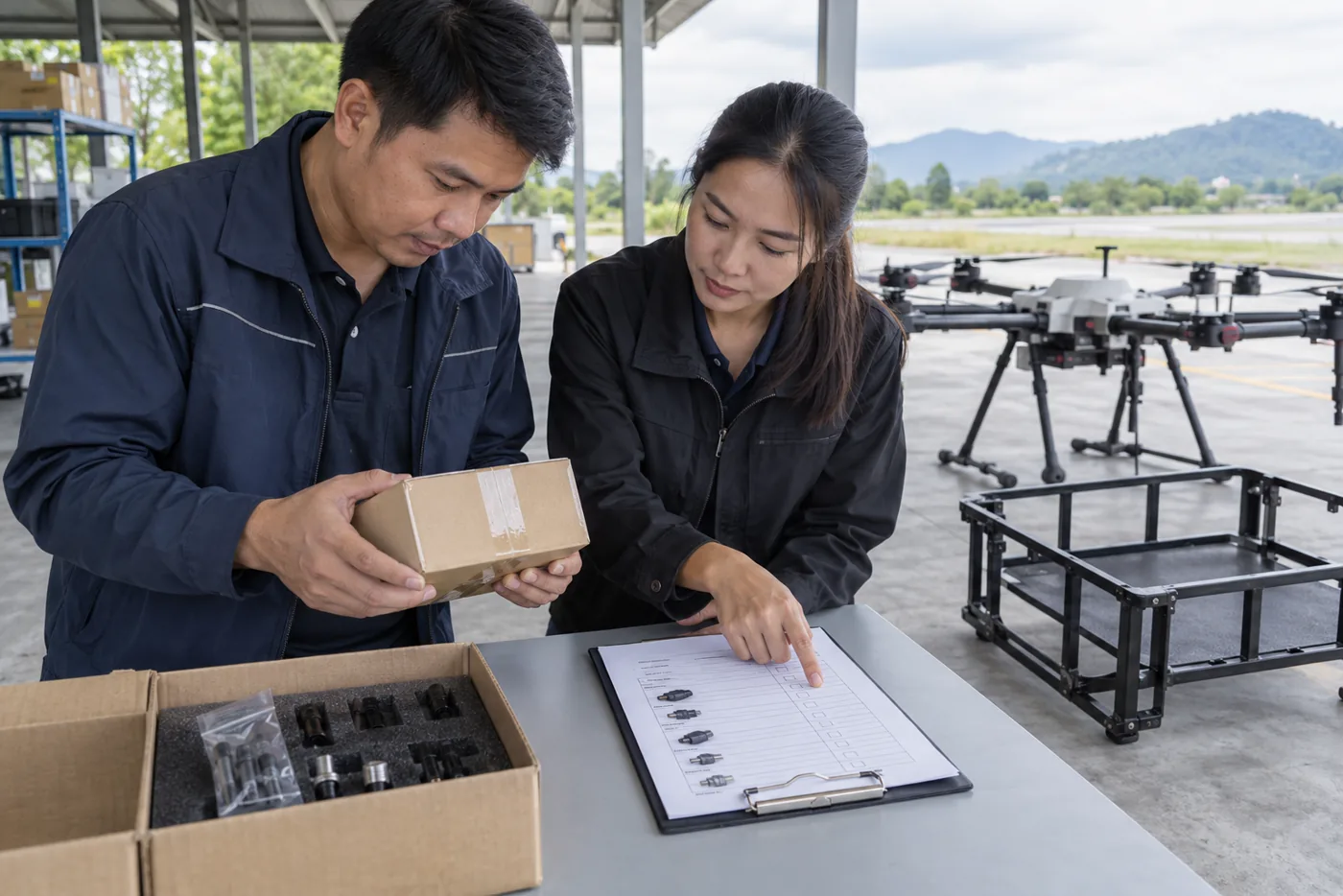
Teaching illustration explains reviewing stock with the owner; it is not a check of mass, center of gravity, packing, or readiness of an actual aircraft. Open the full-size stock review image
Scroll the table horizontally to see every column. When the table has keyboard focus, use the left or right arrow keys.
| Request | Evidence in the exercise | Proposal before 09:00 | At 09:05 and outstanding items |
|---|---|---|---|
| Q-A | v1 needs 3; STOCK-A/v1 confirms 3 until 09:00; ALLOC-A reserves 3; REC-A confirms the recipient's role | planning_candidate_only so that the responsible person can review the drone/service/ground route |
PLAN-A hold_expired_confirmation; ask the owner to reconfirm the stock, and review the personnel, the payload set, and the actual weather/airspace/permissions |
| Q-B | needs 2 but the recipient is unknown; STOCK-B is still requested | hold_recipient and ask the stock owner to respond; do not reuse ALLOC-A |
Remains on hold; do not fill in a recipient or assume goods are available from the supplementary request |
| Q-C | needs 1; BOAT-C the owner responds ready within the exercise | ground_candidate for checking the ground plan |
Review the actual area conditions, recipient, and time; a response within the exercise is not a boat-operation result |
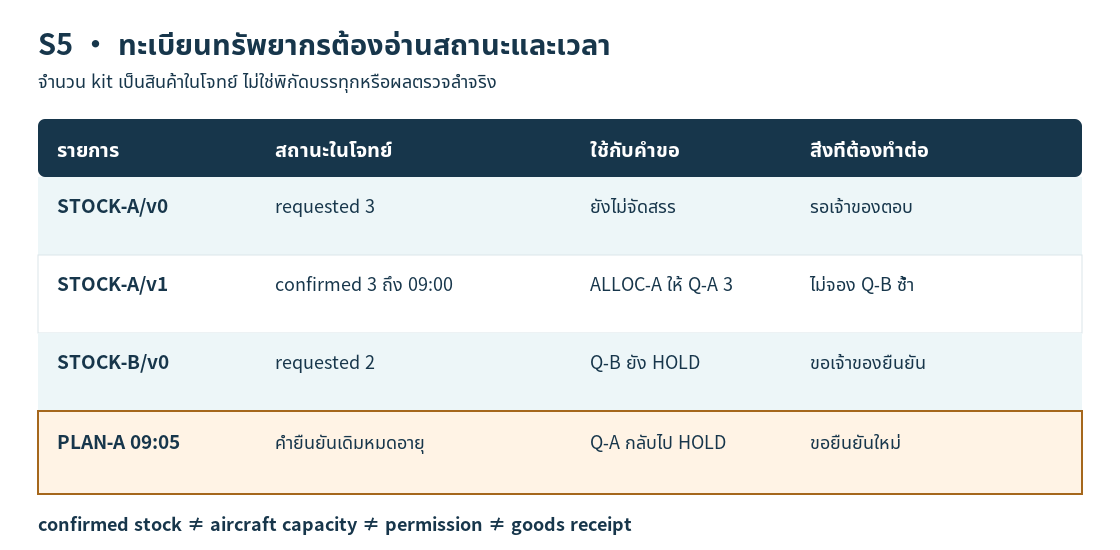
Diagram description: confirming the quantity of goods does not confirm carrying capacity or flight permission. Open the full-size resource chart
ICAO U-AID Guidance addresses advance planning, coordination, approved/qualified operators, and consideration of capability, risk, and airspace (L-03/L-04). In Thailand, CAAT UAS Portal is the route for checking registration, law, and licensing guidance against current requirements (L-05). These two sources do not grant any permit to the exercise; a responsible person must review the actual aircraft, delivery method, area, date, requirements, and coordination. Here AIR-A is unknown/hold, with no data on the total mass, center of gravity, energy, people/team, weather, receiving point, or delivery method, so there is no “ready to fly” status even though STOCK-A once confirmed
The plan has been sent, but the goods have not been received
MSG-A/v0 is a planning package queued offline; two rows use the same key, so both must be retained and checked for duplicates before a retry. MSG-A/v1 has the event sent_in_scenario only; no received/acknowledged was found. HAND-A is a blank receiving slot; no connector kit was actually delivered. Do not put the time the plan was sent into the time the goods were received, and do not use a generated illustration in place of a signed receipt or evidence of condition

Teaching illustration is not evidence of the recipient, quantity, condition of the goods, or an actual handover. Open the full-size recipient image
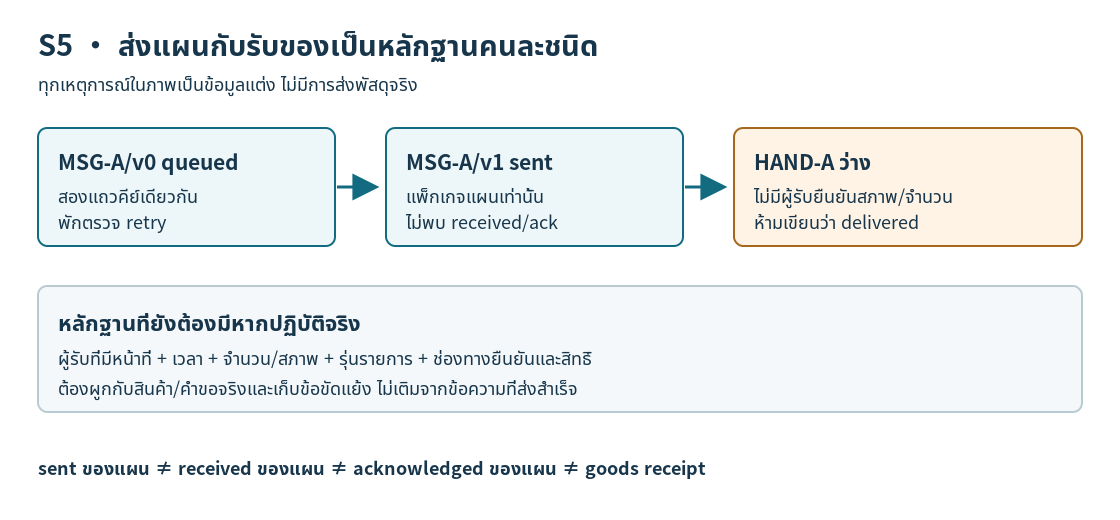
Diagram description: plan sent , plan received , plan acknowledged , and goods receipt are separate events. Open the full-size evidence chart
When the final recipient changes, the plan and the chain of custody must be reviewed
New sub-exercise TRAIN-CSL-ALT-01 is another set of constructed data: at 09:07 there is a message that REC-A is absent and a person, ALT-A, offers to receive the connector kit instead, but no confirmation of ALT-A's identity/duties, no instruction from the requester to change the recipient, and no revised handover list has been found. Q-A in the original S5 exercise was put on hold because the STOCK-A confirmation had expired; therefore no goods were released, no flight started, and nothing was received before this new event, and the time 09:07 must not be filled into HAND-A of the original 16-row set.
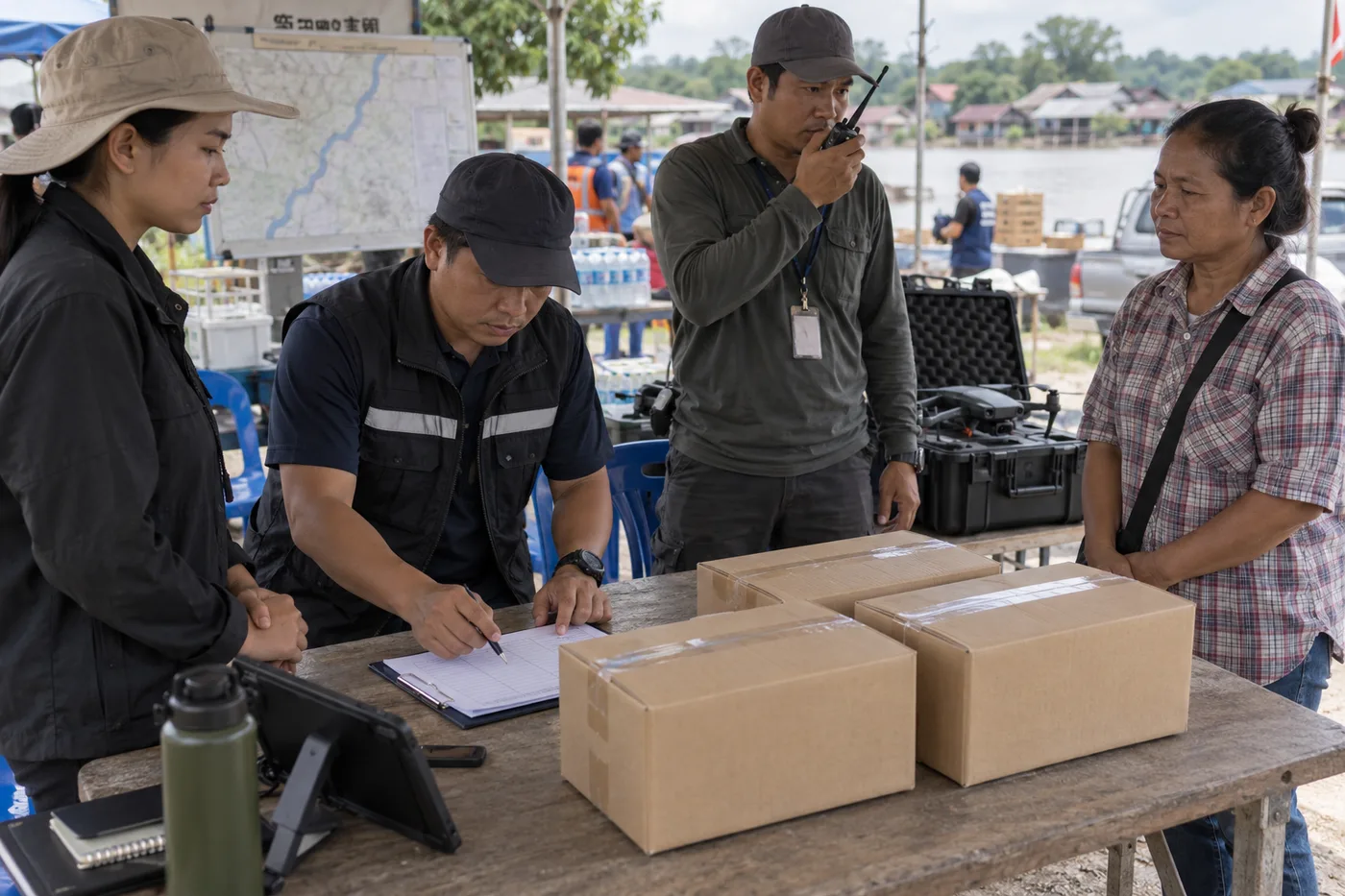
Teaching illustration shows the reason to stop and review; it is not an image of REC-A/ALT-A, evidence of identity, a signed document, or an actual flood event. Open the full-size context image
The evidence that should be kept separate is the change notification, the authority approving the change, the new shipping document specifying the recipient/destination, and the receipt evidence with quantity/condition. Logistics Operational Guide: Standard Documentation specifies that a waybill should name the intended recipient and that the recipient should check the goods and any discrepancies (H-03); Goods Flow Management separates preparing to receive from the actual counting of goods and the goods received note (H-04). This lesson uses that reasoning to design checkpoints for a tabletop exercise . It does not treat the guides as designating approvers in place of the real agencies or as certifying delivery by drone.
Scroll the table horizontally to see every column. When the table has keyboard focus, use the left or right arrow keys.
| What was found in the exercise | Status that can be written | What must be requested, and who owns the answer |
|---|---|---|
| The 09:07 message says that REC-A is absent | change_requested, not yet an instruction to revise the plan |
The coordinator confirms who reported it, through which channel, and which version of Q-A it refers to |
| ALT-A offers to receive in their place, but there is no evidence of the role | alternate_unverified; do not state that this person is the assigned recipient |
The requester/receiving unit confirms the role and authority of ALT-A according to the unit's procedure |
| STOCK-A is confirmed until 09:00 and there is no revised waybill | hold_plan; do not count the stock as ready or order shipment |
The stock owner reconfirms availability; the person with authority over the plan approves the new recipient, destination, and delivery method |
HAND-A is still blank |
goods_receipt_missing; do not close the job as delivered |
The confirmed recipient checks the code, quantity, and condition, and records real evidence when the handover takes place |
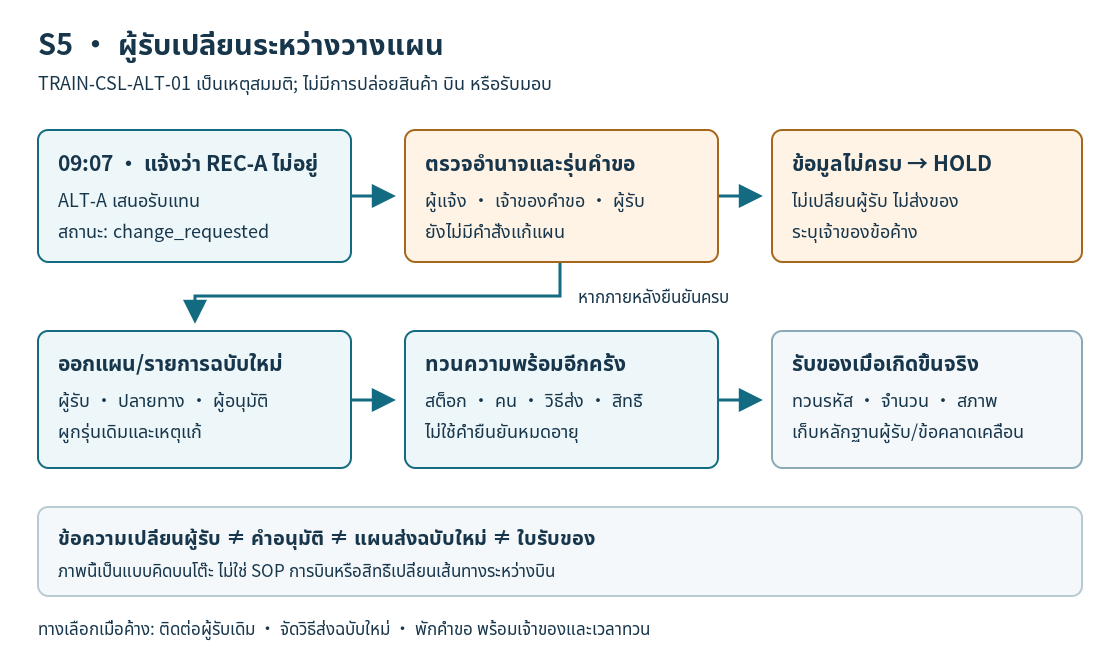
Diagram description: if any confirmation is missing, keep hold_plan and send the outstanding items back to the owner; the options are to coordinate with the original recipient who can confirm, change the transport method with a new plan, or hold the request; do not change the recipient on the basis of a message alone. Open the full-size recipient-change chart
Practice with the incident card and recipient-change record form: B separates the message from the evidence and corrects the brief (APP-CSL-B-K/S/E/C01); O identifies the approver, stock custodian, recipient, and options in the new plan version (APP-CSL-O-K/S/E/C01); D designs the event change_requested → authorized_revision while retaining the original version and testing duplicate, outdated, and misdirected messages (APP-CSL-D-K/S/E/C01). The existing KSEC criteria still apply; no new codes are added and no claim is made that any learner has passed. If the incident occurs during an actual transport , the responsible person should follow the emergency plan and the decision authority approved for that transport method. This lesson gives no instruction to reroute or release goods in the air.
Choose a learning path, B/O/D, and KSEC outcomes
Scroll the table horizontally to see every column. When the table has keyboard focus, use the left or right arrow keys.
| Role | What to know/do first | Deliverable and new ID |
|---|---|---|
| B Beginner | M09/M06/M10; read the CSV, times, and versions, and do not fill in unknowns | Worksheet B: brief and a 16-row ledger, B-v0→v1; APP-CSL-B-K/S/E/C01 |
| O Planner | M09/M06/M10, brief/airspace; separate requested from confirmed | Worksheet O: six-phase plan, resource expiry/options/manifest, O-v0→v1; APP-CSL-O-K/S/E/C01 |
| D Developer | M09/M10, integration/testing; composite key and event semantics | Worksheet D: contract/test matrix/actual results when actually run/rollback, D-v0→v1; APP-CSL-D-K/S/E/C01 |
B Beginner
Do the brief for Q-A/Q-B/Q-C and sort all 16 rows, including the duplicated MSG-A/v0 row. B-v1 must state the options, the owner of each outstanding item, and why “the plan was sent” is not “the goods have arrived”
O Operator/Planner
Make the six-phase plan and the ledger of requested/confirmed/reserved/expired items. Specify gates for people, goods set, area, weather, airspace, recipient/permission, and fallback. At 09:05 STOCK-A must be asked to reconfirm
D Developer/Customizer
Write a 19-field contract and test duplicate, stale, unknown, offline, double-allocation, and blank-receipt cases. APP-CSL-D-S01 requires the learner's actual run results with hash/command/exit/diff to pass; a test plan and expected results alone do not pass
All groups use the 12-outcome rubric and the exercise set rules. KSEC is a designedlearning outcome; E/C are measured from behavioral evidence in the activities and do not label personality. The code APP-CSL-* is new because the multi-request/time/duplicate exercise differs from the original M09/M10 fixtures, and the original codes are retained. The sources and claim boundaries L-01–L-05, H-03/H-04 are in the source register
Evidence status: scenario = synthetic, expected = the author's answers; the author's run results are recorded separately; learners B/O/D = 0/0/0 NOT_RUN, field NOT_RUN, subject-matter reviewer not_assigned/pending_field_review, CLO/PLO pending_design. The images and charts are not evidence of actual practice. Do not use this lesson to certify goods, recipients, flights, or incident resolution. CPX-Sim is still on hold