Drone applications by mission
Start from the results the recipient needs, explore 11 missions, and choose the beginner, planner, or developer path.
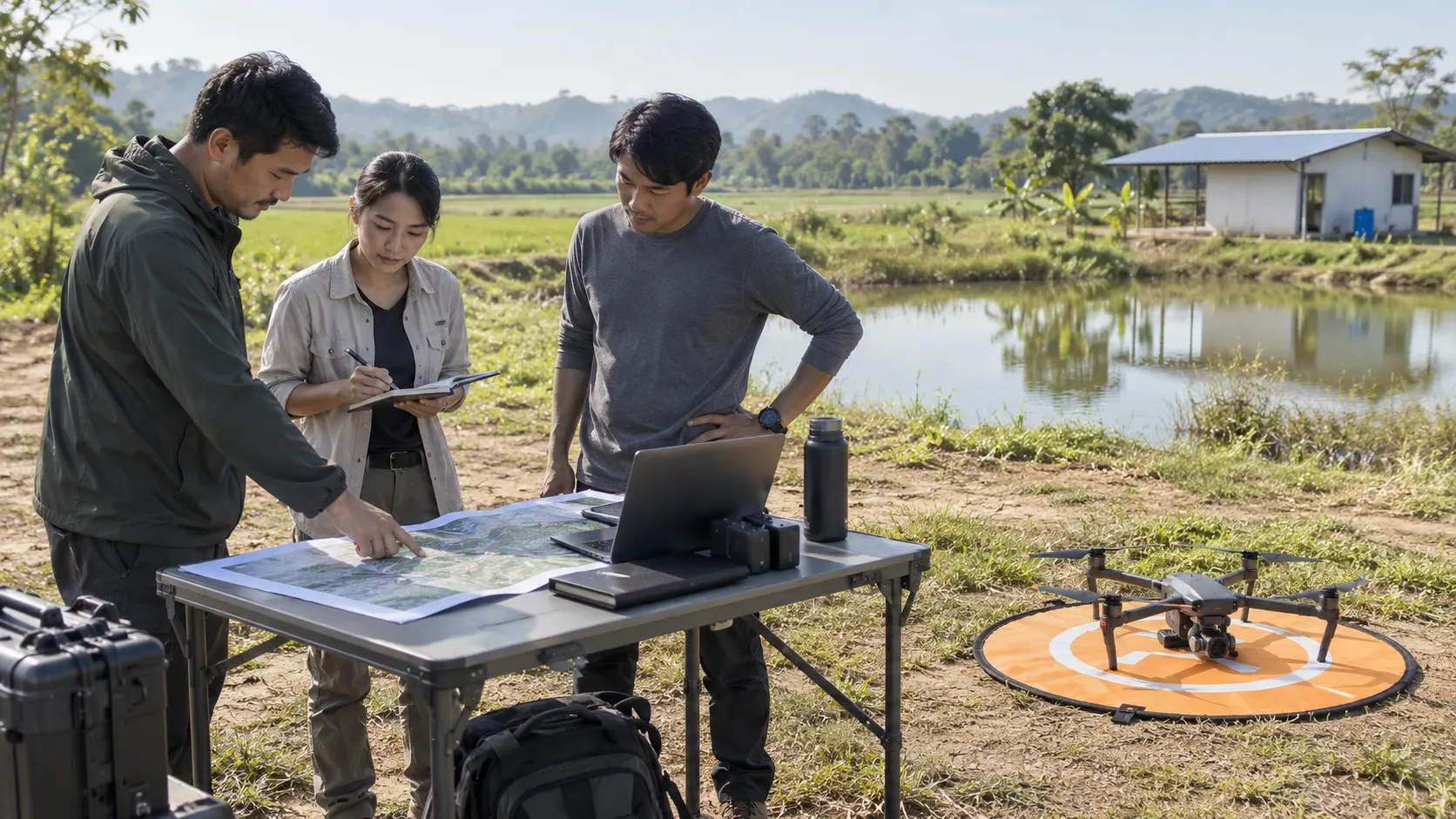
Start with the user of the results
This lesson helps you break a request such as “please fly and look at the area” into a question, a deliverable, and constraints that the person receiving the job can review. When you finish, you should be able to choose the mission closest to your problem, explain which data or service is needed, and know how to continue reading or practicing in your own role.
Before starting, you should know that a UAS consists of an aircraft, a control station, a link, and supporting parts . If the terms are unfamiliar, read that lesson first. No drone is needed for the exercises in this section. Experienced readers can skip to how to choose a set and resources or the three-role practice cases
A drone is one option for doing the work. Before choosing it, compare it with ground inspection, existing data, or a service from another team. For example, aerial images can help select points for ground inspection, but when the recipient needs to know whether a part of a building can bear load, an inspector and additional discipline-specific evidence are needed. Changing the tool does not change the limits of what the data can answer.
KSEC learning outcomes traced to activities and evidence
Use K = Knowledge, S = Skills, E = Ethics, C = Character according to the MHESI announcement on details of learning outcomes of the higher education qualification standards, B.E. 2565 (2022) . This framework separates what is known from work, ethics, and personal behavior, using observable evidence. The table below shows learning outcomes defined by the compiler for this lesson.
Fixed learning-outcome codes help link to OBE or program-level outcomes later. For ways to link learning outcomes, activities, and assessments, see AUN-QA Guide at the Programme Level, Version 4.0 . This table is not yet a curriculum or an endorsement by any agency, and there are no learner trial results from which to conclude effectiveness.
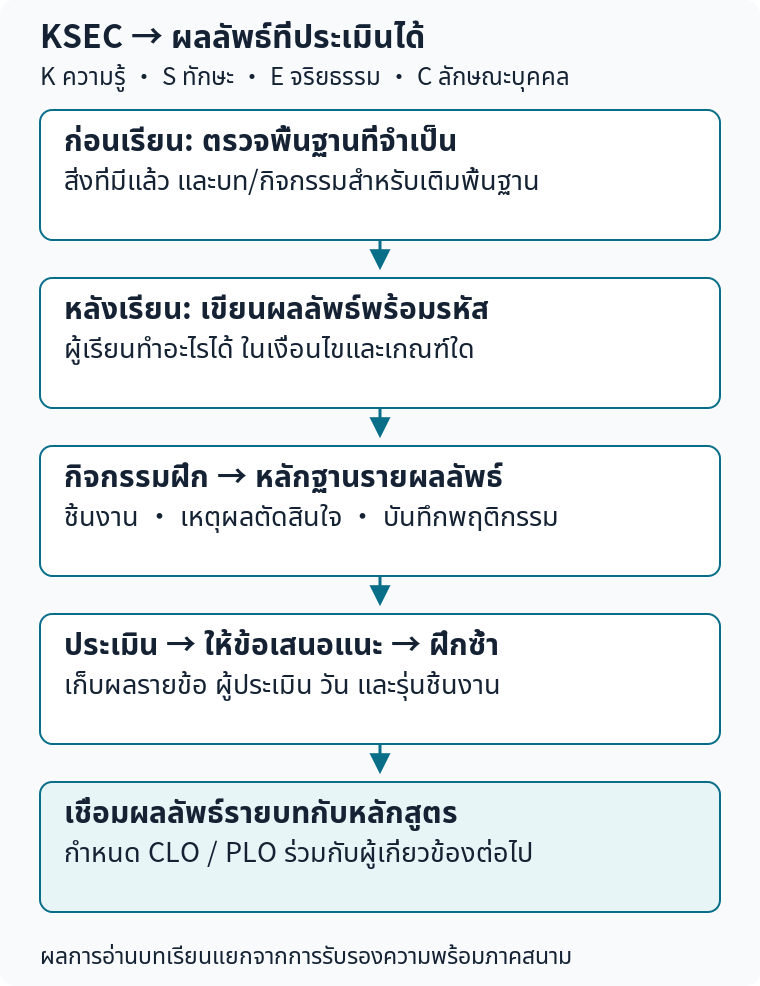
Diagram description: keep the learning-outcome IDs when adjusting activities or criteria, so that reasons and evidence can be traced across versions. Open the full-size diagram linking KSEC with evidence
Scroll the table horizontally to see every column. When the table has keyboard focus, use the left or right arrow keys.
| ID / dimension | Foundations before starting | Goal to be shown | Activity and evidence |
|---|---|---|---|
| APP-OV-K01 / K | Can distinguish UAV from UAS | Match requests to missions and separate different kinds of deliverables | Choose two missions from the table and explain the difference in terms of the question and the results the recipient uses |
| APP-OV-S01 / S | Can read a request and knows their own role | Choose a B/O/D path with its deliverable and the foundation to continue with | Write one reading route with links to lessons that actually exist and what will be submitted |
| APP-OV-E01 / E | Separates observations from conclusions | State unknowns and permissions before proposing use of the results | Answer the case where the recipient asks to certify an area or sends images of persons beyond the exercise; keep the reasons that limit the conclusions/data |
| APP-OV-C01 / C | Knows that outstanding items must have an owner | Record outstanding items and accept stop/review conditions | Make a list of outstanding items, the responsible persons, and the reasons for corrections after an inspector's objection |
B uses the brief as evidence. O links this list with team work and the handover. D links with requirements and the interface register. C is checked from records, review of work, and acceptance of outstanding items; no labels are used to judge personality. Check with the lesson's rubric and use curriculum-mapping.csv as a starting table for designing the curriculum later. The KSEC-to-OBE seam map tells which codes can already be traced to lessons and checking criteria, and what is still waiting for evidence from real people.
Keep results per ID, before/after evidence, and repeated practice work in the KSEC learning record . A solo learner states that it is a self-check and which items are still awaiting a reviewer. E/C must have events and evidence from the activities; do not conclude permanent personal characteristics from a single occasion.
Learning readiness means being able to read the terms/requests and do the activities in the table. Field readiness requires separate evidence on the people, the actual set, condition, area, weather, navigation, and permissions for that job. Passing a KSEC deliverable does not make field conditions pass automatically.
If you are not ready, review UAS systems for the terms K, the mission brief to practice separating the question/deliverable S, observations and conclusions and rights/handover for case E, then use teamwork to practice reviewing duties and recording outstanding items C. These are review points before the activities, not a judgment of the learner's ethics or personality before they enter the class.
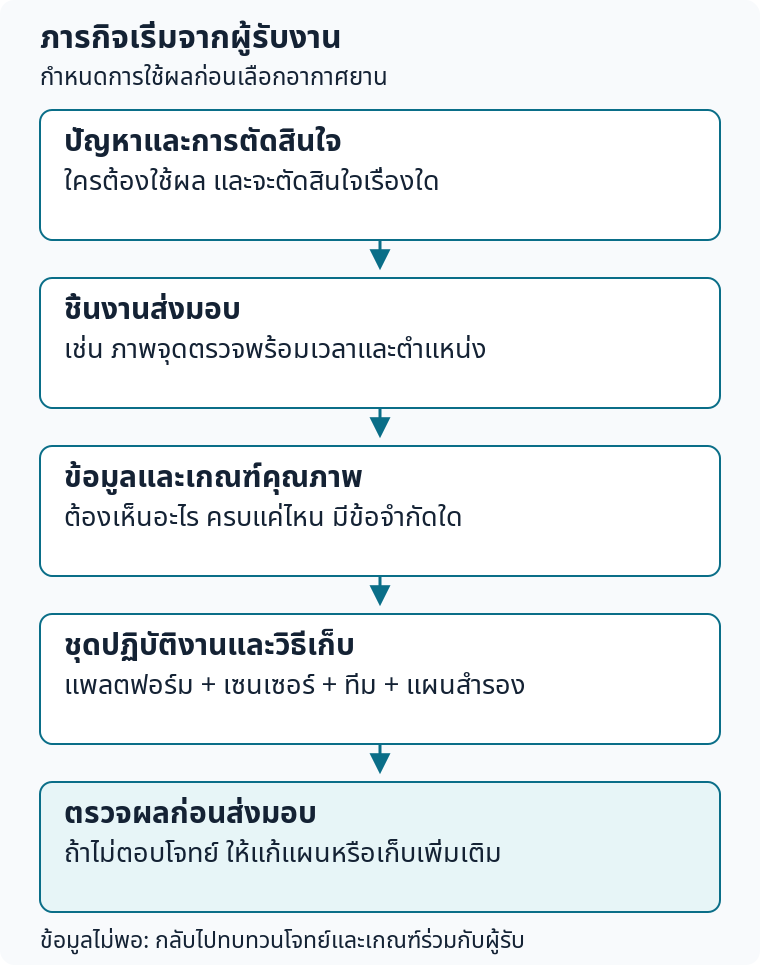
Diagram description: acceptance criteria are agreed from the start, and can loop back to change the plan if the data or resources cannot answer the question. Open the full-size mission-chain diagram
Understand the 11 missions and their different results
One mission may use the same equipment as another, yet the deliverable and the method of checking differ. Crop monitoring must link data with ground conditions, whereas material distribution must check the material, the target area, and the distribution result. The name “agricultural drone” should not be used to cover every condition.
This table is the content scope of the library, checked against the reading lessons and activities available as of 12 October B.E. 2569 (2026). The phrase “has a foundation” means there is related material to read next; it does not mean that the mission has been tried with learners, equipment, or a real field.
Scroll the table horizontally to see every column. When the table has keyboard focus, use the left or right arrow keys.
| Mission | What the recipient should receive | Foundations that can be read now |
|---|---|---|
| M01 Survey and Mapping | Area data, a map, or a model with a reference system, accuracy, and missing parts | The M01 mission lesson with B/O/D worksheets; foundations survey missions and accuracy checking |
| M02 Crop Monitoring | A list of zones to inspect, with time, quality, comparable differences, unknowns, and ground questions | The M02 mission lesson with B/O/D worksheets; foundations mapping applications and mission sensors |
| M03 Spraying/Sowing/Material Distribution | A brief of options, a resource plan, sensitive limits, and evidence that the responsible person can review | Tabletop lessons and B/O/D worksheets; pending_field_review still awaits a field inspector, and no instructions for using materials are given; foundations the whole system and mass/CG |
| M04 Building and Structure Condition Inspection | A list of assets/sections/positions/angles and observations with outstanding items for the specialist inspector to check further | The M04 mission lesson with B/O/D worksheets; foundations sensor limitations and the evidence report ; structures are not certified from images |
| M05 Construction Monitoring and Quantities | Records of observations/quantities according to the report baseline, work package baseline, and data date, with outstanding items | Tabletop lessons and B/O/D worksheets; pending_field_review no field inspector is assigned, and no work acceptance/payment from a proxy; foundations surfaces and volumes and change detection |
| M06 Disaster Assessment and Urgent Situations | Observations and points needing further checks, with cutoff, freshness, coverage, status, and unknowns | The M06 mission lesson with B/O/D worksheets; foundations rapid mapping and floods |
| M07 Search and Rescue Support | The task scope and points to be reviewed, with source, time, position/unknowns, and the tasks the recipient is responsible for checking further | The M07 mission lesson with B/O/D worksheets; foundations searching and image limitations ; people are not confirmed from flags/colors |
| M08 Environment, Forestry, and Resources | Observations on vegetation labels with season, water, sensor/ground context, and questions for field inspection | Tabletop lessons/B/O/D worksheets; pending_field_review; foundations data from different times and separating observations ; restoration is not confirmed from counts |
| M09 Field Logistics Support | Goods matching the code/quantity/condition, with the person in the receiving role and evidence that can be reviewed | Tabletop lessons/B/O/D worksheets; pending_field_review; foundations the logistics chain and balance ; flight is not certified from constructed limits |
| M10 Communications and Data Transmission Support | Data matching the recipient, version, time, completeness, and permissions, with evidence for each stage | Lessons/B/O/D worksheets and an offline receiver lab with 12 cases; pending_field_review; foundations emergency communications and links |
| M11 Photography, Media, and Event Recording | Images or media that are complete in storyline, quality, and usage rights according to the recipient's brief | M11 Media Production has a storyboard / shot list / synthetic images A–D and KSEC for three roles; awaiting a field inspector |
Coverage for each reader group
Use B = beginner, O = operator/planner, D = developer/customizer. The table shows the practice sets already produced, while missions without specific sets keep the original foundation assessment:
- Has practice sets: has the lesson, activities, worksheets, and rubric for that path; the link goes to the part where you can start. It is not learner evidence or field readiness. M03 and M05 still await a field inspector.
- Matches the problem: has a reading lesson and activities that match the sub-goals of that group; it can be used as a foundation
- Needs extension: has related foundations but still lacks a path for choosing use or deliverables specific to the mission
- Needs to be created: no mission lesson directly matching the goal has been found within the scope checked; shared fundamentals are available for reference
Scroll the table horizontally to see every column. When the table has keyboard focus, use the left or right arrow keys.
| Mission | B | O | D |
|---|---|---|---|
| M01 Survey and Mapping | Has B practice set | Has O practice set | Has D practice set |
| M02 Crop Monitoring | Has B practice set | Has O practice set | Has D practice set |
| M03 Spraying/Sowing/Material Distribution | Has B practice set; awaiting a field inspector | Has O practice set; awaiting a field inspector | Has D practice set; awaiting a field inspector |
| M04 Building/Structure Inspection | Has B practice set | Has O practice set | Has D practice set |
| M05 Construction/Quantities | Has B practice set; awaiting a field inspector | Has O practice set; awaiting a field inspector | Has D practice set; awaiting a field inspector |
| M06 Disasters/Situations | Has B practice set | Has O practice set | Has D practice set |
| M07 Search/Rescue | Has B practice set | Has O practice set | Has D practice set |
| M08 Environment/Resources | B brief and unknowns; awaiting a field inspector | O recurring context/resources/handover; awaiting a field inspector | D contract and test proposals; awaiting a field inspector |
| M09 Logistics | B brief/options/unknowns; awaiting a field inspector | O resources/load/handover; awaiting a field inspector | D contract/test proposals; awaiting a field inspector |
| M10 Communications/Data | B exercises/time/evidence; awaiting a field inspector | O two-end plan/backup channel; awaiting a field inspector | D contract/offline lab; awaiting a field inspector |
| M11 Media/Event Recording | B brief/image evidence; awaiting a field inspector | O shooting plan/rights/handover; awaiting a field inspector | D interface/test plan/version; awaiting a field inspector |
The core lessons include this overview, how to choose a set, and three groups of exercises . P2 produced M01/M02/M04/M06/M07 with KSEC activities, B/O/D worksheets, synthetic data, and rubrics complete, 5/5 lessons and 15/15 content paths , with no trials with learners, equipment, or a real field. M07 separates two registers, and coverage/detection/time do not confirm people or a clear area from assumptions.
P3 adds M03 Spraying/Sowing/Material Distribution, M05 Construction Monitoring, M08 Environment Monitoring, M09 Logistics M10 Communications and Data Transmission and M11 Media Production , completing 6/6 lessons and 18/18 content paths . Together with P2 this makes 11 missions and 33 paths . These numbers count lessons and deliverables for the three groups; they are not learning results or real operational readiness.
M03 uses 17 rows of teaching data with no application rate or field result, and M05 uses 14 rows of hypothetical quantities to review the baseline before comparing work; they are not measured quantities or work already accepted. Choose B brief, O baseline plan and handover or D test proposal according to the work to be done
M08 has B brief and unknowns, O context and resources and D requirements and test plan and uses TRAIN-ENV-01, a constructed set of 15 rows for practicing what is known and unknown, pairs with different contexts, withheld data, and zero denominators. The difference still possible for pair A is −10 to +30 percentage points; it does not confirm that vegetation increased or that the ecosystem recovered. There are no source images, measurements, ground results, or confirmation of classification.
The M08 supplement has a three-layer evidence chart before answering about restoration that lets B separate what can be answered, O register targets/reference baselines/ground checks, and D block automatic status escalation. The practice set is still before field observations; P3 still awaits a field inspector.
M09 has B brief and options, O two-destination plan and handover and D requirements and test plan and uses TRAIN-LOG-01, a constructed register of 15 component rows and 8 event rows. The mass/balance/energy figures are teaching assumptions; missing data stay unknown; a complete receipt is not accepted from adding up cumulative totals or from acknowledgments. There is no real measurement, flight, permission, delivery, or evidence of receipt.
M09 source check on 14 October 2026: adjusted the manual links and cited pages to match the files that the DJI page most recently published as of the check date, including the LOG02 source register . This check does not change the practice criteria or the status of awaiting a field inspector.
Before choosing a delivery method for M09, try the exercise card on receiving points and handover methods: compare ground, landing, lowering of goods, and hold, reviewing the recipient, area, set/people, permissions, and receipt evidence separately. This card is another constructed exercise, not a real receiving point or delivery result.
When you must consider several missions that share a team and set, try the exercise card on three requests for shared resources linking M06/M07/M09: one job may start with existing data, another must ask for a recipient and a position, while the logistics job still needs to confirm the receiving point/delivery method. The KSEC B/O/D worksheet separates supplementary requests from acknowledgments and does not queue the same set twice; it is not a plan for prioritizing a real incident.
M10 has B translating requests and evidence, O two-endpoint plan and D trying an offline receiver with 12 constructed cases. Local run results are kept separate from expected results and can check repeats, stale data, recipients, versions, and loss of connection within the limits of the exercise. There are no radio results, flights, confirmation by a real recipient, or learner results.
M11 has B reading the exercise and sample images, O planning the shoot and resources and D reviewing the set and changes . Synthetic images A–D are used to practice judging sharpness, darkness, and obstructions, separating image criteria from usage rights; there are no field shooting results or learner results.
M03/M05/M08/M09/M10/M11 are still in the pending_field_review status and the P3 readiness criteria remain open . No specialist inspector has been assigned and no user has confirmed. P5 has no one trying it yet, so the trial set and record forms have been prepared first. Learner results are NOT_RUN. CPX-Sim is still on hold.
Content status and evidence still pending
The content has 11 missions / 33 role paths and 3 cases of choosing and customizing sets / 9 case paths; the mission case studies S1–S3 and S5–S7 add another 6 cases / 18 role paths. curriculum mapping has 260 designed outcome codes (original foundation 188 + 6 case studies × 12). Links to lessons, anchors, and criteria files have all been checked in the KSEC seam report , with CLO/PLO still empty pending_design. These numbers count content; they are not learner results or field readiness.
Scroll the table horizontally to see every column. When the table has keyboard focus, use the left or right arrow keys.
| Phase | What has been produced | Evidence and outstanding work |
|---|---|---|
| P1 Core lessons | Overview, set-selection method, exercises, and KSEC complete | Not yet a learner trial result or a curriculum endorsement |
| P2 Foundation missions | Content complete: 5/5 lessons and 15/15 paths | No learner or field results yet |
| P3 Domain-specific missions | Content complete: 6/6 lessons and 18/18 paths; the P3 review package has the lesson paths, practice sets, rubrics, and sources/claim limits complete for 12/12 tasks | pending_field_review; the specialist inspectors are still not_assigned and the readiness criteria remain open |
| P4 Choosing and customizing sets | Documents and simulated calculations complete for 3/3 cases | The author's host results are kept separate from hardware/flight/RF/recipient and learners, which have not yet been tested |
| P5 Trial reading and source maintenance | A document set of 21 cards/84 KSEC codes passes the consistency checker, 6 rubrics have hashes matching their files, and 4 public CSV files are blank | Actual trial participants B=0 / O=0 / D=0; NOT_RUN; awaiting assignment of activity facilitators/reviewers, trials, corrections/re-checks of key issues, and assignment of owners for the reference sources |
Adjusted M03 sources and claim limits on 14 October B.E. 2569 (2026): The spraying/sowing/material distribution lesson adds three-way questions and a chart for passing to reviewers, from the FAO/WHO pages that were checked and readable. The full PDF manual has not yet been read, and there is no field inspector, so P3 remains pending_field_review and is not counted as a field inspection result
Adjusted M05 evidence by time on 14 October B.E. 2569 (2026): The construction monitoring lesson: three times to keep separate adds a chart and B/O/D exercise cards so that the report issue date does not overshadow the image capture date or the plan cutoff date. It uses constructed day 1/3/5 events separate from the CSV; no field or learner results are added, and M05 remains pending_field_review
Prepared the P5 trial path on 14 October B.E. 2569 (2026): The pilot B/O/D exercise set before v0 separates the starting data from the rubric/author results used for checking, with a context image and a step chart. The guide set is p5-prep-5; the author's opening of the files and checking of links is not a learner trial result. Participants B/O/D are still 0/0/0, P3 still awaits a field inspector, and CPX-Sim is still on hold.
The next step for P3 is to assign inspectors by domain in the 12-task register to open the questions with task-specific evidence links and then record actual results internally from a copy of the blank record form. Preparing documents is not a passing review. The user has no participants yet, so prepared the seven-stage trial-reading procedure and the download set with a dictionary and a pre-start checklist before the CSV records. All four P5 records still have only table headers; there are zero data rows, and the full P5 remains open. Website checks do not replace learner trial results, and CPX-Sim is still on hold.
P4 choosing and customizing sets through three cases
C01 Condition-inspection camera set, C02 Search data set and C03 Synthetic payload set each have requirements, an interface register, a change log, a test plan, results, and instructions for use, six files per case, with KSEC totaling 36 codes. B/O/D use the same case from the results the recipient needs through to returning to baseline. Every parameter is a constructed value.
The author's local calculation results for 17 cases match the expected results, with repeated runs and baseline-return pairs according to the host evidence and the raw results . The host record shows the limits of the author's evidence; outstanding work regarding specialist inspectors and learners is shown on this page. These results do not substitute for hardware, flight, RF, recipient, or learner testing. Everything not yet tested remains NOT_RUN, and P3 and P5 remain open.
Case studies linking the mission lessons
All 11 main mission lessons are complete. The case studies S1–S3 and S5–S7 connect several lessons to show decisions from the request to the deliverable, keeping the original lessons and KSEC outcomes as the foundation.
Status as of 14 October B.E. 2569 (2026): S0 has prepared the contracts and source register; S1–S3 and S5–S7 have lessons and practice sets with constructed data for B/O/D, plus answer guides kept separate from run results; S4 links roles, deliverables, criteria, and sources in the table below. P3 has an evidence path for 12/12 tasks but the specialist inspectors have not been assigned, P5 has no real learner results yet (B/O/D = 0/0/0), and CPX-Sim is still on hold.
If you need to study the disaster chain start with S1: handing off the assessment → search → logistics work and then go to S5: the logistics plan and handover evidence. Continue with the S5 exercise card for when the recipient changes to review who has the authority to change the plan and when goods can be received. S1, S5, and the sub-card are different sets of constructed data, not a single event that the system links automatically.
If communications in the disaster area are interrupted read M10: choose the data path before choosing a relay drone. Practice checking the inbound link, the exit to the center, the receiver, and the person who acknowledges, while separating the flight-control channel, without inferring coverage from equipment names.
If you need to study building/structure inspection that extends into construction work start with S3: when condition-inspection images can be used to measure quantities. The chart separates the register of observations, new survey measurement work, and acceptance inspection, with KSEC exercises for B/O/D, without treating the S3 practice data and M05 as one set.
If the first question is how to reach surfaces under a structure and collect evidence start with S3: choose the image-collection method before choosing a drone to compare options and record the reason for holding when the angle, light, obstructions, control, or permission is not yet clear; this exercise card is separate from the 14 rows of the main S3 case.
If you need to study disaster data requested for public media read S1: the gate from operational data to media for the public. The images used to coordinate the incident, the publication rights, the captions, and the evidence that the public saw them are separate steps; S1 has no source images or actual publication results.
If you need to study coastal images requested for use in restoration planning or estimating the quantity of work read S2: from observations to a request for area management. S2 holds back conclusions from two-time images that cannot yet be fully compared, then separates the M08 environmental questions from the M05 quantity-survey questions, with new owners and evidence for each job.
Scroll the table horizontally to see every column. When the table has keyboard focus, use the left or right arrow keys.
| No. | Case study | Linked original lessons | What will be practiced |
|---|---|---|---|
| S1 · has lesson and practice set | Flood and rescue | M01 Maps, M06 Assessment, M07 Search, M10 Communications | Data from different times, points not yet confirmed, resources requested/confirmed, and review of the results by the recipient |
| S2 · has lesson and practice set | Water and coast | M01 Survey, M08 Environment, M05 Quantities | Constructed data of 12 rows at two times: raw difference, water datum, coverage, and an independent checkpoint before concluding |
| S3 · has lesson and practice set | Inspecting hard-to-reach structures | M04 Condition Inspection, M05 Construction, C01 Camera set | Constructed image descriptions of 14 rows: light, obstructions, angle, scale, position, permissions, and camera changes before passing to the inspector |
| S5 · has lesson and practice set | Logistics and handover | M09 Logistics, M06 Assessment, M10 Communications | Constructed requests of 16 rows: request versions, confirmed/expired stock, reservations, airspace outstanding items, and separating the sending of a plan from the receiving of goods |
| S6 · has lesson and practice set | Forests and wildfire | M08 Environment, M06 Assessment, M01 Maps, M10 Communications | Constructed data of 16 rows: hotspot pixels, smoke-obscured images, vantage-point observations, and the weather/airspace/permission gate before proposing the use of a drone |
| S7 · has lesson and practice set | Agriculture and decision-making | M02 Crop Monitoring, M03 Spraying/Sowing, M01 Maps, C03 payload | Constructed data of 16 rows: images from different versions/cloud cover/plant spacing, requests to collect samples, and the product/equipment/permission gate before operation |
B/O/D case-study paths and the evidence to submit
Start with the relevant foundation lessons, then choose the row for your role: B = beginner, O = operator/planner, D = developer/customizer. The K/S/E/C codes in each row are designed outcomes , not learner pass results. The case data, images, and answer guides are data created for teaching; the source register and claim limits is a published copy of the original register in the repository, and the original sources that can be opened for reading are in each case lesson
Scroll the table horizontally to see every column. When the table has keyboard focus, use the left or right arrow keys.
| Case and foundation lessons | Role and KSEC ID | Deliverable to be shown | Criteria and source register |
|---|---|---|---|
| S1 Flood and rescue · M01, M06, M07 | B Beginner · APP-CSF-B-K01, APP-CSF-B-S01, APP-CSF-B-E01, APP-CSF-B-C01 |
the brief and the register of every row: data from different times, four options, two recipients, unknowns, and a revised version | rubric S1 · Register F-01–F-04 |
| S1 Flood and rescue · M06, M07, M10 | O Planner · APP-CSF-O-K01, APP-CSF-O-S01, APP-CSF-O-E01, APP-CSF-O-C01 |
Plan and manifest: requested/confirmed, QA, backup route, and acknowledgment by the recipient | rubric S1 · Register F-01–F-04 |
| S1 Flood and rescue · M06, M10, C02 | D Developer · APP-CSF-D-K01, APP-CSF-D-S01, APP-CSF-D-E01, APP-CSF-D-C01 |
Contract and test results: duplicate/time/version/rights/offline, expected versus actual, and rollback | rubric S1 · Register F-01–F-04 |
| S2 Water and coast · M01, M08 | B Beginner · APP-CSC-B-K01, APP-CSC-B-S01, APP-CSC-B-E01, APP-CSC-B-C01 |
12-row brief: raw difference, water datum, checkpoints, limits, and HOLD | rubric S2 · Register C-01–C-06 |
| S2 Water and coast · M01, M08, M05 | O Planner · APP-CSC-O-K01, APP-CSC-O-S01, APP-CSC-O-E01, APP-CSC-O-C01 |
Re-collection plan: reference ledger, people/set, footprint, and acceptance criteria before the work | rubric S2 · Register C-01–C-06 |
| S2 Water and coast · M01, M08 | D Developer · APP-CSC-D-K01, APP-CSC-D-S01, APP-CSC-D-E01, APP-CSC-D-C01 |
Two-time contract: datum/water/checkpoints, mutation, actual run results, and return to baseline | rubric S2 · Register C-01–C-06 |
| S3 Inspecting hard-to-reach structures · M04, M05 | B Beginner · APP-CSS-B-K01, APP-CSS-B-S01, APP-CSS-B-E01, APP-CSS-B-C01 |
14-row image register: what is seen/unknown, light, obstructions, angle, scale, and permissions | rubric S3 · Register S-01–S-06, N-01–N-02 |
| S3 Inspecting hard-to-reach structures · M04, M05 | O Planner · APP-CSS-O-K01, APP-CSS-O-S01, APP-CSS-O-E01, APP-CSS-O-C01 |
Access plan: four methods, team/set, image criteria, and specialist inspector | rubric S3 · Register S-01–S-06, N-01–N-02 |
| S3 Inspecting hard-to-reach structures · M04, C01 | D Developer · APP-CSS-D-K01, APP-CSS-D-S01, APP-CSS-D-E01, APP-CSS-D-C01 |
Camera-change contract: quality/rights/version, baseline, rollback, and retest | rubric S3 · Register S-01–S-06, N-01–N-02 |
| S5 Logistics and handover · M09, M06 | B Beginner · APP-CSL-B-K01, APP-CSL-B-S01, APP-CSL-B-E01, APP-CSL-B-C01 |
Brief and 16-row register: multi-version requests, unknowns, and separating messages from goods | rubric S5 · Register L-01–L-05 |
| S5 Logistics and handover · M09, M06, M10 | O Planner · APP-CSL-O-K01, APP-CSL-O-S01, APP-CSL-O-E01, APP-CSL-O-C01 |
Plan and resource register: requested/confirmed/reserved/expired, options, and gates before the work | rubric S5 · Register L-01–L-05 |
| S5 Logistics and handover · M09, M10 | D Developer · APP-CSL-D-K01, APP-CSL-D-S01, APP-CSL-D-E01, APP-CSL-D-C01 |
Contract and test matrix: duplicate/expiry/offline/receipt, actual, and rollback | rubric S5 · Register L-01–L-05 |
| S6 Forests and wildfire · M08, M06 | B Beginner · APP-CSW-B-K01, APP-CSW-B-S01, APP-CSW-B-E01, APP-CSW-B-C01 |
Brief and 16-row register: pixel/image/unknowns and owners | rubric S6 · W-01–W-05 |
| S6 Forests and wildfire · M08, M06, M10 | O Planner · APP-CSW-O-K01, APP-CSW-O-S01, APP-CSW-O-E01, APP-CSW-O-C01 |
Six-phase plan: cutoff, options, gates, and manifest/ACK | rubric S6 · W-01–W-05 |
| S6 Forests and wildfire · M08, M10 | D Developer · APP-CSW-D-K01, APP-CSW-D-S01, APP-CSW-D-E01, APP-CSW-D-C01 |
contract/test/rollback: revision/visibility/unknown/time and actual | rubric S6 · W-01–W-05 |
| S7 Agriculture and decision-making · M02, M01 | B Beginner · APP-CSA-B-K01, APP-CSA-B-S01, APP-CSA-B-E01, APP-CSA-B-C01 |
Brief and 16-row register: candidate/cloud/different distances/outstanding items | rubric S7 · A-01–A-06 |
| S7 Agriculture and decision-making · M02, M03, C03 | O Planner · APP-CSA-O-K01, APP-CSA-O-S01, APP-CSA-O-E01, APP-CSA-O-C01 |
Six-phase plan: ground/options/limits/product/payload/airspace | rubric S7 · A-01–A-06 |
| S7 Agriculture and decision-making · M02, M03, C03 | D Developer · APP-CSA-D-K01, APP-CSA-D-S01, APP-CSA-D-E01, APP-CSA-D-C01 |
Contract/test/rollback: version, cloud, unknown rights, and actual | rubric S7 · A-01–A-06 |
This table has route data for designing learning in 18 rows; the P5 trial-reading cards for the case studies are an additional option beyond the three original pilot cards. curriculum mapping has 260 codes (original foundation 248 + 12 more for S7), with CLO/PLO still pending_design; no curriculum has been approved. The JSON coverage register is in the repository at docs/drone-mission-case-study-coverage.json , keeping docs/drone-mission-knowledge-coverage-2026-10-12.json as the original check baseline
S1–S3 and S5–S7 have sample deliverables for B/O/D, teaching images, diagrams, practice data, answer guides, worksheets, rubrics, and source registers. The author's local calculation and file-check results are kept separate from learner results. Specialist inspectors have not been assigned and there are no real learner results yet, so this lesson or plan is not used to certify operational practice or to close P3/P5; CPX-Sim is still on hold.
Choose a path according to the work to be done
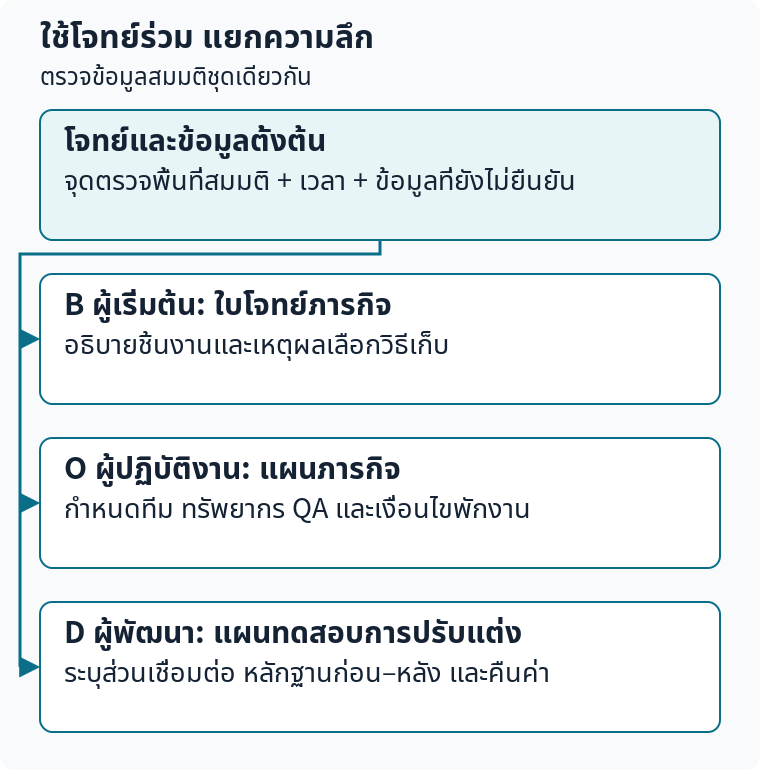
Diagram description: reader groups are roles in producing deliverables, not licenses or certification levels. An operator may return to do the brief, and a beginner may try reading the test plan. Open the full-size reader-path diagram
Scroll the table horizontally to see every column. When the table has keyboard focus, use the left or right arrow keys.
| Path | What to do to show a result | Where to start reading and doing |
|---|---|---|
| B Beginner | Explain the question, recipient, deliverable, options, and unknowns in a one-page brief | Read C01–C03: the problem, aircraft, and data then do the B summary sheet |
| O Operator/Planner | Arrange the plan, people, resources, backup plan, and acceptance conditions that can be checked | Start with C04–C08: from the work set to cost then do the O plan |
| D Developer/Customizer | Define the requirements, the connection register, before/after results, and the rollback method | Read C09: changing systems then do the D test plan |
Steps for using this section with your own problem
- Write the recipient's question and the decision that will use the results. Choose the closest of M01–M11. If there are several missions, separate the deliverable of each job.
- State what you must know beforehand and what you do not yet know, such as the area owner, the age of the data, the type of material, or the position quality. Do not fill gaps from advertising specifications.
- Check C01–C10 in the selection lesson , tie every option to the same deliverable, and open the manual of the actual model/set when hardware is available.
- Practice with the shared synthetic data first. A solo learner alternates between being the proposer and the reviewer, or has a peer check against the rubric.
- Keep the version before correction, the version after correction, and the reasons for the change. Check what is knowledge from documents, what is an exercise result, and what still needs to be tested.
Advice: when a request is too broad for the data, propose the result that can be answered together with a list of outstanding items, for example “send a list of points to be checked further” with time and limits, instead of concluding “the area is now safe.” Readiness for the exercise and readiness for real operations must be recorded separately.
Sources and review date
- CAAT, Guidance for Development of an Operations Manual, Issue 01 Rev 00, 18 October 2022: used for the structure of roles, planning, and records. The original OM guidance : this document does not replace the current requirements of an actual job
- NIST, Standard Test Methods for Aerial Drone Capabilities and the abstract of the 2024 publication: used to separate equipment capability from operator skill and to design repeatable assessments
- FAO/ITU, E-agriculture in Action: Drones for Agriculture (2018), FAO's publication page: used as context for agricultural and resource applications; it is not guidance on chemicals, permissions, or current returns
- Coverage basis: the library's lesson register, edition checked on 12 October B.E. 2569 (2026), evaluates the reading lessons and activities; there are no learner trial results or real mission results yet for this new section.
Content register reviewed on 12 October B.E. 2569 (2026) · continue with choose sets and ways of working or download the practice-set descriptions and license