Choosing a drone set and working method to match the deliverable
Use the shared questions C01–C10 to check aircraft type, sensors, equipment kit, team, cost and evidence before changing a system
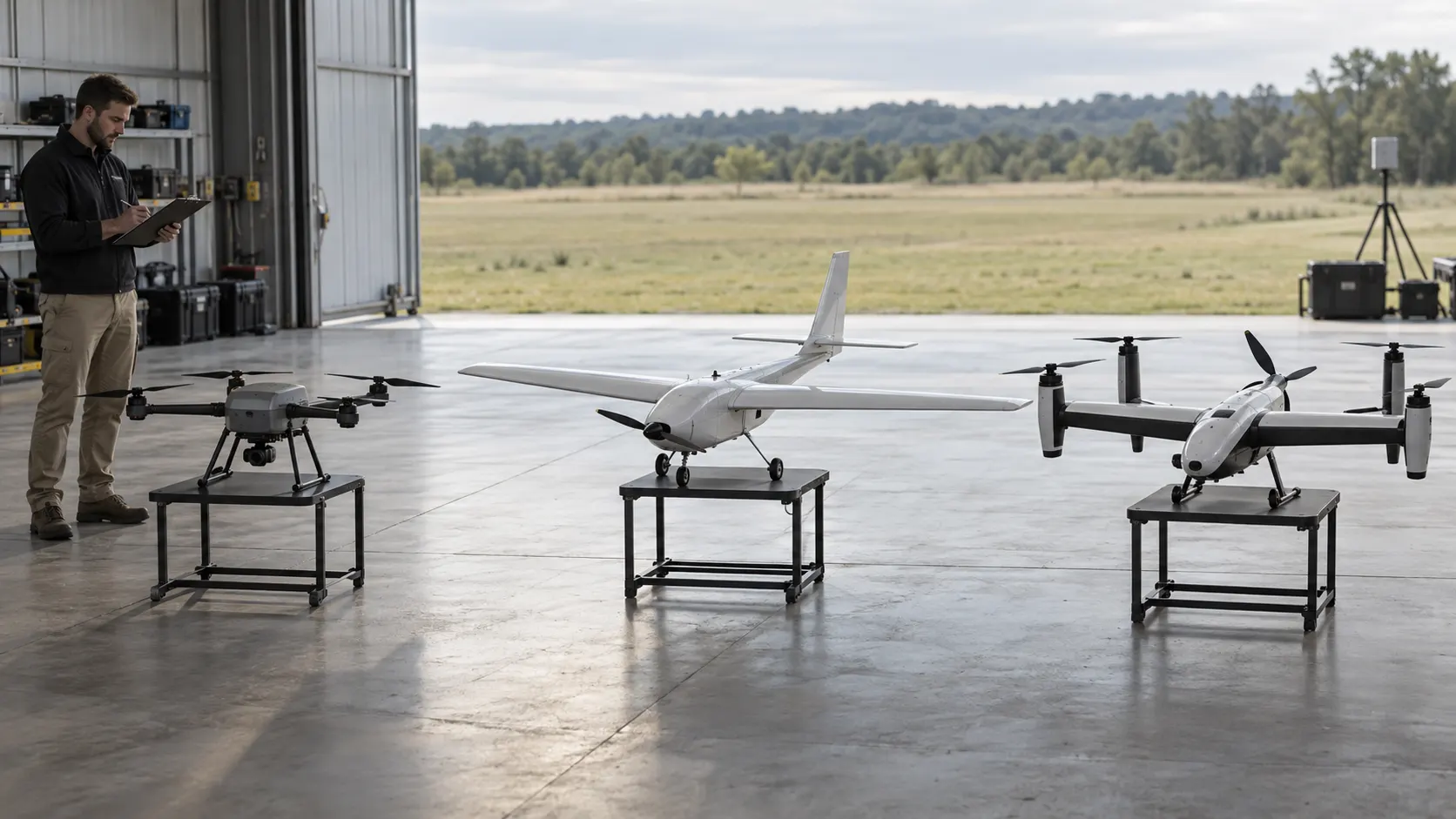
Goals and what you need to know first
By the end of the chapter, you should be able to write the reasons for choosing a way of working and an operating kit tied to the deliverable, state the conditions that have not yet been met, and state the evidence that will be used to decide again. Read the overview of the 11 missions and the UAS system first. If hardware must be modified, also review System assembly as well.
C01–C10 are shared questions, not scores for ranking drone models. The comparison examples in this chapter are concepts or synthetic data with stated conditions. No option guarantees performance from aircraft type alone. When selecting a real kit, the aircraft manual, payload, battery, firmware and the operator's procedures must be checked against the exact model.
Take the shared criteria to practise M09 Logistics by separating the aircraft configuration, the system/service owner and the method of delivery to the recipient, then comparing vehicles/boats/services under the same conditions. A service provider is not an aircraft type, and fabricated numerical limits do not confirm readiness to deliver goods.
For a structure whose viewing angle is hard to reach, try S3: Choose the method of collecting evidence under the structure before choosing the drone kit . The practice card separates image work from tactile work, then compares existing images, ground methods and drones against the same inspector's question, holding any method that cannot yet prove its angle, lighting, control, people and rights.
KSEC learning outcomes of the kit-selection chapter
Use the meanings of K/S/E/C according to the framework and references in the overview chapter . This table is a set of goals defined by the compiler. B focuses on questions/reasons C01–C03, O extends to the kit, people, QA and cost C04–C08, and D adds integration and checking of changes C09. All groups must maintain the boundary of evidence C10.
Scroll the table horizontally to see every column. When the table has keyboard focus, use the left or right arrow keys.
| ID / dimension | Prerequisites | Goal to demonstrate | Activity and evidence |
|---|---|---|---|
| APP-SEL-K01 / K | Knows the UAS types and the meaning of deliverables | Can explain the aircraft/sensor types that answer the question, and their limitations | Writes the reasons for the options conditionally, citing the baseline chapter or the manual of the exact kit model |
| APP-SEL-S01 / S | Can read units, mass, time and data | Builds a proposal from C01–C10 according to the role, with what will be checked | B makes a brief, O makes a ledger of people/kits/QA/cost, D makes the interfaces and a before/after plan |
| APP-SEL-E01 / E | Can separate real data, hypothetical data and rights | Proposes ways of using data without fabricating evidence or disclosing more than necessary | Reviews cases of images of people, old data and untested results; keeps the limitations of the submitted version |
| APP-SEL-C01 / C | Knows the duties of the owner of outstanding items | Shows responsibility for review/stopping and for revising the proposal | Records the reviewer, outstanding evidence, review conditions and the revised version with reasons |
Check with rubric APP-SEL . Do not use a total score to hide a significant error. Being able to read/fill in a proposal is readiness to learn; real use still requires closing the conditions on people, kit, condition and field in C04–C06 according to the real work.
If the terminology/mechanisms are unclear, review UAS fundamentals and sensors before K. If you cannot make a kit ledger, start with System assembly before S. For E, use the evidence report to review rights and not fabricating conclusions, and for C use teams/communication to practise having the successor review the duties and stop conditions; readiness to learn is not used to judge personal qualities.
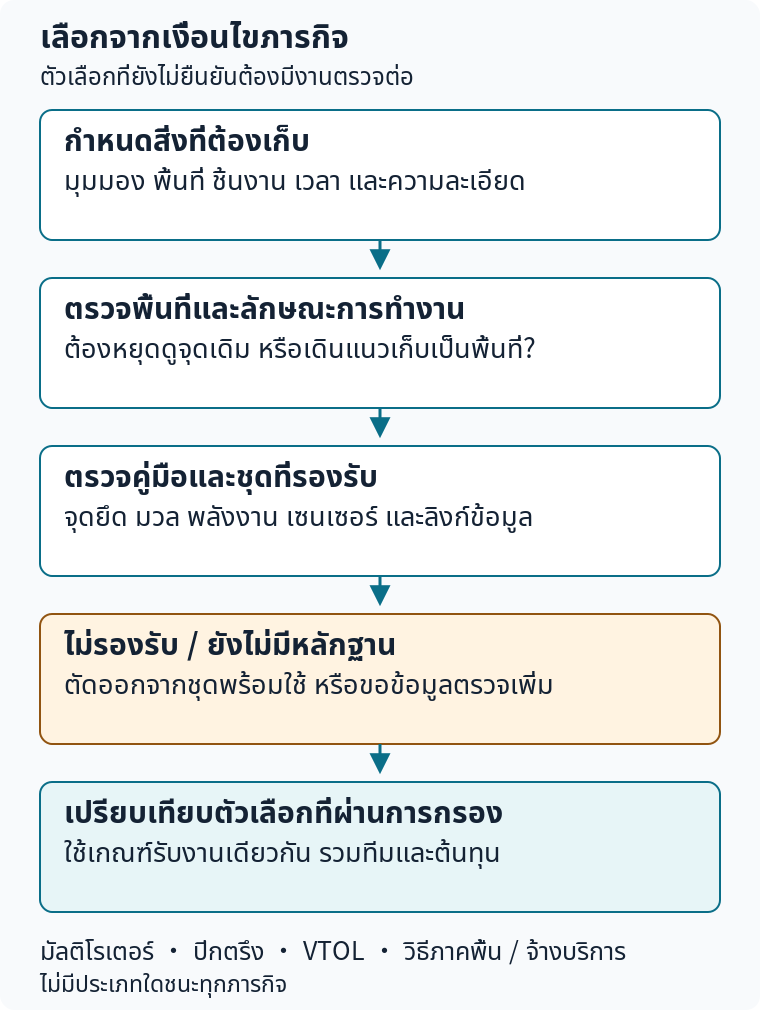
Diagram description: start with a checkable requirement, then remove the options that cannot yet answer the requirement before comparing cost Open the full-size kit-selection diagram
C01 Turn the problem into a deliverable
Ask who receives the result, what decision it is used for, when, and what data would change the decision. For example, “need to choose points to send a team to inspect in a hypothetical area” should deliver a list of points with observations, provenance, time, position, limitations and what must be confirmed further and should not use “fly over the whole area” as the criterion of success
- Write the question and the area/time scope
- Agree the deliverable and its format with the recipient, for example a CSV and a one-page report
- State the acceptance criteria, for example every item can be traced back to its source and time, and rows that fail quality are on the outstanding list
- Compare drones with ground methods, existing data and other services; if the existing data is sufficient, a new flight may not be needed
Continue practising in the mission brief . A common mistake is choosing the camera before knowing the question, and then having to deliver something the camera does not measure.
C02 Choose the aircraft type from the conditions
This table explains general mechanisms according to aircraft type fundamentals as a conceptual comparison, not a model test result or a “best” list. Real speed, distance, time and wind resistance must be checked against the conditions in the manual and the data for the kit used.
Scroll the table horizontally to see every column. When the table has keyboard focus, use the left or right arrow keys.
| Type | Conditions to consider | Points to prove before choosing |
|---|---|---|
| Multirotor | The work needs to hover and look at a specific point, take off and land vertically, and have a suitable control area | Image vibration, wind around obstacles, real mass, return and reserve energy, limits of the vision/navigation system |
| Fixed-wing | The work collects data while moving continuously, and the take-off/landing area and method support that | Turning path, image-capture speed, take-off/landing method, emergency area and aircraft tracking |
| VTOL | Needs vertical take-off and landing together with a wing-borne flight phase, and the team has a way to manage the transition phase | Transition conditions, firmware, weight and balance, energy in each mode, a fallback method when the transition is not possible |
For the small-area case in the joint exercise , choose to use the data given on the computer first. If a single-point image must be added in the future, a multirotor might be considered because it needs to hover and look, but the readiness of a real aircraft cannot yet be judged until the kit and the area are fully checked.
C03 Tie sensors to questions
Scroll the table horizontally to see every column. When the table has keyboard focus, use the left or right arrow keys.
| Question | Data that may be used | What that data still does not confirm |
|---|---|---|
| Which area has surface characteristics or obstacles that need further checking? | RGB with the viewpoint, time and position | Strength, water depth, or what lies under obscuring parts |
| Which point has a thermal difference to check further? | Thermal, recording the type of measurement and the collection conditions | The identity of a person, or a cause, from colour alone; temperature measurement must match the capability and calibration |
| Which area of the crop has a signal different from other areas? | Multispectral with illumination data, calibration, and ground sample plots | The cause of disease, type of fertiliser or spray rate without further agricultural evidence |
| What surface/elevation shape is needed, and within what bounds? | Images for photogrammetry, or LiDAR, according to the conditions of the problem | The ground under every crop/water point, and accuracy without checkpoints or an uncertainty assessment |
Read payload and calibration, sensor limitations and map accuracy Image resolution and positional accuracy are separate conditions. Add a sensor when it helps answer the question and there is a way to check the result, not merely because more data can be collected.
C04 Check the whole kit, mass, balance and energy
The kit ledger must include the aircraft, camera/gimbal, mounts, cables, battery, storage media, link, ground station, software, charger and support equipment. Models that fit together mechanically may still not be supported electrically, in firmware or in data.
An example of a manufacturer's source to check is DJI Payload SDK: Payload Design Specifications , which separates the installation, balance, clearance, electrical and data requirements by supported equipment. Use it to see how to find the requirements for the exact model; do not carry one model's numerical values over as the limit for every kit.
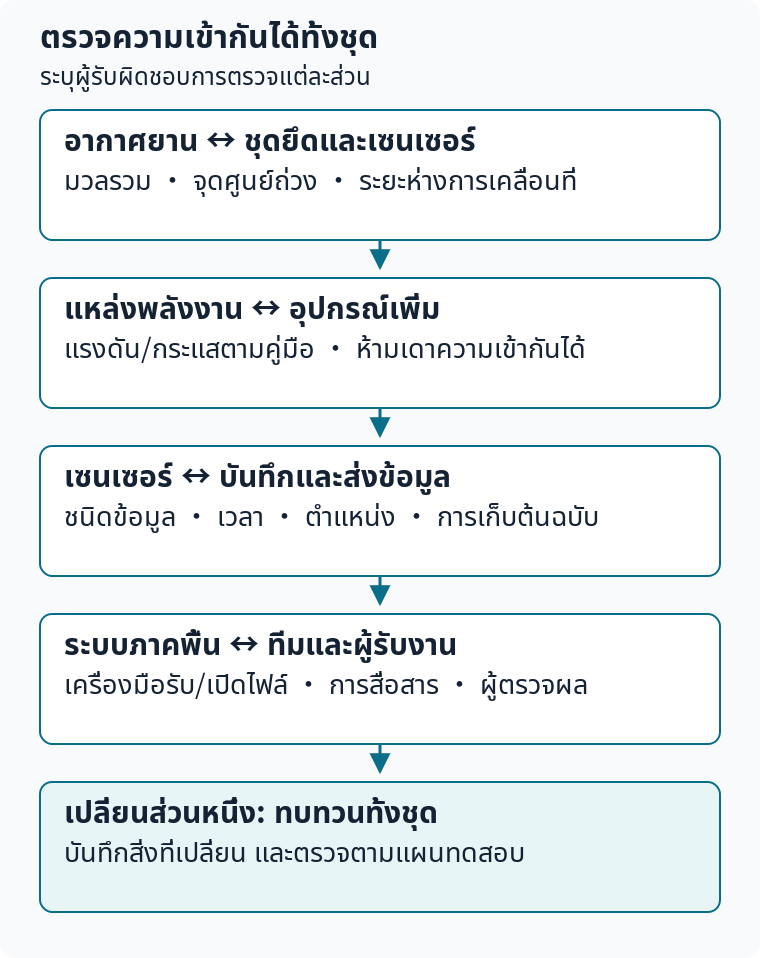
Diagram description: moving the camera may change the balance, cables and image frame, even if the main parts are the same Open the full-size kit-interface diagram
- List the models, quantities, masses, mounting positions and limitations, separating values from the manual from measured values
- Check the total mass and CG against the limits of the real kit, including mounts, cables and consumables. Do not look only at the camera's mass.
- Record usable energy, power by phase of the work, round trip and reserve from the manual/appropriate test results. The Wh value on a label is not a guaranteed flight time.
- Check the connectors, voltage, current, data rate, timestamp, storage and mutual interference
- If anything is unknown, enter the reviewer and the evidence required before passing; do not substitute the figures of another kit
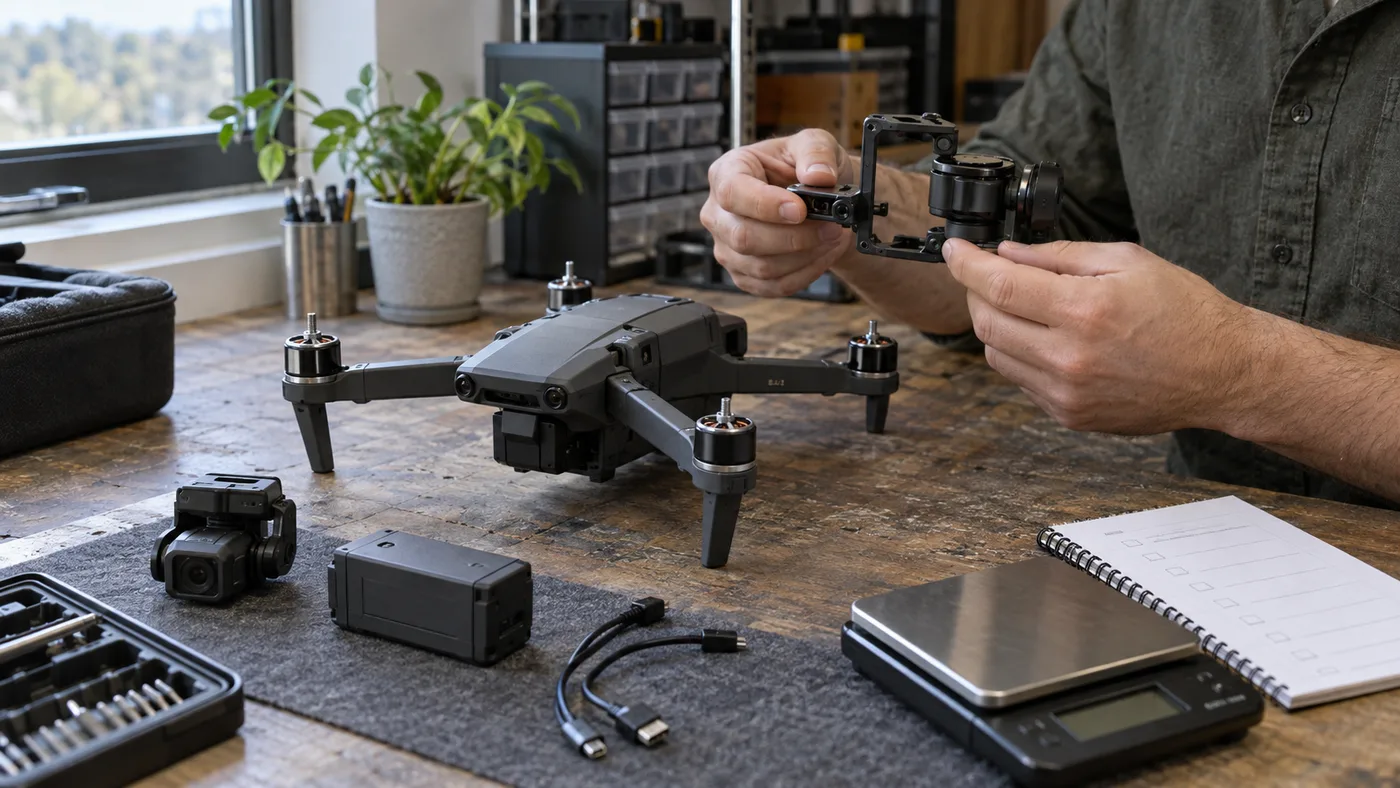
Use System assembly, balance and CG and mass/CG calculator as the basis. The calculator helps check units and assumptions but does not check strength or certify flight.
C05 Check the area, air, navigation and current requirements
Have the responsible person check the information for the actual day, area and form of work , namely people and obstacles, take-off/landing and fallback points, the area owner, local weather, link readiness and navigation, including registration, radio use, insurance, permissions and the relevant data requirements. This chapter does not take heights, distances or legal conditions from a 2022 document and use them as current rules.
- Check CAAT's UAS Portal and eAIP Thailand together with the announcements/coordination relevant to that job. Keep the document name, edition, date checked and the person who confirmed.
- Check radio-equipment and spectrum information from the NBTC Office by tying it to the equipment and the actual manner of use
- Use the site assessment, flight authorisation, weather brief and GNSS to help make a checklist
The phrase “has GNSS” does not confirm the quality of position in every condition, and receiving a proposal in an exercise is not permission to fly. If an important readiness check cannot yet be done, stop the relevant step or use another method that can answer the deliverable.
C06 Organise people, maintenance and resources
Separate the decision owner, the aircraft pilot, the assistants according to the form of work, the area coordinator, the condition/maintenance inspector, the data custodian and the acceptance inspector. One person may take on several duties, but overlapping work and the successor when someone is not ready must be visible.
Also schedule time for preparation, charging/battery replacement, data screening, rework and handover. A spare unit that nobody can operate, or data that does not enter the existing process, may not be a usable fallback plan. Check the equipment's condition status, repair history, manual/firmware version, replacement parts and the person responsible for restoring condition before use.
Use teamwork and field checklist with the successor reading back the duties and stop conditions. The exercise Plan O has an example that arranges both the data work and the outstanding work before going into the field.
C07 Agree on QA, time, position, privacy and delivery
Set the criteria from the recipient's decision; do not use words such as “very clear” or “complete” without a definition. A deliverable should carry the report version, question, source, time/time zone, position reference system, known quality, limitations, rows that failed and how to contact the reviewer.
For example, in an exercise, check that rows are no older than the agreed age, times are not in the future, local coordinates are complete and within the frame, confirmation status is clear, and nothing is obscured to the point that the question cannot be answered. Old data or missing coordinates still have value for a follow-up list, but must be separated from the list that can be used to choose points at that time.
Keep the originals and the edit history, collect only what is needed, restrict access and redact unnecessary parts according to the rights and the requirements of the real work. The recipient should be able to open the files and review the limitations before confirming acceptance. Read time and position, evidence and reports and data handover
C08 Compare buying, self-use, renting and hiring using the same accepted result
Use the same period, volume of work, acceptance criteria and service scope before comparing prices. Renting only the aircraft still requires people, batteries, processing and responsibility for the work. For hiring, check whether the contract really includes the deliverable, data rights, rework and the delivery deadline.
Synthetic example for learning only: over one year, 12 identical jobs; assume every option delivers a list of points with a report that passes the same criteria in all 12. There is no tax, interest, resale price or damage. The numbers are not market prices or procurement advice.
Scroll the table horizontally to see every column. When the table has keyboard focus, use the left or right arrow keys.
| Option | Start-up cost | Fixed over the year | Cost per job | Total for 12 jobs |
|---|---|---|---|---|
| Buy and use own | 90,000 | 36,000 | 1,200 | 140,400 baht |
| Rent the kit, own team | 12,000 | 0 | 5,000 rental + 1,800 team/data | 93,600 baht |
| Hire for the deliverable | 0 | 0 | 8,500 service + 500 acceptance check | 108,000 baht |
The simplified formula of the example is start-up cost + fixed cost over the period + number of jobs × cost per job Cost per accepted result = total cost / number of results actually accepted. If no job has passed, the cost per result cannot be concluded by division yet. If only 10 jobs pass, the divisor must change to 10 and the cost of reworking the missed jobs must be included. If the recipient needs a map instead of a list of points, the scope and the costs of every option must be set again.
Decision steps: check first that each path meets the criteria, calculate completely, then try changing the number of jobs, labour and rework costs, and set a review point. Choose based on people's readiness, continuity, rights and risk together with cost. Read the executive decision case and the F39 lifecycle cost chapter to practise further.
C09 Change the system while knowing the effect on interfaces and how to roll back
When the question needs a capability that the existing kit lacks, define the requirements before modifying; for example, time and position must be captured completely in the delivery format. Do not start from “add AI” with nothing to measure. Adding a camera mount may change the CG, vibration and image frame; changing software may change the timestamp, units and the meaning of states.
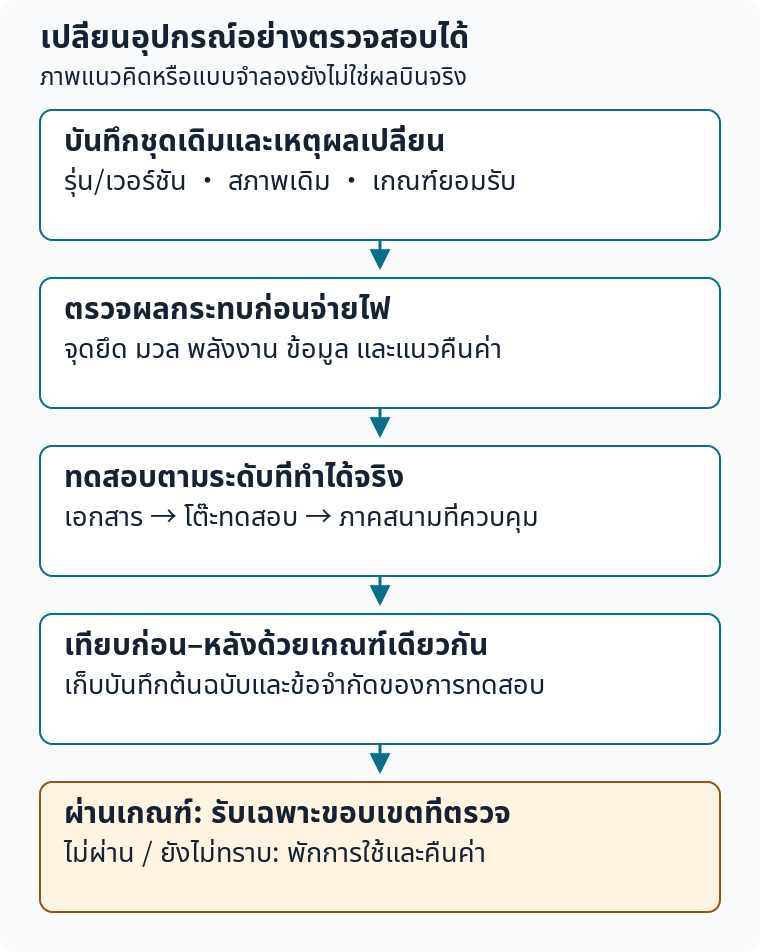
Diagram description: there must be a way back and a stop condition from the test plan onward, not waiting until a change causes wrong work to be delivered Open the full-size change-and-evidence diagram
- Record the baseline: equipment model, firmware/software, settings, dataset and previous results
- Make a ledger of the mechanical, electrical, data and timing interfaces and the successor; specify input/output, units, bounds and the result when data is missing
- Change one bounded issue at a time, keep the before/after versions, and check side effects on images, position, energy and data according to what was changed
- Check normal and error cases, such as old timestamps, missing coordinates, lost connections and out-of-range values. Never convert “unknown” into “pass”.
- State who orders a stop, the rollback criteria, how to restore the previous version/settings and the check after restoring. Keep data from the failed version separately with its status.
Read requirements and testing then do Plan D . This exercise changes data-screening rules on paper; it is not an instruction to modify, or a certification of, real hardware.
C10 Separate four kinds of evidence
Scroll the table horizontally to see every column. When the table has keyboard focus, use the left or right arrow keys.
| Evidence | What it answers | What cannot yet be claimed from that evidence |
|---|---|---|
| Content | Do the sources match the text? Are the links and exercises consistent? | That learners really understand or can do the work, from the results of checking the web page |
| Learner | Can the learner create the deliverable and explain the reasons according to the rubric? | Equipment performance or field readiness from passing a worksheet |
| Equipment/kit | What results the tested model and settings give under those conditions | Results for every kit or every condition from an experiment on a single kit |
| Field | Can the real team and kit produce the deliverable under the stated working conditions? | Permanent readiness, or permission for other work, from the result of a single mission |
NIST separates the assessment of system capability from the proficiency of the operator, a basic idea that can be adapted for exercises; see the NIST test methods page and the 2024 publication abstract . The criteria in this set were designed by the compiler for learning; they are not a NIST assessment or a certificate.
Three requests using the same kit: decide at the mission level before queuing drones
When a coordinator receives several requests at once, do not start by asking which drone is free. Separate the results the recipient needs, the time of the evidence, the capability of the kit, the resource owner, and the person responsible for prioritising first. FEMA's explanation of resource management states that the type/quantity, destination and user must be identified, and that requesting, acknowledging, mobilising and tracking are separated. NIST emphasises measuring capability by task , such as sensing, endurance, communications and logistics; having the equipment's name in a register is not evidence that it can do that work. This is a question-framing from the US, not an SOP or a rule permitting flight in Thailand.
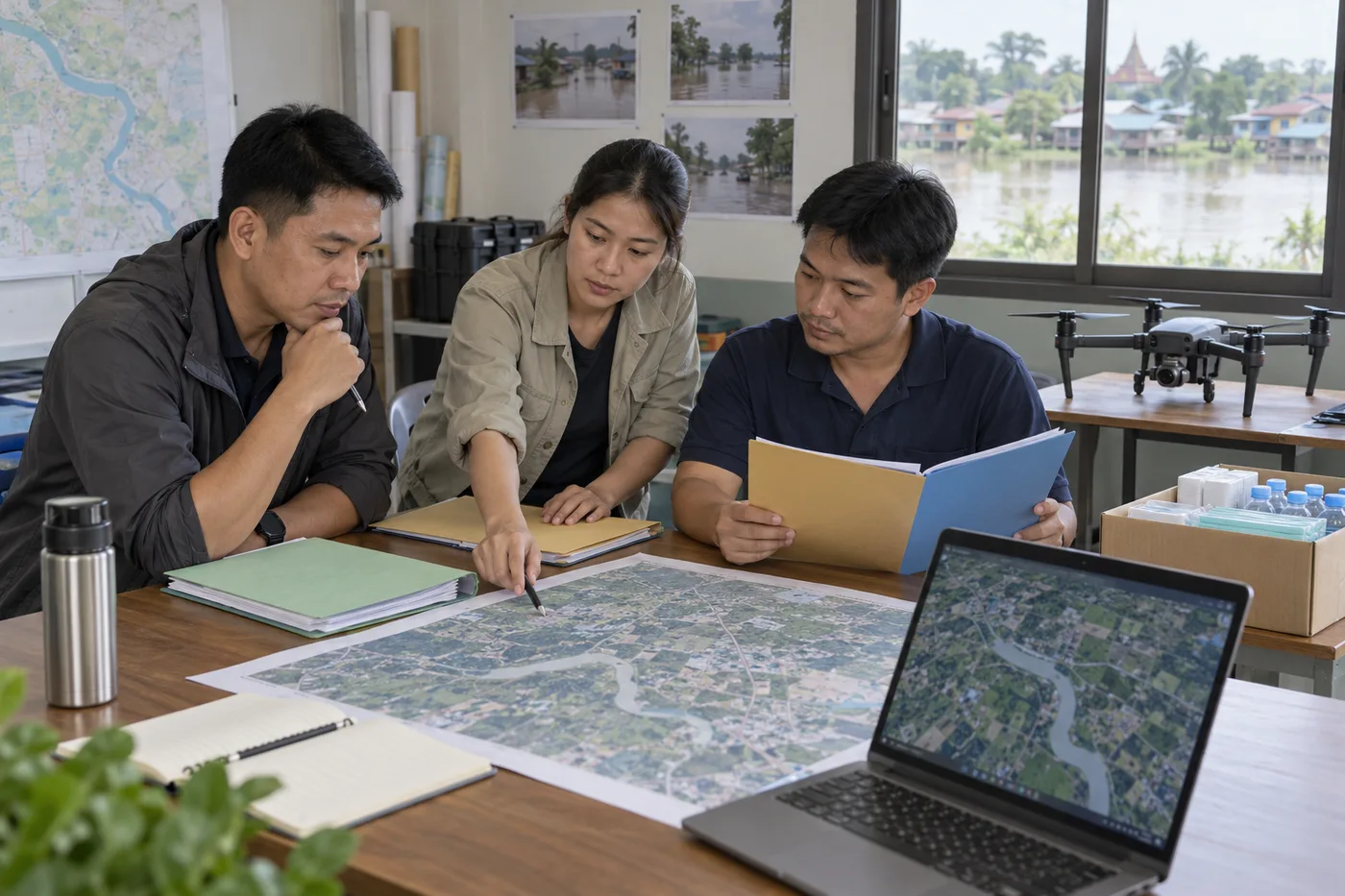
Photorealistic image created for teaching shows a discussion before assignment; it is not an image of a real incident or real resources, and does not show that the drone can carry goods. Open the full-size context image
Scenario TRAIN-PORTFOLIO-01 was fabricated as of 13 October 2026 at 10:00 (+07:00) in a hypothetical flood context. There are no real coordinates, persons, aircraft, acknowledged resources, flight results or learner results. The three requests need different results:
Scroll the table horizontally to read the outstanding items and the decision for each request
| Request and result recipient | What is available / what is still missing | Path proposed in the practice sheet |
|---|---|---|
REQ-1 M06 Situation assessment: the operations side needs a brief to choose points for further inspection |
Has images and a time record 07:00; there is no evidence of the current condition or of people/kit/permissions for new collection | Draft a brief from the existing data stating the time and the unknowns; send a separate request for new data; do not say “latest situation” |
REQ-2 M07 Search Support: the coordinator asks for a re-check of a suspicious point |
There is a message “looks like a person”, but the source/position and the person responsible for the re-check are not complete | Ask for clarification and send through the incident channel; do not create a flight or announce that a person was found from a training flag |
REQ-3 M09 Logistics: the requester needs a sealed hygiene kit delivered to the recipient |
The item list exists, but the recipient, pick-up point, delivery method and receipt are not confirmed; the boat B-1 has only been requested |
Wait for the recipient and delivery method; compare ground/boat routes after the owner replies; do not convert an imaging drone into a cargo drone |
U-1 is a multirotor with an RGB camera in the ledger only; there is no evidence yet that it is ready to fly or compatible with a payload kit. T-1 is one imaging team whose time the owner has not yet confirmed. Both are shared resources, so they must not be promised to REQ-1 and REQ-2 in the same period. There is no confirmed thermal or cargo kit, and the request for boat B-1 is not yet a boat ready for use. If a genuine urgency arises, the incident authority uses its own response channels immediately; the statuses in this practice sheet do not tell anyone to delay assistance.
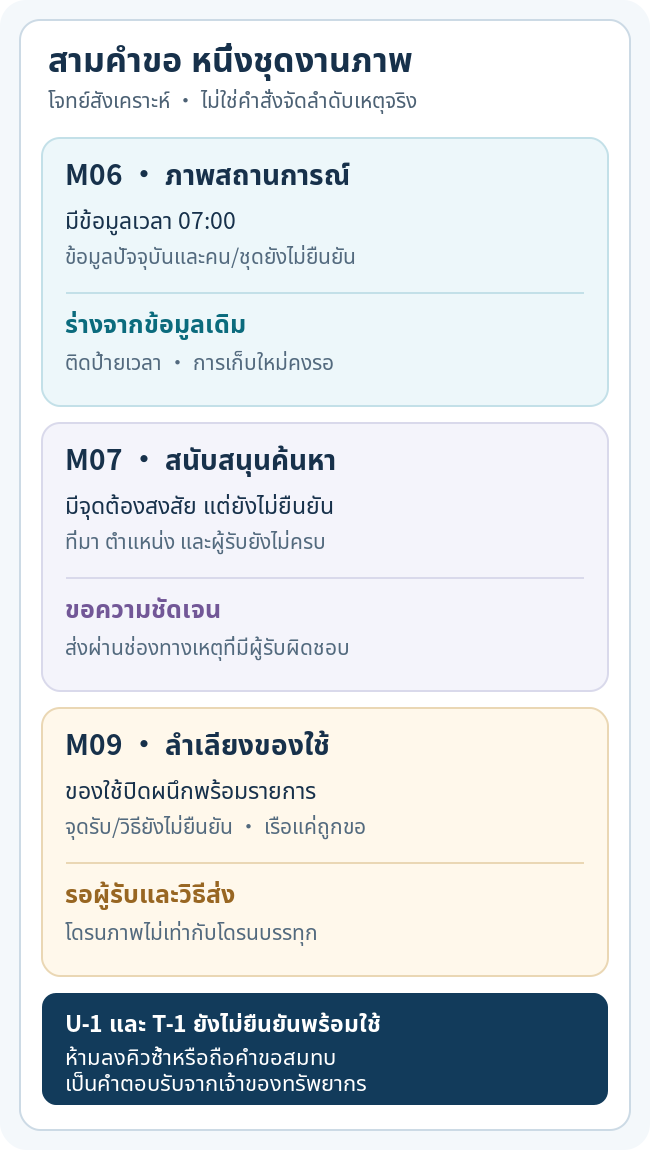
This chart is the expected result of the teaching scenario and does not rank the importance of human lives or serve as an assignment order. Open the full-size horizontal chart or the vertical chart for mobile
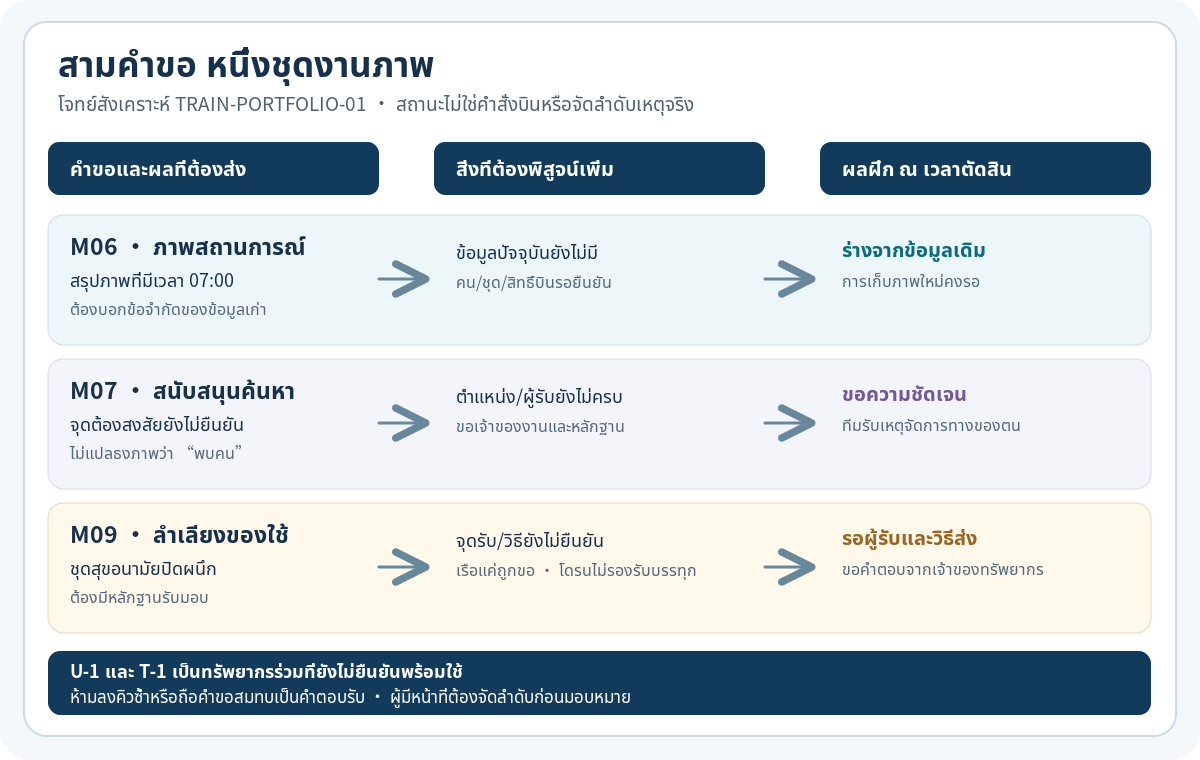
Proceed in order C01 → C03 to screen the data and methods that answer the problem, then C04–C07 check the kit, people, rights and delivery method. Write requested, owner_confirmed and assigned separately; only the persons responsible in a real incident prioritise and confirm the queue. If the recipient's location or readiness changes, make a new version, keep the original, notify holders of the old plan and review the effect on other requests. NPS example shows continuous adjustment of a search plan from new mission reports, but does not provide ordering criteria for the flood situation in this scenario.
The KSEC of the three groups use the codes of the existing kit-selection chapter (APP-SEL-K01/S01/E01/C01) and the existing rubric: B must know the deliverable/unknowns (K), compare existing data, ground and drone methods (S), not fabricate the words “found a person/current/sent” (E), and revise the brief after comments, with the owner of the outstanding items (C). O must know the resource status (K), make a conditional two-path plan and not queue twice (S), keep a joint request as pending (E), and read the plan back to the recipient when conditions change (C). D must know provenance/status/version (K), write the contract and negative tests for double booking/old data/a boat that does not reply/an unsupported kit (S), separate expected from actual=NOT_RUN (E), and propose notifying about stale or rolled-back versions (C). The prerequisites and deliverables of each group are in the downloadable practice card; source register states which parts can be cited and the boundaries that must not be carried over.
Steps for reviewing a proposal, and common mistakes
- Write a one-paragraph proposal stating the question, the kit/way of working, the deliverable, the reasons and the outstanding conditions
- Have the reviewer try to raise one objection, such as a change of time, an area that is not ready, or the recipient adding a requirement
- Revise the proposal while keeping what is unknown, with the owner of the outstanding items and the evidence that will close them
- Use the three-role criteria to check the deliverable, then go on to do the joint case
Problems to catch: using advertised flight time as actual working time, forgetting the mounts/cables/people in the cost, using thermal images to conclude about an individual, filling missing coordinates with zero, using old data as the current situation, and interpreting exercise results as flight readiness. Each should be fixed with sources, evidence and criteria tied to the problem.
References and review date
- CAAT, OM preparation guidelines, Issue 01 Rev 00 (18 October 2022): use only the structure of roles, plans and records; check current rules separately with the agency and the real work
- NIST, Aerial Drone Tests and the 2024 publication abstract: use the idea of separating systems, people and repeatable evidence; do not claim certification
- The repository's baseline chapters linked from each C have their own specific sources and limits. Selecting a real model requires adding the exact kit's manual to the evidence register.
Reviewed 11 October B.E. 2569 (2026) · The cost examples and exercise conditions are newly compiled work for learning; there are no real results from learners, equipment or the field.
Continue practising with the communications mission M10
For data-delivery missions, use M10 Communications to compare aircraft configuration, service owner and channel architecture as three axes, against ground/offline delivery/deferred sending, using the same criteria of recipient, time, completeness, rights and resources. The name of a type does not guarantee range or continuity.
Continue practising with the media-production mission M11
M11 Media production : use the recipient, message, channel, format, rights and deadline to decide whether an aerial viewpoint adds meaning. Separate the aircraft configuration, the kit/service owner and the camera/gimbal method, then compare ground and existing media with usage rights using the same criteria. A gimbal requires checking the interfaces of the real kit, and an image that looks good does not close an outstanding rights issue. Read O shoot/delivery plan or D change-and-rollback proposal
The P4 cases C01 Condition-inspection camera kit, C02 Search data kit and C03 Synthetic payload kit use the same baseline, so that B chooses by the recipient's problem, O builds a resource ledger and D checks changes, missing data, repeated-run results and baseline restoration. All the numbers are fabricated for teaching. Host results do not confirm compatibility or real flight readiness.