Advanced level: STM32, control and drone firmware
Study STM32 selection, timing and RTOS together with sensor fusion, PID, failsafe and flight logs, to plan evidence-based experiments with PX4 or ArduPilot
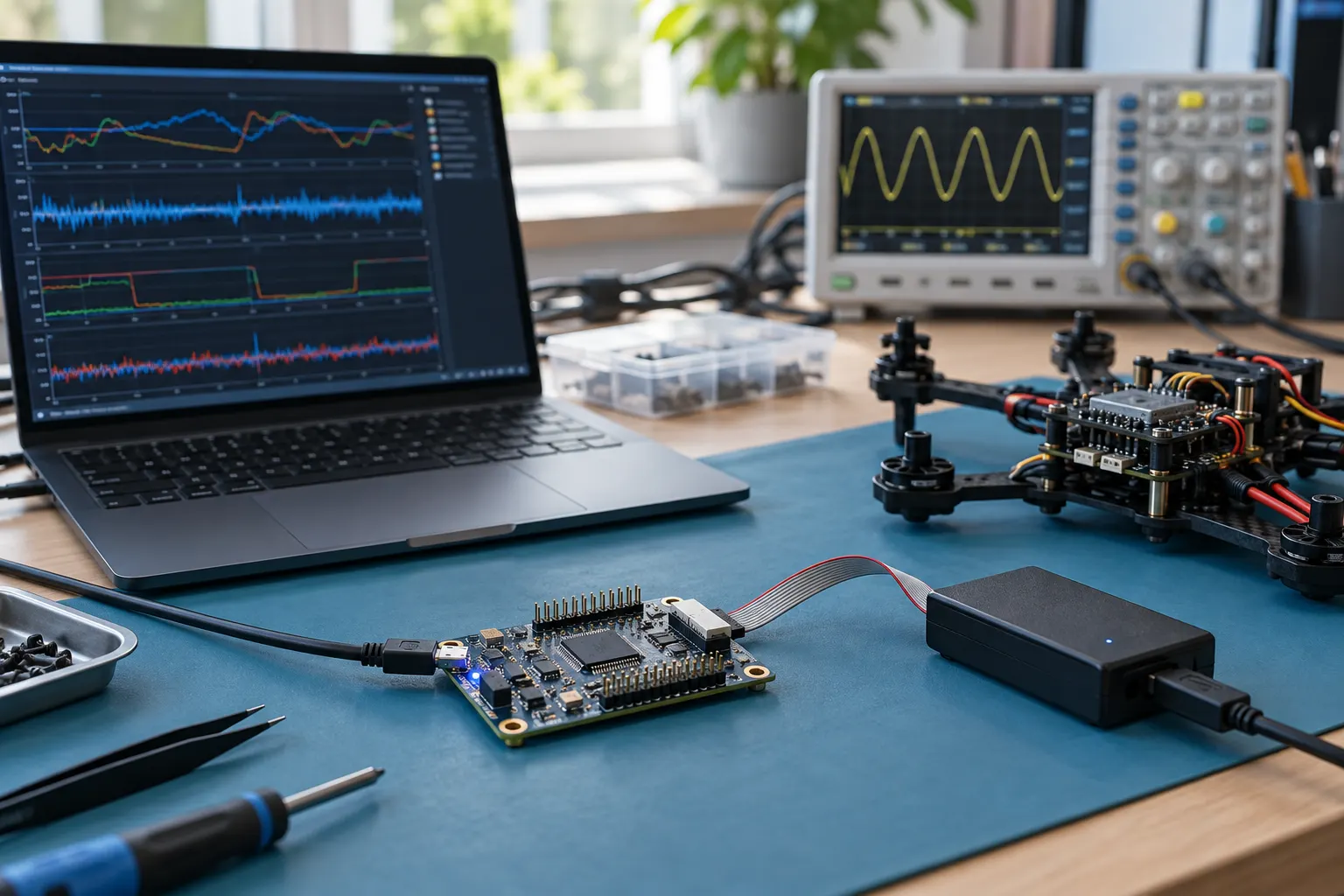
Start with the Flash and RAM guide to read compile figures and plan space before adding more work
Objectives and training options
This lesson trains you to read the structure of a control system, analyse timing, and use evidence to find the causes of abnormal behaviour. You can start with a computer and logs without buying a flight controller. If you want to measure timers or interrupts on hardware, then choose an STM32 development board with a supported debugger.
You should have completed reading the IMU and communication , and understand units and introductory C/C++. The Python practice sets on a PC, ArduCopter 4.7.1 SITL and the NUCLEO-F446RE/STM32duino 3.0.0 reference timing set in the linked chapters have passed the software-side checks; there are still no upload, timing, sensor or flight results from real equipment
Choose chapters according to your background and goal
Study in the order below, or open only the topic you need for reference. The times given are practice plans, not automatic reading times or results of trials with learners.
-
Foundation: can read C/C++ and time units · suggested practice time 45 minutes
Understanding check: explain one log row with its units, and state that IRQ latency cannot yet be measured
-
Timer Interrupt and tick handoff
Foundation: has completed the time-budget chapter and understands polling · suggested practice time 45 minutes
Understanding check: explain why a tick is skipped and why that cannot be observed from the log
-
Foundation: has completed Timer Interrupt and can read a counter · suggested practice time 60 minutes
Understanding check: separate an overflow at enqueue from a dropped row that could not be sent over Serial
-
Data age and the Freshness Gate
Foundation: understands a FIFO queue and time differences from the same clock · suggested practice time 60 minutes
Understanding check: explain fresh at the time limit, stale beyond the limit, and what the gate does not guarantee
-
Foundation: can read the six-column CSV from the Freshness Gate chapter · suggested practice time 45 minutes
Understanding check: do the seven-case worksheet and cite the rows that support the conclusion
-
Foundation: has completed Log diagnosis and understands cumulative totals versus deltas · suggested practice time 45 minutes
Understanding check: check four cases, and explain the hash and the boundaries of evidence not yet confirmed
-
Foundation: has completed sensors, units, time and log reading · suggested practice time 90 minutes
Understanding check: cite the time/mode in a log and state that real flight has not been confirmed
Choose a practice environment
- Python on a PC: analyse synthetic data and check answers
- Compile for NUCLEO-F446RE: check code against the reference target; this is not yet an upload result or a board measurement
- ArduCopter SITL: study firmware in a simulated environment from existing results and logs
- DroneSim: practise assembly, mission planning and reading Replay; MCU code is not yet run
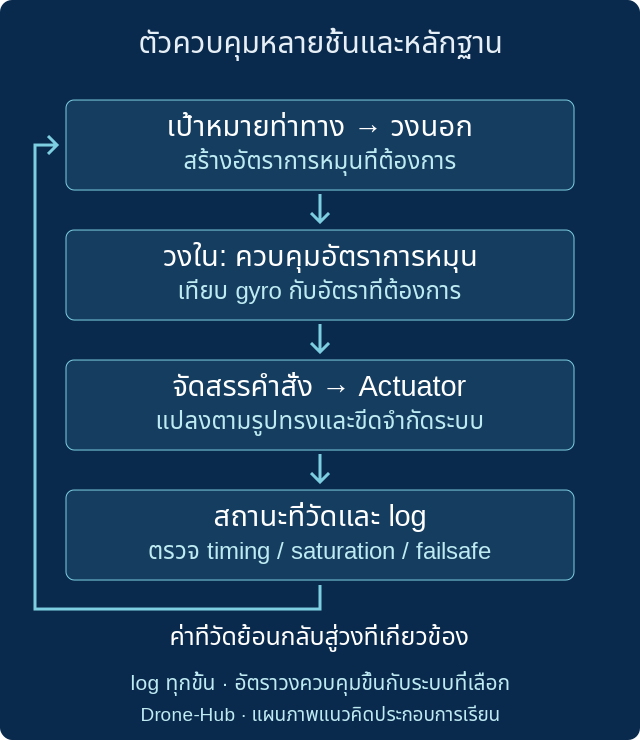
Concept image of the control loop, for reference between chapters; not a flight test result
Open a topic from an old link
Saved topic links still use this page as a passage to the chapters that have since been separated
Choosing an STM32 and reading the firmware structure
From measured values to thrust commands
Budgeting time and checking latency
STM32 set: practise timing and reading a log
STM32 set: practise Timer Interrupt and tick handoff
STM32 set: data queue from an ISR to the main loop
STM32 set: screening out stale data before use
Practice set: diagnosing STM32 Logs
Practice set: recording Log provenance and boundaries
Failsafe must relate to the flight state
Download PC-based timing, PID and failsafe exercises
Try a GCS failsafe with real ArduCopter in SITL
Next steps for firmware/SITL and reading logs
Connecting to missions and further study
Read data through a web tool
Open the CSV reader and Log chart tool to practise with synthetic examples or the six-column CSV of the Freshness Gate set. It processes locally, supports up to 1 MB/10,000 rows, and has a narrower scope than the original Python analyser. Statistics are computed from every row, while the chart shows at most 1,000 points and may not show every peak.
Self-check your understanding
Open the three-level quiz with explanations 4 questions per level; the pre-reading and post-review rounds are recorded only in the browser, use the same questions, and are not an assessment of real learners or a certificate
Prepare to collect evidence from a real board
UNO/ESP32/STM32 experiment-preparation guide with worksheets check the model, wiring, source/core clock and raw files before concluding. The guide is ready to use, but the actual upload/measurement still awaits equipment
Practise reading PID and stale data from evidence
Guided practice set on PID/STOP_SIM, 8 questions uses the existing PC Log, 4 cases, with a blank worksheet/answers giving reasons and the referenced row positions. Practise reading units, deadline, saturation and limitations before studying the firmware results
Practise the ISR queue and separating the causes of lost data
Guided practice set on FIFO/counter, 8 questions trace a 4-slot queue with a blank 12-step table, compared against the existing 13 rows of synthetic data, with answers giving reasons/units/boundaries, before moving on to the Freshness Gate
Practise reading data age and the point of use
Guided practice set on the Freshness Gate, 8 questions compare against the existing 13-row Log, calculate time boundaries and 6 clock-wrap cases, with worksheets/answers, to separate stale data from lost data
Practise diagnosing and writing conclusions from a Log
Guided practice set on Log Diagnostics, 8 questions calculate 8 pairs from the 7 existing cases, with a blank report form/answers, to separate cumulative totals from deltas and to limit conclusions to the evidence
Practise checking provenance and the boundaries of evidence
Guided practice set on Log provenance and boundaries, 8 questions check four pairs of the existing files, separating values from the file from declarations, with a three-layer report form/answers and an example of transforming bytes on a copy
Practise reading causes and times in SITL firmware
Guided practice set on SITL firmware, 8 questions reads the results of the two existing runs, with 11 events, a 7-phase timetable, and answers that separate ACK / host observation / the boundary of evidence
Practise phase and the polling time budget
Guided practice set on polling timing, 8 questions reads the 11 existing synthetic rows, calculates seven pairs, and traces the scheduler over seven calls, with answers that separate late/skipped/work/dropped
Practise handing a tick from an ISR to main
Guided practice set on Timer Interrupt, 8 questions reads the 11 existing synthetic rows, calculates seven pairs, and traces a handoff over nine calls, with answers that separate the callback, the hardware update and the timing measurement point