Coordination, computer-based drills and post-mission review
UAT 460 UAS for Public Safety, Search and Rescue, and Emergency Management
Lesson
By the end of this module you will be able to
- Coordinate airspace with crewed aircraft and calculate how many sorties fit in the gaps between movements
- Write a communications plan with at least two primary systems and a backup, and draft an airspace notification request in NOTAM format
- Assemble the mission file and check gate G3 before launch
- Rehearse the plan on a computer with a random simulation, and read the result as percentiles and the share of runs that meet the target
- Review after the operation by comparing the plan with the actual log, write SMART corrections, and check whether an improvement is real when data are scarce
Why this matters
At 16:15 the air branch coordinator at the command post announces three helicopter movements. An air ambulance will land on the hospital roof from 16:52 to 17:02. A police helicopter will orbit the incident area taking pictures from 17:20 to 17:40. The air ambulance will leave the hospital from 17:43 to 17:48. If the drone team stops flying for every helicopter, it can fly only one sortie before sunset. If nobody is told that drones are in the air, the risk of being near an aircraft with people on board is too high to accept. The right answer lies in the middle: agree in advance who flies when, how high, and who has the authority to order a stop.
This module closes the planning loop with the last two steps of the eight-step mission-planning process: step 7, coordination and communication, and step 8, after-action review. It also adds what sits between them: the mission file that gathers the results of Modules 16 to 19, with gate G3 before launch, and the computer-based drill that tests the plan before time is spent on field drills. Even the best plan can fail if the people involved do not know it, and it will fail again if nobody compares the plan with what actually happened after the mission.
Coordinating airspace with crewed aircraft
The first principle is that crewed aircraft have priority. Article 5(2)(j) of the 2015 Ministry of Transport notification prohibits flying an unmanned aircraft close to an aircraft with a pilot on board (Ministry of Transport, 2015). The notification does not say how many metres “close” is, so the team should not decide this alone. It must agree with the pilot of that aircraft before flight and record the agreement.
The CAAT guidance PDRA101 applies only to beyond-visual-line-of-sight (BVLOS) flight. Its Annex A asks the pilot to consider whether there is an airport, aircraft or helicopter within 9 km of the flight area, whether aircraft take off and land nearby and during which hours the site is open, and what extra risk-reduction measures apply, such as an observer (Civil Aviation Authority of Thailand, 2025). The missions in this course fly within visual line of sight, so they fall outside the scope of PDRA101, but these questions work as a team checklist. This is an application defined by the course, not a regulation.
There are three tools for separating aircraft, and they can be used together:
- Separation by time. Stop flying while the helicopter is moving, with a margin before and after.
- Separation by area or height. The helicopter is above the drone’s ceiling or on the other side of the area. The acceptable values are set by the helicopter pilot, not by the drone team.
- Separation by communication. The observer or the air branch coordinator listens on the airspace net and has the authority to order “stop flying” at once.
Planning decides which tool can be used by working out the numbers. Example 1 calculates how many sorties fit under two options.
Example 1 Flight windows around helicopter movements
Times are in minutes after 16:00. The air ambulance arrives at 52 to 62, the police helicopter orbits from 80 to 100 and the air ambulance departs at 103 to 108. The team keeps a 5 minute margin before and after each movement. One four-face scan takes 10.9 minutes (Module 19) and a battery swap takes 6 minutes. The flyable period runs from 16:22 to sunset at 17:50 (all values assumed). Compare two options: stopping for every helicopter, and agreeing with the police pilot to orbit at 150 m, which is 60 m above the drone’s 90 m ceiling, so that flying can continue.
# drone-free windows around helicopter movements and how many sorties one aircraft can still fly (minutes after 16:00; all values assumed)
heli = [("air ambulance in", 52, 62), ("police helicopter orbit", 80, 100), ("air ambulance out", 103, 108)]
clear, sortie, swap, horizon = 5, 10.9, 6.0, (22, 110)      # clearance before and after (min), one four-face scan (module 19), battery swap (min), first launch 16:22 to sunset 17:50
def fmt(m): return f"{16 + int(m) // 60:02d}:{int(m) % 60:02d}"
def plan(movements):
    blocks = sorted((a - clear, b + clear) for _, a, b in movements)
    merged = []
    for a, b in blocks:                                      # merge blocks that touch or overlap
        if merged and a <= merged[-1][1]:
            merged[-1] = (merged[-1][0], max(merged[-1][1], b))
        else:
            merged.append((a, b))
    free, cur = [], horizon[0]
    for a, b in merged:
        if a > cur:
            free.append((cur, min(a, horizon[1])))
        cur = max(cur, b)
    if cur < horizon[1]:
        free.append((cur, horizon[1]))
    t, out = horizon[0], []
    for a, b in free:
        t = max(t, a)
        while t + sortie <= b:
            out.append((t, t + sortie))
            t += sortie + swap
    return merged, out
for label, use in (("stop for every movement", heli), ("police orbit kept above 150 m by agreement", [h for h in heli if "police" not in h[0]])):
    merged, out = plan(use)
    fly = sum(e - s for s, e in out)
    print(f"{label}: stops {', '.join(f'{fmt(a)}-{fmt(b)}' for a, b in merged)}")
    print(f"   {len(out)} sortie(s) at {', '.join(fmt(s) for s, e in out)}; {fly:.1f} min on station = {fly / (horizon[1] - horizon[0]):.0%} of the window")
stop for every movement: stops 16:47-17:07, 17:15-17:53
1 sortie(s) at 16:22; 10.9 min on station = 12% of the window
police orbit kept above 150 m by agreement: stops 16:47-17:07, 17:38-17:53
3 sortie(s) at 16:22, 17:07, 17:23; 32.7 min on station = 37% of the windowIf the team stops every time, the stops for the police helicopter and the departing air ambulance join into one period, 17:15 to 17:53. The gap from 17:07 to 17:15 is only 8 minutes, which is not enough for a 10.9 minute sortie, so only one sortie remains. That is 12% of the time over the area. If height separation can be agreed with the police, the gap from 17:07 to 17:38 is wide enough for two sorties, giving three sorties in total, 32.7 minutes or 37% of the time. That is 21.8 minutes more than before. The agreement with the police pilot is therefore worth two sorties. But 150 m is an assumed value. If the pilot does not agree, or changes their mind during the mission, the team must go back to the first option at once.
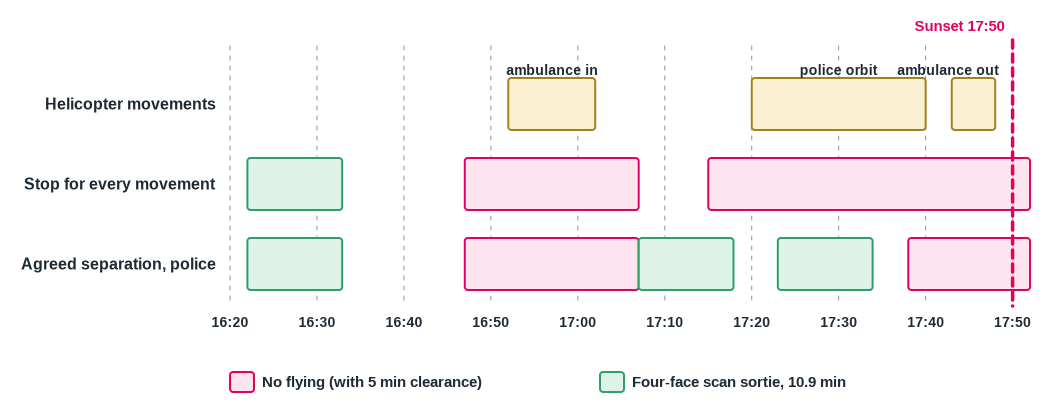
A good agreement is short and checkable. It states who agrees with whom, the time and height, who orders a stop, and which signal is used. The air branch coordinator holds the agreement and announces changes. The incident command system has the form ICS 220 Air Operations Summary for the air branch (Federal Emergency Management Agency, n.d.). The drone team should ask the coordinator to record the drones in the incident’s air operations summary, rather than leave them as an aircraft that nobody knows about.
Communications plan and airspace notification
An agreement that nobody can pass on is no agreement. The communications plan says who talks to whom on which net, and what is used instead when that net fails. The incident command system has the form ICS 205 Incident Radio Communications Plan for listing the nets, and ICS 213 General Message for messages that must be sent in writing (Federal Emergency Management Agency, n.d.). Thailand’s National Disaster Prevention and Mitigation Plan sets the guideline of arranging at least two primary communication systems and a backup communication system (Department of Disaster Prevention and Mitigation, 2021). The team’s plan therefore follows that rule on every net.
| Net | Who talks to whom | Main messages | Primary system | Backup system |
|---|---|---|---|---|
| Command | IC and operations section chief | Objectives, priorities, orders to stop or change the plan | Fire service radio | Mobile phone |
| Airspace | Air branch and helicopter pilots | Arrival and departure times, heights, stop-flying order | Radio carried by the air branch coordinator | Coordinator’s phone |
| Operations | Operations section and UAS group leader | Image requests, progress, products ready | Fire service radio | Mobile phone |
| UAS group | Group leader, pilots, observers, safety officer | Flight orders, “stop flying”, positions, malfunctions | Team handheld radios | Hand signals and phone |
| Data and imagery | Situation unit, data manager and UAS group | Images, annotated maps | Team wireless network | Mobile network, or a memory card carried by hand |
This table continues from Example 4 of Module 19, which found that a single radio and a single data manager are single points of failure. The backup systems in this table are therefore things that the mission file must really provide. The air branch coordinator holds the radio that listens to the helicopters. The drone team does not have to carry it.
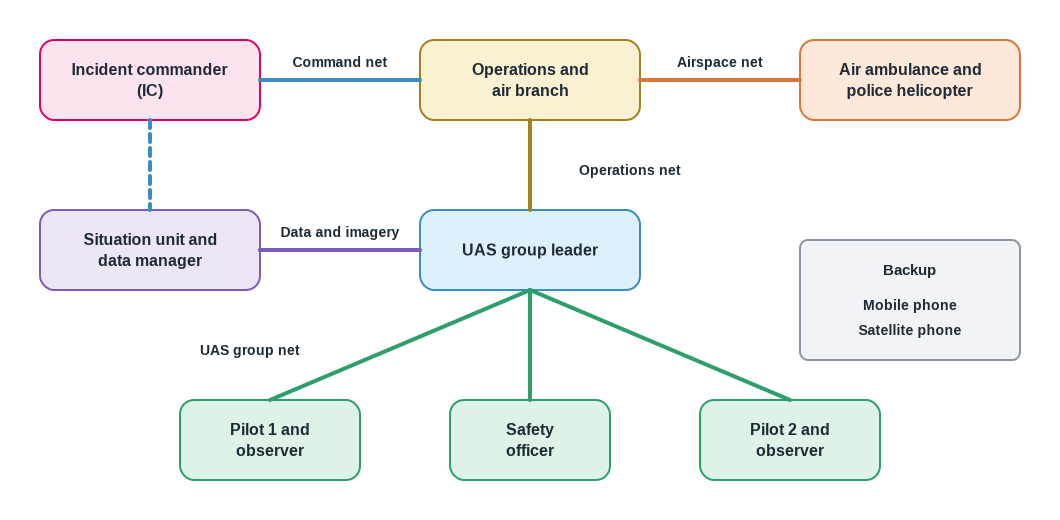
Annex A of PDRA101 asks the team to check mobile phone coverage at the flight area, to use a satellite phone instead if there is no signal, and to check that the NOTAM is still Active before flight, giving a telephone number that can be reached in the area (Civil Aviation Authority of Thailand, 2025). The missions in this course fly within visual line of sight, but the team uses this as good practice.
A NOTAM is a notice to pilots in the fixed message format of ICAO. The EUROCONTROL guidance explains how to write one. Item Q) contains the FIR, the subject code, the traffic type (IV means instrument and visual), the purpose (NBO means that pilots must be notified immediately, that it qualifies for the pre-flight information bulletin, and that it concerns flight operations) and the scope (W means navigation warning). The lower and upper limits are in hundreds of feet, the coordinates are rounded to whole minutes, and the three-digit radius is in nautical miles, rounded up. Items B) and C) are the start and end times, as ten-figure groups in UTC (EUROCONTROL, 2020).
Example 2 Draft NOTAM for a night search at the old market
The old market wing collapses at 19:40 and the team must fly a night search from 19:45 to 05:45 local time (UTC+7). The operational radius, including a margin, is 150 m, the highest flight height is 40 m, and the ground is 150 m above mean sea level (all values assumed). Write the draft and check the radius, the upper limit and the times.
import math
from datetime import datetime, timedelta
# draft of an airspace-notification request in the ICAO NOTAM item format (Q, A, B, C, E, F, G); place, times and heights are assumed
local_start = datetime(2026, 10, 14, 19, 45)                 # local time UTC+7: the night search starts just after the collapse
local_end = datetime(2026, 10, 15, 5, 45)                    # one 10-hour period, ends before sunrise
def utc10(dt): return (dt - timedelta(hours=7)).strftime("%y%m%d%H%M")      # ten-figure group in UTC
def latlon(lat, lon):
    la, lo = abs(lat), abs(lon)
    return f"{int(la):02d}{round((la % 1) * 60):02d}{'N' if lat >= 0 else 'S'}{int(lo):03d}{round((lo % 1) * 60):02d}{'E' if lon >= 0 else 'W'}"
radius_m = 150.0                                             # operational volume of the night search plus its buffer (assumed)
radius_nm = math.ceil(radius_m / 1852.0)                     # three digits in nautical miles, rounded up
ground_m, top_agl_m = 150.0, 40.0                            # ground elevation of the city and the highest flight height (assumed)
top_ft = (ground_m + top_agl_m) / 0.3048
top_fl = math.ceil(top_ft / 100)                             # flight level: hundreds of feet, rounded up
lines = [
    f"Q) VTBB/QXXXX/IV/NBO/W/000/{top_fl:03d}/{latlon(15.5, 102.5)}{radius_nm:03d}",
    "A) VTBB",
    f"B) {utc10(local_start)}",
    f"C) {utc10(local_end)}",
    "E) EMERGENCY RESPONSE UAS ACT. RADIUS 150M FM OLD MARKET. CTC +66 XX XXX XXXX",
    "F) SFC",
    f"G) {top_agl_m / 0.3048:.0f}FT AGL",
]
print("\n".join(lines))
print(f"check: radius {radius_m:.0f} m = {radius_m / 1852:.3f} NM -> {radius_nm:03d}; top {top_ft:.0f} ft AMSL -> FL{top_fl:03d}; "
      f"local {local_end:%H:%M} on the 15th = {utc10(local_end)[-4:]} UTC on the 14th")
Q) VTBB/QXXXX/IV/NBO/W/000/007/1530N10230E001
A) VTBB
B) 2610141245
C) 2610142245
E) EMERGENCY RESPONSE UAS ACT. RADIUS 150M FM OLD MARKET. CTC +66 XX XXX XXXX
F) SFC
G) 131FT AGL
check: radius 150 m = 0.081 NM -> 001; top 623 ft AMSL -> FL007; local 05:45 on the 15th = 2245 UTC on the 14thCheck each item. 19:45 local is 12:45 UTC, so it is written 2610141245 in the format year, month, day, hour, minute. The 150 m radius is 0.081 nautical miles, rounded up to 001, and the upper limit of 623 ft above mean sea level, rounded up to hundreds of feet, is 007. The end time, 05:45 on the 15th local, is 22:45 UTC on the 14th. Items F) and G) give the lower and upper limits as text: ground to 131 ft above ground (40 m divided by 0.3048). The most common mistake is to write the local time directly, or to forget that the UTC date differs from the local date.
This example teaches the message format only. The subject code (QXXXX) and the telephone number are left blank, and the author has not checked the FIR code against the procedures of Thailand’s aeronautical information service. The real filing process, and which missions need a NOTAM, must always be checked against the conditions in the permit and the advice of CAAT. The word NOTAM does not appear in the 2015 notification as checked by the author, and the author found no requirement that a flight within visual line of sight must have a NOTAM issued. PDRA101, for its part, requires the NOTAM issuing procedure to be stated in the plan for beyond-visual-line-of-sight flights.
The mission file and gate G3
The results of Modules 16 to 20 together form one mission file, a single document that the decision maker, the pilots and the later reviewer can read in a few minutes. The FEMA CPG 101 guide recommends writing plans in plain, clear language and summarising key information with checklists and visuals such as maps and flow charts (Federal Emergency Management Agency, 2025).
| # | Document in the file | From | Author | Reviewer |
|---|---|---|---|---|
| 1 | Known, assumed and unknown table, constraint clock and the schedule worked back from the decision time | Module 16 | UAS group leader | IC |
| 2 | Measurable objectives with the G1 check result | Module 16 | UAS group leader | IC |
| 3 | Wind record, line of sight, SORA chain and flight authorisation status with the G2 check result | Module 17 | Safety officer | UAS group leader |
| 4 | Aircraft and equipment selection table with the battery plan | Module 18 | UAS group leader | Pilot |
| 5 | Map of the operational volume, scan plan, return altitude and rally points | Module 19 | Pilot | Safety officer |
| 6 | Contingency table, ERP checklist and single-point-of-failure check result | Module 19 | Safety officer | UAS group leader |
| 7 | Airspace agreement, communications plan and NOTAM if needed | Module 20 | Air branch coordinator | UAS group leader |
| 8 | One-page crew briefing sheet and ICS 214 activity log | Module 20 | UAS group leader | Safety officer |
Before flight the team passes gate G3, a ten-item checklist. Every item must be answered yes before the aircraft can fly. If any item is answered no, fix it at the step that caused it, do not skip it. Item ten exists to catch what changed while the plan was being prepared.
| Item | What is checked | Passes when |
|---|---|---|
| 1 | Objectives | The IC confirms the question still matches the situation now |
| 2 | Flight authorisation | The permit, or the right under the CAAT notifications, is still valid and covers this flight |
| 3 | Wind and weather | The latest wind does not exceed the planning limit of the aircraft to be used |
| 4 | Aircraft and batteries | The pre-flight check is passed and the full battery sets of the plan are present |
| 5 | Return point | RTL_ALT_M, rally points and virtual fence are loaded and tested |
| 6 | Airspace | There is an agreement with every aircraft scheduled in the flight period, and the times are the latest |
| 7 | Notification | The NOTAM, or other notification required by the conditions, is Active |
| 8 | Communications | Every net and its backup are tested; phones have signal at the launch point |
| 9 | Crew | Briefed, know the contingency table, and nobody is more fatigued than the unit’s threshold |
| 10 | New events | The air branch coordinator and the operations section chief confirm there is no new information that changes the known, assumed and unknown table |
ICS 214 is the unit’s Activity Log form (Federal Emergency Management Agency, n.d.). The safety officer writes in the actual time of every step, from receiving the request to briefing the commander. This log is the raw data for the after-action review. Without it, the team has only memory.
Computer-based drills
The US Homeland Security Exercise and Evaluation Program (HSEEP) divides exercises into two groups. Discussion-based exercises are seminars, workshops, tabletop exercises and games. Operations-based exercises are drills, functional exercises and full-scale exercises. A drill checks a single task or function, has a narrow focus, and is measured against a standard set in advance (Federal Emergency Management Agency, 2020).
A computer-based drill in this course is the course’s own term, not an HSEEP exercise type. It means simulating the plan with a program, giving the time of each task as a random variable and rehearsing the plan thousands of times in a few seconds. It is used to rank which plan change is worth the most before time is spent on field drills. It is not a substitute for a field drill.
Example 3 Computer-based rehearsal of the time from request to first thermal image
The target is to deliver the first thermal image to the commander within 15 minutes of receiving the request (assumed value). The tasks run in this order: analyse the situation, then plan the route followed by airspace coordination, which together run in parallel with preparing the kit, then launch, then the first image. Each task time is triangular (minimum, maximum, mode). In nine of ten runs the kit preparation is normal, and in one of ten there is a battery or thermal-camera warm-up problem that adds five minutes. Compare four versions of the plan, 2,000 runs each.
import random, statistics as st
# computer-based drill: time from request to first thermal image, 2,000 simulated runs per plan version (task times in minutes, assumed)
def run(rng, airspace_plan, kit, template):
    tri = rng.triangular                                                # triangular(low, high, mode)
    analyse = tri(1, 4, 2) if template else tri(3, 8, 5)
    plan = tri(2, 5, 3) if template else tri(4, 10, 6)
    airspace = tri(0.5, 2, 1) if airspace_plan else tri(2, 8, 4)        # confirm a pre-agreed plan, or agree the details live
    prepare = tri(2, 5, 3) if kit else tri(4, 12, 6)
    if rng.random() < 0.10:                                             # 1 run in 10: battery or thermal warm-up fault
        prepare += 5
    launch, first_image = tri(1, 4, 2), tri(1, 3, 2)
    return analyse + max(plan + airspace, prepare) + launch + first_image
TARGET = 15.0                                                           # minutes from request to first image
versions = (("baseline plan", (False, False, False)), ("+ airspace plan agreed", (True, False, False)),
            ("+ staged kit", (True, True, False)), ("+ planning templates", (True, True, True)))
for label, flags in versions:
    rng = random.Random(480)
    t = sorted(run(rng, *flags) for _ in range(2000))
    print(f"{label:<24} median {st.median(t):5.1f} min  90th percentile {t[1799]:5.1f} min  within {TARGET:.0f} min: {sum(x <= TARGET for x in t) / len(t):5.1%}")
baseline plan median 21.1 min 90th percentile 24.0 min within 15 min: 0.1%
+ airspace plan agreed median 18.3 min 90th percentile 21.2 min within 15 min: 3.4%
+ staged kit median 17.5 min 90th percentile 19.8 min within 15 min: 6.6%
+ planning templates median 11.3 min 90th percentile 13.8 min within 15 min: 95.0%The baseline plan has a median of 21.1 minutes, and only 0.1% of runs meet the target. Agreeing the airspace plan in advance lowers the median by 2.8 minutes. Staging the kit lowers it by a further 0.8 minutes, and the planning templates that the team prepared lower it by another 6.2 minutes, giving a median of 11.3 minutes and 95.0% of runs meeting the target. Staging the kit helps little because “prepare the kit” runs in parallel with planning and airspace coordination, and it is the only task not on the critical path of Module 16. Shortening a parallel task reduces the total time only if that task is the slowest. Agreeing the airspace in advance and the templates directly shorten the tasks on the critical path.
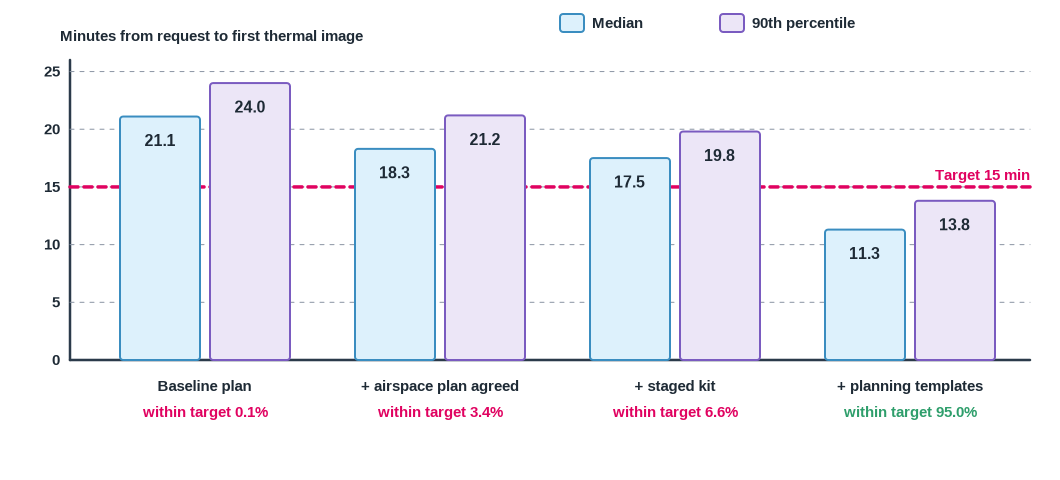
There are three rules for reading the results correctly. First, look at the 90th percentile and the share that meets the target, not the median alone, because the incident commander meets the bad day, not only the typical day. Second, changing one thing at a time may not reach the target. Combine several changes and see which one is on the critical path. Third, all the numbers come from assumed task times. The result can say that if the task times are like this, this change is worth the most. It cannot say that the field will give 95%. Measuring the team’s real task times and putting them in place of the assumed values is the job of the field drill.
After-action review
HSEEP calls the output of an exercise the after-action report and improvement plan (AAR/IP). Observations are divided into strengths and areas for improvement, with emphasis on issues that are important to mission success or that form a trend. Each correction must be written in the SMART form: specific, measurable, achievable, relevant and time-bound. It must have a person responsible, be tracked to completion, and be checked again to confirm that it worked (Federal Emergency Management Agency, 2020). The cycle applies to real missions as well.
The team uses a two-step review. The first step compares the plan with the actual log to find where time was lost. The second step checks whether a correction that was made really worked, or whether the team was just lucky.
Example 4 Plan against the activity log of a field drill
The team rehearses the tower facade-scan scenario of the case study, setting the request at 16:05 and the decision time at 16:35 as in the real incident. It uses a two-aircraft plan that assumes an airspace agreement made in advance, so the coordination time is set at only 1 minute. The plan states the time for each step, and the safety officer records the actual times in ICS 214 format (all values assumed).
from datetime import datetime
# after-action review, step 1: the plan against the activity log (ICS 214 style) of the facade-scan mission; plan = two aircraft with an airspace plan agreed in advance
def t(s): return datetime.strptime(s, "%H:%M")
log = [("request received", "16:05"), ("objectives issued", "16:11"), ("route and risk plan done", "16:19"),
       ("airspace coordination confirmed", "16:28"), ("launch", "16:30"), ("scan complete", "16:37"),
       ("annotated product ready", "16:43"), ("briefed to the commander", "16:46")]
plan = [("objectives issued", 5), ("route and risk plan done", 6), ("airspace coordination confirmed", 1), ("launch", 2),
        ("scan complete", 6.3), ("annotated product ready", 4), ("briefed to the commander", 2)]
decision = "16:35"
prev = t(log[0][1])
rows = []
for (name, hhmm), (_, planned) in zip(log[1:], plan):
    actual = (t(hhmm) - prev).total_seconds() / 60
    rows.append((name, planned, actual, actual - planned))
    prev = t(hhmm)
for name, p, a, d in rows:
    print(f"{name:<32} plan {p:4.1f}  actual {a:4.1f}  difference {d:+5.1f} min")
late = (t(log[-1][1]) - t(decision)).total_seconds() / 60
worst = max(rows, key=lambda r: r[3])
print(f"briefed {late:.0f} min after the 16:35 decision; largest overrun: {worst[0]} ({worst[3]:+.1f} min)")
objectives issued plan 5.0 actual 6.0 difference +1.0 min
route and risk plan done plan 6.0 actual 8.0 difference +2.0 min
airspace coordination confirmed plan 1.0 actual 9.0 difference +8.0 min
launch plan 2.0 actual 2.0 difference +0.0 min
scan complete plan 6.3 actual 7.0 difference +0.7 min
annotated product ready plan 4.0 actual 6.0 difference +2.0 min
briefed to the commander plan 2.0 actual 3.0 difference +1.0 min
briefed 11 min after the 16:35 decision; largest overrun: airspace coordination confirmed (+8.0 min)The plan takes 26.3 minutes in total, so the briefing would finish at 16:31, 3.7 minutes before the decision time. The actual run took 41.0 minutes, 14.7 minutes more than planned. The biggest overrun is airspace coordination, which took 9 minutes instead of 1 (8.0 minutes over), more than half of the total overrun, because the advance agreement that the plan assumed did not yet exist. As a result the commander received the product at 16:46, 11 minutes after the decision time. The other steps overran by 0 to 2 minutes each, the normal error of a plan written on paper. The correction worth making is the airspace coordination step alone, following the critical-path idea of Module 16, which says to improve first the step that is on the critical path and overruns the plan the most.
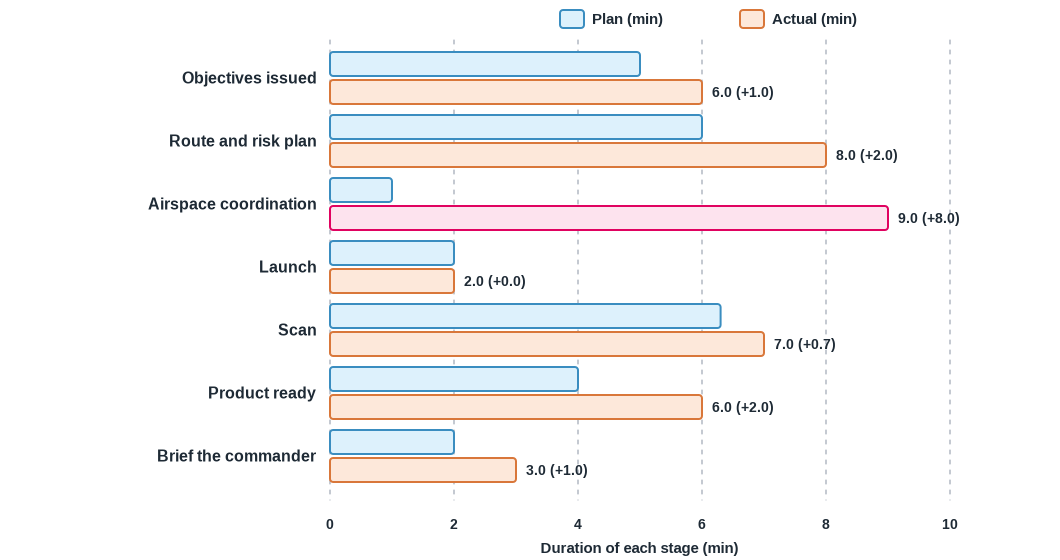
Observations are written as rows of a table, with the cause and a SMART correction. Here is one row from Example 4.
| Observation | Cause | SMART correction | Responsible | Due | How the result is checked |
|---|---|---|---|---|---|
| Airspace coordination took 9 minutes, the plan said 1 minute | The advance agreement that the plan assumed did not exist. The air branch coordinator and the pilot had to negotiate the details live every time | Draft a standard one-page agreement with the air branch coordinator that states times, heights, who orders a stop and the signals, then rehearse using it once | UAS group leader | 15 November 2026 | Repeat the drill: this step takes no more than 3 minutes five times in a row |
After the correction the team rehearses again, but only a few times. With so little data it is hard to tell whether things really improved or the team was lucky. Example 5 uses two methods that suit small data. The first is the Wilson confidence interval for the share of runs that meet the target (Wilson, 1927). The NIST statistics handbook says to use it when the sample is small, because an interval from the normal approximation may not be accurate enough (NIST/SEMATECH, n.d.). The second is the bootstrap for the difference of medians, which resamples the original data with replacement 10,000 times to see how much the difference varies (Efron, 1979).
Example 5 Real improvement or luck, with six drills before and six after
Times from request to first image (minutes) for six drills before and six drills after the corrections were applied. The target is 15 minutes (assumed data).
import math, random, statistics as st
# after-action review, step 2: do six drills before and six after the changes show a real improvement? (minutes from request to first image; assumed data)
before = [22.5, 19.8, 24.1, 21.0, 18.6, 23.3]
after = [13.9, 16.2, 12.8, 14.4, 15.7, 13.1]
TARGET = 15.0
def wilson(k, n, z=1.96):                                              # 95 % Wilson interval for a proportion
    p = k / n
    c = (p + z * z / (2 * n)) / (1 + z * z / n)
    h = z * math.sqrt(p * (1 - p) / n + z * z / (4 * n * n)) / (1 + z * z / n)
    return c - h, c + h
for name, x in (("before", before), ("after", after)):
    k = sum(v <= TARGET for v in x)
    lo, hi = wilson(k, len(x))
    print(f"{name:<6} median {st.median(x):4.1f} min, {k} of {len(x)} within {TARGET:.0f} min = {k / len(x):.0%} (95% interval {lo:.0%} to {hi:.0%})")
rng = random.Random(480)
diffs = sorted(st.median(rng.choices(after, k=6)) - st.median(rng.choices(before, k=6)) for _ in range(10000))
print(f"change in median {st.median(after) - st.median(before):+.1f} min, bootstrap 95% interval {diffs[249]:+.1f} to {diffs[9749]:+.1f} min")
before median 21.8 min, 0 of 6 within 15 min = 0% (95% interval 0% to 39%)
after median 14.2 min, 4 of 6 within 15 min = 67% (95% interval 30% to 90%)
change in median -7.6 min, bootstrap 95% interval -9.9 to -4.5 minAfter the correction the median fell by 7.6 minutes, and the bootstrap interval of the difference is minus 9.9 to minus 4.5 minutes, which does not straddle zero, so it is credible that the time really improved. But the share meeting the target, 4 of 6 (67%), has an interval as wide as 30% to 90%, so it still cannot be said that the team meets the target consistently. The more drills, the narrower the interval. The honest conclusion is: “definitely better; not yet known whether the target is met consistently; rehearse more”.
Designing injects and evaluating an exercise fairly
The computer-based drill above tests a plan with numbers. A command-post or tabletop exercise tests people and the passing of information between roles, with exercise control feeding the trainees events written in advance. HSEEP calls the chronological list of such events a Master Scenario Events List (MSEL), which controllers inject into play to prompt action, and it describes a simulation cell that delivers messages on behalf of organisations that are not taking part, while evaluators observe behaviour against the plan (Federal Emergency Management Agency, 2020). Each event is an inject, and it is best written as a card with five fields: the recipient, the release condition or time, the objective being tested, the behaviour to observe, and the evidence to collect. A card missing any field, or addressed to a role that does not exist in the exercise, cannot be evaluated.
A fair evaluation looks only at what the trainees knew at the time they had to decide. It does not judge afterwards with information revealed later, and it separates “the behaviour did not happen” from “there was no chance to observe it”, because an inject delivered after the decision time, or never delivered, says nothing about the trainee. A recipient answering “acknowledged” also does not mean the situation was resolved.
Example 6 Checking inject cards and judging results by what trainees could know
Three cards are checked for all five fields and a real recipient. Then four delivery records are judged by the time of delivery against the time the trainee had to decide (invented data, in minutes from the start).
# inject cards for a command-post exercise, and fair scoring of what trainees could see (invented cards; minutes from exercise start)
ROLES = {"coordination", "drone team", "rescue", "airspace coordinator"}
FIELDS = ("to", "release", "objective", "behaviour", "evidence")
cards = {
    "I1": dict(to="coordination", release="T+05", objective="check the time of a report before asking for a survey",
               behaviour="asks for the observation time and records it as unknown", evidence="first message, question back, revised message, acknowledgement time"),
    "I2": dict(to="drone team", release="T+15", objective="two units ask for the same area", behaviour="proposes a plan and asks the airspace role to check it",
               evidence="proposal, reply, revision number"),
    "I3": dict(to="pilot", release="T+20", objective="old position data arrive", behaviour="treats the position as old", evidence=""),
}
for cid, c in cards.items():
    bad = [f for f in FIELDS if not c.get(f)]
    if c.get("to") not in ROLES:
        bad.append(f"unknown recipient '{c.get('to')}'")
    print(f"{cid}: {'ready' if not bad else 'fix: ' + ', '.join(bad)}")
log = [  # card, minute delivered (None = never arrived), minute by which the trainee had to decide, behaviour seen by the evaluator
    ("I1", 5, 12, True), ("I2", 20, 18, False), ("I4", 8, 15, False), ("I5", None, 30, False)]
for cid, got, decide, seen in log:
    if got is None or got > decide:
        verdict = "no_opportunity: do not score as a failure"
    else:
        verdict = "observed" if seen else "not_observed: record the evidence and ask why"
    print(f"{cid}: delivered {got}, decision due {decide} -> {verdict}")
I1: ready
I2: ready
I3: fix: evidence, unknown recipient 'pilot'
I1: delivered 5, decision due 12 -> observed
I2: delivered 20, decision due 18 -> no_opportunity: do not score as a failure
I4: delivered 8, decision due 15 -> not_observed: record the evidence and ask why
I5: delivered None, decision due 30 -> no_opportunity: do not score as a failureCard I3 is unusable: it has no evidence to collect and its recipient “pilot” is not a role in the exercise. I2 arrived at minute 20 but the trainee had to decide by minute 18, and I5 never arrived. Neither should count as a trainee failure; they are findings about the exercise design or the delivery channel. I4 arrived in time but the behaviour was not seen, so the evidence is recorded and the reason is asked in the after-action review.
Two cautions about airspace in an exercise. First, if the drone team proposes a flight plan and the airspace role in the exercise replies “no objection”, that is an agreement inside the exercise. It is not evidence of authorisation from the real authority, and it is not acceptance of the mission. Trainees should keep these three statuses apart in their records. Second, stopping the exercise clock does not stop real aircraft. If real flights share the site, exercise control must keep them apart from the injects and always use the real stop-flying procedure of the plan. Separation distances and the response to a helicopter in an exercise must be agreed with an aviation specialist beforehand, not set as one command for every aircraft.
Keeping a live exercise safe
A field drill puts real aircraft, real people and an imagined emergency in one place, so it carries two kinds of risk. One is the flight risk already handled in Modules 17 and 19. The other belongs to the exercise itself: someone is hurt during play, a trainee treats an inject as real, or a real emergency happens while the exercise is running. ISO 22398 gives good-practice guidelines for planning, conducting and improving exercises (International Organization for Standardization, 2013). HSEEP adds the points that matter most in the field (Federal Emergency Management Agency, 2020).
- Appoint a safety controller when field play is potentially dangerous, and put at least one controller at every venue where possible.
- Keep real-world medical and emergency procedures separate from the exercise, with a way to call and send the real ambulance service that is not part of play.
- Write down safety requirements and policies, including weather, heat stress and hypothermia.
- Have a plan to pause, postpone or cancel if a real emergency interferes with the exercise.
The ICS forms give ready-made places to record this: ICS 208 Safety Message/Plan for the safety briefing, ICS 206 Medical Plan, and ICS 215A Incident Action Plan Safety Analysis (Federal Emergency Management Agency, Emergency Management Institute, n.d.). The forms are made for real incidents, so using them in a drill also rehearses the paperwork. A drill adds one rule of its own: the stop word for a real emergency, which anyone may call, ends all play and puts every aircraft on the ground.
Example 7 A go/no-go check and a stop-flying time budget for a field drill
A drill has three venues (the launch area, an observation point and a command table). The draft plan has two controllers and no real-world medical arrangement. Check it against the four points above and the safety briefing. Then work out how high the aircraft may fly if every aircraft must be on the ground within 45 s of the stop word: 3 s for the call, 2 s for the pilot to react, descent at 2 m/s and 5 s to land (all assumed).
REQUIRED = ["safety_controller", "real_world_medical", "weather_limits", "pause_cancel_plan", "safety_brief"]

def gate(plan):
    missing = [k for k in REQUIRED if not plan.get(k)]
    short = max(0, plan["venues"] - plan["controllers"])      # one controller at every venue where possible
    return missing, short

draft = dict(venues=3, controllers=2, safety_controller="named person", real_world_medical=None,
             weather_limits={"wind_ms": 8, "heat_index_c": 41}, pause_cancel_plan="stop word; Exercise Director may pause or cancel",
             safety_brief=True)                                # the plan is assumed
fixed = dict(draft, controllers=3, real_world_medical="first-aid kit and the number of the real ambulance service")
for name, plan in (("draft", draft), ("fixed", fixed)):
    missing, short = gate(plan)
    print(f"{name}: missing {missing or 'none'}, controllers short by {short} -> {'NO-GO' if missing or short else 'GO'}")

# stop-flying budget: from the stop word to every aircraft on the ground (all values assumed)
T_CALL, T_REACT, T_LAND, V_DESC, LIMIT = 3.0, 2.0, 5.0, 2.0, 45.0     # s, s, s, m/s, s
h_max = (LIMIT - T_CALL - T_REACT - T_LAND) * V_DESC
print(f"a budget of {LIMIT:.0f} s allows a descent from at most {h_max:.0f} m")
for h in (40, 60, 90):
    t = T_CALL + T_REACT + h / V_DESC + T_LAND
    print(f"fly at {h:3d} m: all aircraft down in {t:4.1f} s -> {'within budget' if t <= LIMIT else 'too slow'}")
draft: missing ['real_world_medical'], controllers short by 1 -> NO-GO
fixed: missing none, controllers short by 0 -> GO
a budget of 45 s allows a descent from at most 70 m
fly at 40 m: all aircraft down in 30.0 s -> within budget
fly at 60 m: all aircraft down in 40.0 s -> within budget
fly at 90 m: all aircraft down in 55.0 s -> too slowThe draft is a NO-GO: it lacks the real-world medical arrangement, and one venue has no controller. After the two fixes it is a GO. The budget of 45 s leaves 35 s for descent, which at 2 m/s allows at most 70 m. A drill at 40 m or 60 m passes, but one at 90 m needs 55 s, so the exercise heights are set at 60 m even though the general ceiling is higher. The check does not replace the flight approvals of Module 17: an exercise is a real operation with a story laid over it.
Module lab
Practical: capstone project, mission file, drills and after-action review
- Mission file Choose a hypothetical emergency scenario of the department, such as a fire in a classroom building, and combine the results of Modules 16 to 19 into a file following the eight-item table.
- Airspace The instructor plays the air branch coordinator and provides a schedule of hypothetical aircraft movements. Run the code of Example 1 with that schedule, compare the two options and write a one-page airspace agreement.
- Communications Write a table of communication nets with primary and backup systems for every net. Draft a NOTAM following Example 2 (a format exercise, not sent) and test the backup of one net.
- Computer-based drill Measure the team’s real task times, at least five per task, and put them in place of the assumed values in the code of Example 3. Run at least three versions of the plan, then report the median, the 90th percentile and the share that meets the target.
- Field On the university’s closed field, an area closed to outside persons, fly a demonstration within visual line of sight, in daylight and under the conditions of the Civil Aviation Authority of Thailand (CAAT). Before flight the instructor checks that no person, vehicle or building unrelated to the flight is within 50 m horizontally (Article 9(2)(b) of the 2015 notification, used in Module 17), on the assumption that the target teaching building counts as related to the flight, which the instructor must confirm against the conditions of the flying site. Follow the plan in the file. Pass gate G3 before flight. The safety officer fills in ICS 214, and the instructor announces “helicopter in” on the radio twice, as scheduled, to test the stop-flying procedure.
- Review Use the code of Example 4 to compare the plan with the log, and write at least three SMART AAR/IP rows. Rehearse again as appropriate, then use Example 5 to check whether the improvement is real, with an honest summary of the remaining uncertainty.
Submit the mission file, the computer-based drill report, the ICS 214 log and the AAR/IP.
Common mistakes
Watch out
- Deciding alone how many metres “close” means, instead of agreeing with the pilot of the crewed aircraft and recording it.
- Stopping flying every time without trying to agree, or the opposite, flying on without an agreement.
- Having one communication system per net. When it fails, nobody can order a stop.
- Treating the sample NOTAM in a textbook as a form that can really be filed, when the codes and the Thai filing process must be checked with CAAT.
- Writing NOTAM times as local time. Forgetting that UTC is 7 hours behind Thailand and the date may differ.
- Skipping gate G3 because of hurry. Item 10 is the one that catches new events.
- Treating the result of a computer-based drill as a real result, when the task times are assumed values.
- Drawing a conclusion from two or three drills without stating the uncertainty. Small data need a confidence interval.
- Writing a correction that is not SMART, such as “improve coordination”, which has no owner, no deadline and cannot be checked.
Summary
- Crewed aircraft have priority. Article 5(2)(j) of the 2015 notification prohibits flying close to them. The acceptable values must be agreed with the pilot and recorded. The tools for separating aircraft are time, area or height, and communication. The number of sorties that fit in a gap is found from , and an advance agreement can turn one sortie into three.
- The communications plan has at least two primary systems and a backup on every net. The air branch coordinator holds the airspace net. A NOTAM uses a fixed format, with the radius in nautical miles rounded up and times in UTC, but the example in this lesson teaches the format only. The real process is checked with CAAT.
- The mission file combines the results of Modules 16 to 20. Gate G3 has ten items, and the aircraft flies only if every answer is yes. The ICS 214 log is the raw data of the review.
- A computer-based drill simulates task times at random to rank plan changes. Read the result at the median, the 90th percentile and the share that meets the target, and remember that the values are assumed, not field results.
- The AAR compares the plan with the log to find the step that overran most, writes SMART corrections with an owner and a due date, and, when data are scarce, uses the Wilson confidence interval and the bootstrap to state the uncertainty honestly.
Self-check questions
- An air ambulance arrives at 52 to 62 and departs at 103 to 108 (minutes after 16:00). The team keeps a margin of 8 minutes before and after. The police have agreed to height separation, so they do not count as a stop period. A scan sortie takes 10.9 minutes and a battery swap takes 6 minutes. Flying starts at 16:22 and must finish before 17:50. How many sorties can fly, and when do they start?
- A night mission starts at 20:00 local time on 14 October 2026 and ends at 05:30 on the 15th. The operational radius is 2,000 m and the flight ceiling is 90 m, from ground 150 m above mean sea level. What are the values of items B) and C), the radius in item Q), the upper limit in item Q), and item G)?
- Six drills, five meet the target. What is the 95% Wilson confidence interval of the share that meets the target (use z = 1.96), and which value from the normal approximation is abnormal?
- Why is “train the team to coordinate better” not a SMART correction? Rewrite it as a SMART correction for the “product ready” step of Example 4, which took 6 minutes against a plan of 4 minutes.
- From the results of Example 3, which change lowers the median most, by how much, and why is that result still not a field confirmation?
Answers
- The stop periods are 52 − 8 = 44 to 62 + 8 = 70 and 103 − 8 = 95 to 108 + 8 = 116, that is 16:44 to 17:10 and 17:35 to 17:56. The flyable gaps are 16:22 to 16:44 (22 minutes) and 17:10 to 17:35 (25 minutes). Using gives and , so 2 sorties in total, starting at 16:22 and 17:10, with a total flying time of 21.8 minutes.
- UTC is 7 hours behind Thai time. 20:00 is 13:00 UTC on the 14th, so B) is 2610141300, and 05:30 is 22:30 UTC on the 14th, so C) is 2610142230. The radius is 2,000/1,852 = 1.08 nautical miles, rounded up to 002. The upper limit is (150 + 90)/0.3048 = 787.4 ft, which rounded up to hundreds of feet gives 008, and G) is 90/0.3048 = 295.3, so write 295FT AGL.
- . The Wilson interval is 0.436 to 0.970, that is 44% to 97%. The normal approximation gives 0.535 to 1.132, whose upper bound exceeds 100%, which is impossible. So small data make the normal approximation unusable, as NIST warns.
- The statement is not specific, cannot be measured, has no person responsible and has no deadline. It can be rewritten, for example, as “The data manager prepares a template of the annotated thermal-image map in advance and rehearses it three times by 15 November 2026. The target is that the product-ready step takes no more than 4.5 minutes in three drills in a row”, which has an owner, an action, a measure and a due date.
- The planning templates lowered the median from 17.5 to 11.3, which is 6.2 minutes, more than the airspace agreement (2.8 minutes) and the staged kit (0.8 minutes). All three together lowered it by 9.8 minutes. The result is still not a field confirmation because each task time is an assumed value. It can only be used to rank the corrections. The team must rehearse in the field and measure real times.
Key formulas
| Number of sorties that fit in a time gap w | |
| Radius in a NOTAM (nautical miles, rounded up) | |
| Difference between actual time and plan | |
| Wilson confidence interval for a proportion |
Key references
- Federal Emergency Management Agency. (2025). Developing and maintaining emergency operations plans: Comprehensive Preparedness Guide (CPG) 101, version 3.1. U.S. Department of Homeland Security. link
- Federal Emergency Management Agency. (2020). Homeland Security Exercise and Evaluation Program (HSEEP). U.S. Department of Homeland Security. link
- Federal Emergency Management Agency, Emergency Management Institute. (n.d.). ICS forms. ICS Resource Center. link
- EUROCONTROL. (2020). EUROCONTROL guidelines: Operating procedures for AIS dynamic data (OPADD), edition 4.1 (EUROCONTROL-GUID-121). link
- สำนักงานการบินพลเรือนแห่งประเทศไทย. (2568). แนวปฏิบัติในการขอปฏิบัติการบินอากาศยานซึ่งไม่มีนักบินโดยใช้การประเมินความเสี่ยงที่เป็นไปตามเงื่อนไขที่กำหนดสำหรับการบินเกินกว่าระยะสายตา (CAAT-GM-UAS-PDRA101 ปรับปรุงครั้งที่ 00). link
- กระทรวงคมนาคม. (2558). ประกาศกระทรวงคมนาคม เรื่อง หลักเกณฑ์การขออนุญาตและเงื่อนไขในการบังคับหรือปล่อยอากาศยานซึ่งไม่มีนักบิน ประเภทอากาศยานที่ควบคุมการบินจากภายนอก พ.ศ. 2558. ราชกิจจานุเบกษา, 132(86 ง), 6–12. link
- กรมป้องกันและบรรเทาสาธารณภัย. (2564). แผนการป้องกันและบรรเทาสาธารณภัยแห่งชาติ พ.ศ. 2564–2570. กระทรวงมหาดไทย. link
- NIST/SEMATECH. Confidence intervals for proportions (section 7.2.4.1). e-Handbook of statistical methods. link
- Wilson, E. B. (1927). Probable inference, the law of succession, and statistical inference. Journal of the American Statistical Association, 22(158), 209–212. link
- Efron, B. (1979). Bootstrap methods: Another look at the jackknife. The Annals of Statistics, 7(1), 1–26. link
- International Organization for Standardization. (2013). Societal security: Guidelines for exercises (ISO 22398:2013). ISO. link
Further reading
Study the assigned knowledge units in advance, review media and take the module quiz
Coordinating missions and rescue airspace
Computer-based mission drills and team evaluation
Tabletop exercises and after-action review
CPX + Sim
CPX: practising decisions and coordination across several agencies
Designing a CPX exercise: from objectives to review
Drones in a CPX: coordinating flights and shared airspace
In class / field
Lab or field practice from worksheets with a safety checklist
Learning evidence: Checked worksheets and quiz results