Coordination with field units and data management
UAT 460 UAS for Public Safety, Search and Rescue, and Emergency Management
Lesson
By the end of this module you will be able to
- Explain the principles of the incident command system under the National Disaster Prevention and Mitigation Plan and place the drone team correctly in the structure
- Check the span of control of an organisation chart and propose branches
- Receive mission requests from several units, prioritise them and schedule the drone teams
- Set up the life cycle of mission imagery from collection to deletion or evidence, estimate storage and use SHA-256 hashes with a chain-of-custody record
Why this matters
Five minutes after take-off at the tanker incident, the drone pilot hears three instructions at once. The hazmat officer wants the placard zoomed, a traffic officer wants the drone sent to the end of the queue, and a paramedic wants it to check the roadside ditch for a second casualty. Each says theirs is the most urgent. Meanwhile someone asks for a clip to be sent to a private chat group, and someone else photographs the ground-station screen and posts it on social media.
This does not happen because people do not care; it happens because there is no structure. This module covers the two things that fix it: coordination with field units under the incident command system and data management from the memory card to the investigator’s hands. Full emergency mission planning and detailed airspace coordination are covered in modules 16–20 of this course.
The incident command system
The National Disaster Prevention and Mitigation Plan 2021–2027 adopts the principles of the incident command system (ICS), with these key principles (Department of Disaster Prevention and Mitigation, 2021).
- Management by objectives: assess the situation, then set objectives that all units work on together in each operational period.
- Incident Action Plan (IAP): sets the tactics and resources needed to achieve the objectives.
- A flexible structure that grows or shrinks with the incident, built on unity of command: each subordinate reports to only one supervisor.
- Unified command: when several agencies have legal authority over the same incident, several commanders jointly set objectives and make decisions within one structure, so everyone moves in the same direction.
NIMS describes the standard structure: the commander has a command staff of a safety officer, a public information officer and a liaison officer, and a general staff of the Operations, Planning, Logistics and Finance/Administration sections. NIMS states that the optimal span of control is one supervisor to five subordinates, but that this is a guideline rather than a fixed rule (Federal Emergency Management Agency, 2017).
Where does the drone team fit? NIMS explains that when a single helicopter is the only air asset, it is usually under the direct control of the Operations Section Chief, and when air operations become more complex, for example with several helicopters and fixed-wing aircraft, the Operations Section Chief establishes an Air Operations Branch. In a small incident like the case study, the drone team is set up as a UAS group under Operations, and its imagery and products go to the situation unit of the Planning Section, which assembles the situation picture for the commander.
Example 1 Checking the span of control of the first organisation chart
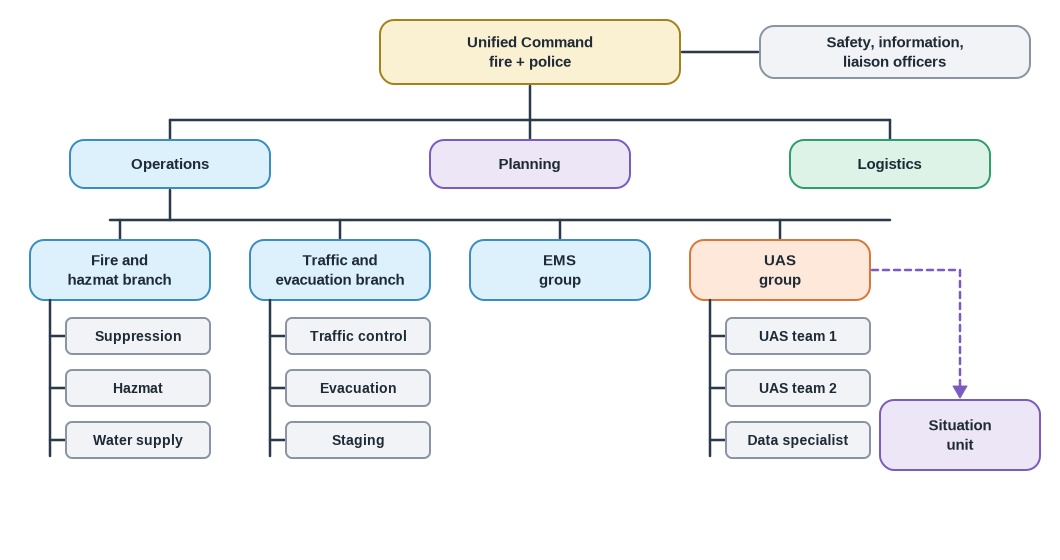
The unified command chart for the tanker incident in the first hour is shown below. The unit sets more than 1:7 as the point at which branches must be added (an assumed unit rule), with the NIMS ratio of 1:5 as the reference.
import hashlib
# span of control in the first organisation chart of the tanker incident (assumed)
OPTIMAL, LIMIT = 5, 7          # NIMS optimal ratio; upper limit chosen by the unit
org = {
    "Unified Command":    ["Safety Officer", "Public Information Officer", "Liaison Officer",
                           "Operations Section", "Planning Section", "Logistics Section"],
    "Operations Section": ["Fire Suppression Group", "Hazmat Group", "Traffic Control Group",
                           "EMS Group", "Evacuation Group", "UAS Group", "Staging Area", "Water Supply"],
    "Planning Section":   ["Situation Unit", "Resources Unit"],
    "UAS Group":          ["UAS Team 1", "UAS Team 2", "Data Specialist"],
}
for boss, subs in org.items():
    n = len(subs)
    note = "split: add branches" if n > LIMIT else "ok"
    print(f"{boss:<20} 1:{n} (optimal 1:{OPTIMAL}) -> {note}")
Unified Command 1:6 (optimal 1:5) -> ok
Operations Section 1:8 (optimal 1:5) -> split: add branches
Planning Section 1:2 (optimal 1:5) -> ok
UAS Group 1:3 (optimal 1:5) -> okThe Operations Section Chief has eight direct reports, too many to listen to and direct in time when the incident changes fast. The unified command therefore creates a fire and hazmat branch (suppression, hazmat, water supply), a police-led traffic and evacuation branch (traffic control, evacuation, staging), an EMS group and the UAS group, leaving the Operations Section Chief with four direct reports. The Planning Section at 1:2 is not a problem, because 1:5 is an optimum, not a minimum.
Receiving and prioritising mission requests
Unity of command means that the pilot takes tasks from the UAS group supervisor only. Other units that need information send a request through the agreed channel, and the group supervisor sets the order, not whoever shouts loudest.
FEMA’s ICS Resource Center publishes standard forms that can be adapted, such as ICS 213 General Message, ICS 205 Incident Radio Communications Plan, ICS 214 Activity Log and ICS 220 Air Operations Summary (Federal Emergency Management Agency, Emergency Management Institute, n.d.). The municipal team uses a drone mission request form with at least the requester and unit, the question to answer (which EEI), location, time needed, type of product, recipient and urgency. The supervisor reads every request back before accepting it.
Priority combines urgency (is it needed before the situation gets worse?) with impact (does it change a life-safety decision?) as . Ties go to the shorter task first, because that answers more requests sooner.
Example 2 Scheduling six requests for two flight teams
In the first five minutes the group supervisor receives six requests and rates urgency and impact from 1 to 3, the time needed and the latest useful start time (assumed values).
# ordering mission requests for two UAS teams: priority = urgency x impact (assumed)
req = [  # id, from, urgency 1-3, impact 1-3, minutes, latest start (min after now)
    ("R1", "Hazmat: read the UN number", 3, 3, 8, 10),
    ("R2", "IC: 360-degree overview", 3, 2, 6, 15),
    ("R3", "Traffic: queue length on the bypass", 2, 2, 10, 40),
    ("R4", "EMS: check the ditch for a second casualty", 3, 3, 5, 10),
    ("R5", "Planning: quick-look map", 1, 2, 12, 90),
    ("R6", "Hazmat: PID readings downwind", 2, 3, 15, 30),
]
order = sorted(req, key=lambda r: (-(r[2] * r[3]), r[4]))
free = {"Team 1": 0, "Team 2": 0}
for rid, what, u, i, dur, latest in order:
    team = min(free, key=free.get)
    start = free[team]
    free[team] = start + dur
    flag = "" if start <= latest else "  LATE"
    print(f"{rid} p{u * i} {team} {start:3d}-{start + dur:3d} min  {what}{flag}")
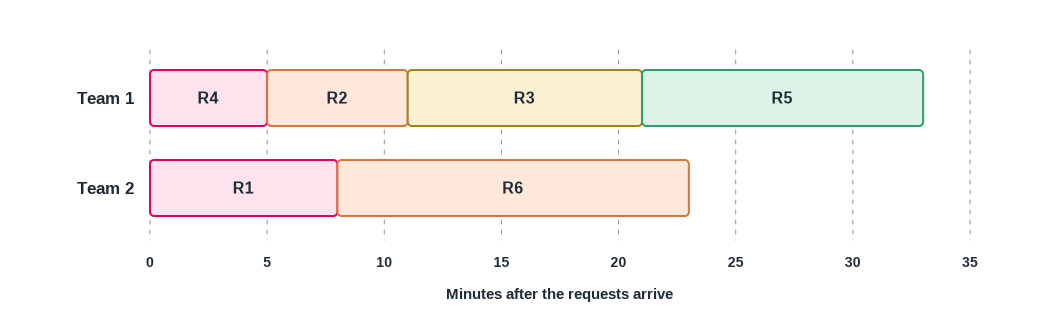
R4 p9 Team 1 0- 5 min EMS: check the ditch for a second casualty
R1 p9 Team 2 0- 8 min Hazmat: read the UN number
R2 p6 Team 1 5- 11 min IC: 360-degree overview
R6 p6 Team 2 8- 23 min Hazmat: PID readings downwind
R3 p4 Team 1 11- 21 min Traffic: queue length on the bypass
R5 p2 Team 1 21- 33 min Planning: quick-look mapThe two life-safety tasks start immediately and in parallel. Every task starts before its latest start time, so none is flagged LATE. The lowest-priority quick-look map arrives at minute 33, still in time for the first planning meeting. The supervisor tells every requester when to expect the product, so nobody comes to hurry the pilot directly.
Airspace and communications
Large incidents often bring other aircraft, such as a police helicopter or an air ambulance. The 2015 Ministry of Transport notification prohibits flying a drone close to a manned aircraft (Ministry of Transport, 2015). The team must therefore know in advance which aircraft will arrive and have a stop-flying procedure that everyone knows.
- Communications plan: list the drone group’s radio channel, the channel to Operations and the emergency channel, as on an ICS 205. The national plan also requires at least two communication systems.
- Stop-flying call: anyone who sees a manned aircraft approaching or another hazard may say “stop flying” at once. The pilot descends or lands and reads back.
- Pre-flight notification: if the area is under a specific notification, such as a temporary security no-fly area, the team must notify CAAT and any agency named in the notification before every flight (Module 5).
Data management
One night of operations produces a lot of imagery, much of it showing people, and part of it may become evidence. The team must therefore set up the data life cycle before an incident, not when someone asks for a clip.
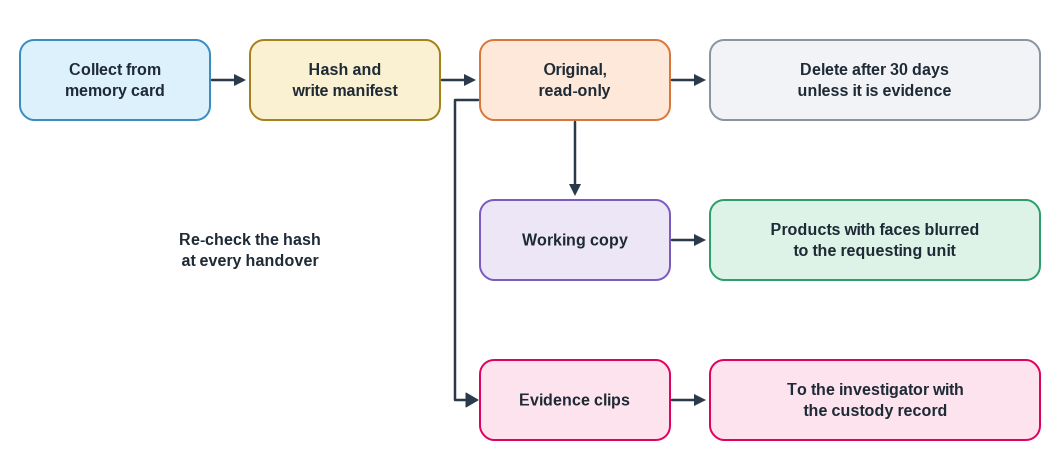
- Collect: copy from the memory card only with unit equipment, using one naming scheme such as incident code, date, sortie and camera.
- Hash immediately: NIST IR 8387 recommends hashing evidence as close to collection as possible and storing the hashes separately from the files in a secure location (Guttman et al., 2022). SHA-256 is specified in FIPS 180-4.
- Read-only originals: nobody edits an original; all work is done on copies.
- Working copies and products: products sent to units have uninvolved faces and number plates blurred and go only to units with a reason to use them.
- Retain and delete: imagery not related to any incident is deleted on schedule; evidence goes to the investigator with a custody record.
Section 37 of the Personal Data Protection Act 2019 requires a data controller to provide appropriate security measures and a system for deleting or destroying personal data after the retention period or when it is no longer necessary. Although section 4 exempts state agencies responsible for public safety from parts of the Act, the last paragraph of the same section still requires those agencies to secure personal data to the standard (Personal Data Protection Act, 2019). The legal bases and ethics of using imagery are covered in Module 5.
Example 3 Storage for one festival night
The drone records to its card at far higher bit rates than the live stream: 40 Mb/s for the EO camera and 8 Mb/s for the thermal camera, 5.5 hours in total across all sorties, plus 70 map photos of 9 MB each. Unit policy keeps routine footage for 30 days, and about 4% is expected to be incident-related clips (assumed values).
# storage for one festival night and the retention policy (assumed)
eo, ir = 40, 8                        # Mb/s recorded on board
hours = 5.5                           # h of recording across all sorties
gb = (eo + ir) * 1e6 * hours * 3600 / 8 / 1e9
photos = 70 * 9.0 / 1000              # GB, quick-look map photos of 9 MB each
print(f"video {gb:.1f} GB + photos {photos:.2f} GB per night")
keep_days, incident_share = 30, 0.04  # routine footage kept 30 days; 4 % becomes incident evidence
print(f"routine footage deleted after {keep_days} days: {gb * (1 - incident_share):.1f} GB")
print(f"incident clips kept with the case file: {gb * incident_share:.1f} GB")
video 118.8 GB + photos 0.63 GB per night
routine footage deleted after 30 days: 114.0 GB
incident clips kept with the case file: 4.8 GBOne night yields almost 120 GB, nearly all of it footage of ordinary people unrelated to any incident. Scheduled deletion is therefore not just about saving space; it reduces the risk of a large personal-data leak. The 4.8 GB of incident clips must be stored separately with their hashes and custody record.
Hashes and the chain of custody
A hash is like a fingerprint of a file. The same file always gives the same value, but a change of even one bit changes the value completely. NIST IR 8387 lists weaknesses in the chain of custody, such as evidence changed before it is hashed, evidence changed and re-hashed with the stored hash overwritten, or accidental changes. Hashes should therefore be computed at collection and kept where the file’s custodian cannot change them.
A chain-of-custody record shows who held which file, when, for what purpose and to whom it was passed. At every handover the receiver recomputes the hash and compares it with the manifest. If it does not match, stop, record it and keep both files for examination; never edit the manifest to make it match.
Example 4 SHA-256 manifest and the check at handover
The data manager writes the manifest for sortie 4 right after landing. On the way, someone opens the placard photo and accidentally saves over it. This example uses short byte strings in place of real files.
# SHA-256 manifest written at collection, checked again at handover
files = {"DJI_0412.MP4": b"video bytes of sortie 4", "DJI_0413.JPG": b"photo of plate UN1294",
         "flightlog_04.csv": b"t,lat,lon,alt\n0,13.0,101.0,40\n"}
manifest = {n: hashlib.sha256(b).hexdigest() for n, b in files.items()}
for n, h in manifest.items():
    print(f"{n:<17} {h[:16]}...")
received = dict(files)
received["DJI_0413.JPG"] = b"photo of plate UN1203"          # one character changed
for n, b in received.items():
    ok = hashlib.sha256(b).hexdigest() == manifest[n]
    print(f"{n:<17} {'match' if ok else 'MISMATCH: stop and record'}")
DJI_0412.MP4 24909daac8b64f78...
DJI_0413.JPG e6cae33c158c43fa...
flightlog_04.csv b80d0642828d972a...
DJI_0412.MP4 match
DJI_0413.JPG MISMATCH: stop and record
flightlog_04.csv matchA single changed character breaks the hash. The receiver refuses that file as evidence, records the event in the custody record and requests a fresh copy from the original. Remember that a matching hash only shows the file has not changed since the manifest was made. It does not prove where or when the image was taken or that it was lawfully obtained; that needs the metadata, flight logs and custody record together.
Sent, received, acknowledged: the receiver checks before accepting
A matching hash says the file did not change. It does not say that the mission request has reached the person who must act on it. Data exchange between units has at least three events that must be kept apart, each with its own time. Sent means the sender released the message. Received means that revision reached the recipient. Acknowledged means the responsible recipient answered that the request is understood and accepted within the scope asked. An online icon, a count of bytes sent or an automatic reply from an app is not a person’s acknowledgement. While there is no answer, keep the status “awaiting acknowledgement” and do not close the request.
The receiver should check each message in an order agreed before the mission. The example below uses teaching rules (every value is assumed and is not a radio or flight requirement): recipient, plan revision, a creation time that is not in the future, age against the permitted lifetime, then duplicate identifiers, and the link state last.
Example 5 A receiver for mission requests and a three-state log
The base message was created at second 10 and may live for 30 seconds. Eight cases are tested, then the log of two messages is read: one acknowledged, one sent but still silent.
# receiver check for mission messages, and the delivery ladder (teaching rules; all values assumed)
ME, PLAN = "UAS-GROUP", "PLAN-1"
accepted = {}
def receive(m, now, connected=True):
    if m["to"] != ME:
        return "wrong_recipient"
    if m["plan"] != PLAN:
        return "stale_plan"
    if m["created"] > now:
        return "future_timestamp"
    if now - m["created"] >= m["ttl"]:                 # age equal to the lifetime is already expired
        return "expired"
    if m["id"] in accepted:
        return "duplicate_ignored" if accepted[m["id"]] == m else "id_conflict"
    if not connected:
        return "queued_offline"
    accepted[m["id"]] = m
    return "accepted"
base = dict(id="M1", to=ME, plan=PLAN, created=10, ttl=30, text="request: ditch check")
cases = [("normal", base, 20, True), ("same message again", dict(base), 21, True),
         ("same id, new text", dict(base, text="request: plate check"), 22, True),
         ("age equals lifetime", dict(base, id="M2"), 40, True), ("wrong recipient", dict(base, id="M3", to="TRAFFIC"), 20, True),
         ("old plan", dict(base, id="M4", plan="PLAN-0"), 20, True), ("created in the future", dict(base, id="M5", created=30), 20, True),
         ("no link", dict(base, id="M6"), 20, False)]
for name, m, now, up in cases:
    print(f"{name:<22} age {now - m['created']:3d} s  -> {receive(m, now, up)}")
log = {"M1": {"sent": 12, "received": 14, "acknowledged": 19}, "M6": {"sent": 12}}
for mid, ev in log.items():
    state = max(ev, key=ev.get) if "acknowledged" not in ev else "acknowledged"
    wait = ev["acknowledged"] - ev["sent"] if "acknowledged" in ev else None
    print(f"{mid}: last state {state}" + (f", sent to acknowledged {wait} s" if wait is not None else ", still waiting: do not close the request"))
normal age 10 s -> accepted
same message again age 11 s -> duplicate_ignored
same id, new text age 12 s -> id_conflict
age equals lifetime age 30 s -> expired
wrong recipient age 10 s -> wrong_recipient
old plan age 10 s -> stale_plan
created in the future age -10 s -> future_timestamp
no link age 10 s -> queued_offline
M1: last state acknowledged, sent to acknowledged 7 s
M6: last state sent, still waiting: do not close the requestAn age exactly equal to the lifetime counts as expired, by the rule set above. A repeated identifier has two forms: if every field is the same, ignore it openly; if the identifier is the same but the content differs, keep the original and report the conflict instead of overwriting. Without a link the message is not “received” but “waiting to send”. M1 took 7 seconds from sent to acknowledged, while M6 is still silent and needs an owner to chase it. This checker confirms only form, time and plan revision. It does not confirm that the sender may task the group or that the content is true.
Module lab
Lab: tabletop incident command and data handover
- Organise. The class takes roles from role cards: unified commanders from fire and police, section chiefs, the UAS group supervisor, flight teams, the data manager and requesters from other units. Draw the chart and check the span of control with the code in Example 1.
- Receive requests. The instructor sends requests at intervals, both on the form and verbally by skipping the chain. The team must read back, prioritise with the code in Example 2 and report expected delivery times.
- Field. Fly two of the requests on a closed field within visual line of sight under CAAT conditions. Practise the “stop flying” call when the instructor announces a simulated helicopter.
- Data handover. Copy the files from the card, build a SHA-256 manifest with
hashlib, write a custody record and pass the files to another team to check without explaining the steps. The other team must detect the one file the instructor secretly altered. - Write an ICS 214-style activity log for the drone group and summarise which requests skipped the chain and how it was handled.
Common mistakes
Watch out
- The pilot takes orders from several people instead of only through the group supervisor.
- Prioritising by the requester’s voice or rank instead of urgency and impact on life safety.
- Not telling requesters when to expect products, so they come and hurry the pilot at the screen.
- Sending clips to private chat groups or posting screenshots, leaking personal data and weakening evidence.
- Hashing after files have been edited, or storing hashes in the same place as the files.
- Believing that a matching hash means the image is true.
Summary
- ICS under the national plan uses management by objectives, an incident action plan, a flexible structure, unity of command and unified command. The drone team is a group under Operations and delivers products to the situation unit of Planning.
- The optimal span of control is 1:5; when a supervisor has too many direct reports, add branches.
- Mission requests go through the group supervisor and are prioritised with , shorter tasks first on ties, with expected delivery times reported back.
- The data life cycle is: collect, hash at once, read-only originals, work on copies, blur before sharing, then delete or hand over as evidence, as section 37 of the PDPA requires.
- SHA-256 hashes and a custody record show that a file has not changed, not that its content is true.
Self-check questions
- The Operations Section Chief has nine direct reports. What should be done, and how many branches are needed at least if each branch has no more than five units?
- Request A has urgency 3, impact 2 and takes 10 minutes; request B has urgency 2, impact 3 and takes 4 minutes. With one flight team, which goes first?
- Video is recorded at a combined 30 Mb/s for 4 hours. How many GB is that?
- A clip’s SHA-256 hash matches the manifest. What does this show, and what does it not show?
- Why should the drone pilot take tasks only from the group supervisor, even when the requester is a senior officer?
Answers
- Split into branches or groups, each with its own supervisor. With no more than five units per branch, at least branches are needed.
- and are equal, so the shorter task, B (4 minutes), goes first, then A.
- bytes, or 54 GB.
- It shows the file has not changed by even one bit since the manifest was made. It does not show where, when or by whom the image was taken, whether it reflects reality or whether it was lawfully obtained, and if someone altered both the file and the manifest, the values could still match.
- For unity of command. Orders from several directions conflict and push life-safety tasks aside. The supervisor sees all requests and can prioritise by urgency and impact, leaving the pilot free to concentrate on flying safely.
Key formulas
| Span of control | |
| Request priority | |
| Video data volume |
Key references
- กรมป้องกันและบรรเทาสาธารณภัย. (2564). แผนการป้องกันและบรรเทาสาธารณภัยแห่งชาติ พ.ศ. 2564–2570. กระทรวงมหาดไทย. link
- Federal Emergency Management Agency. (2017). National incident management system (3rd ed.). U.S. Department of Homeland Security. link
- Federal Emergency Management Agency, Emergency Management Institute. (n.d.). ICS forms. ICS Resource Center. link
- Guttman, B., White, D. R., & Walraven, T. (2022). Digital evidence preservation: Considerations for evidence handlers (NIST IR 8387). National Institute of Standards and Technology. link
- National Institute of Standards and Technology. (2015). Secure hash standard (SHS) (FIPS 180-4). link
- พระราชบัญญัติคุ้มครองข้อมูลส่วนบุคคล พ.ศ. 2562. ราชกิจจานุเบกษา, 136(69 ก), 52–95. link
- กระทรวงคมนาคม. (2558). ประกาศกระทรวงคมนาคม เรื่อง หลักเกณฑ์การขออนุญาตและเงื่อนไขในการบังคับหรือปล่อยอากาศยานซึ่งไม่มีนักบิน ประเภทอากาศยานที่ควบคุมการบินจากภายนอก พ.ศ. 2558. ราชกิจจานุเบกษา, 132(86 ง), 6–12. link
Further reading
Study the assigned knowledge units in advance, review media and take the module quiz
Forming the team and incident-coordination SOPs
Preserving evidence and handing over data
Originals, hashes and traceable reports
M10 Communications: from sending data to evidence the receiver can use
C02 Search data kit: figures that are on time, but can the receiver use them yet
In class / field
Lab or field practice from worksheets with a safety checklist
Learning evidence: Checked worksheets and quiz results