C02 Search data kit: figures that are on time, but can the receiver use them yet
Calculate serialization time while checking offline status, plan version and TTL, without claiming delivery to people, together with KSEC criteria and a B/O/D practice set.
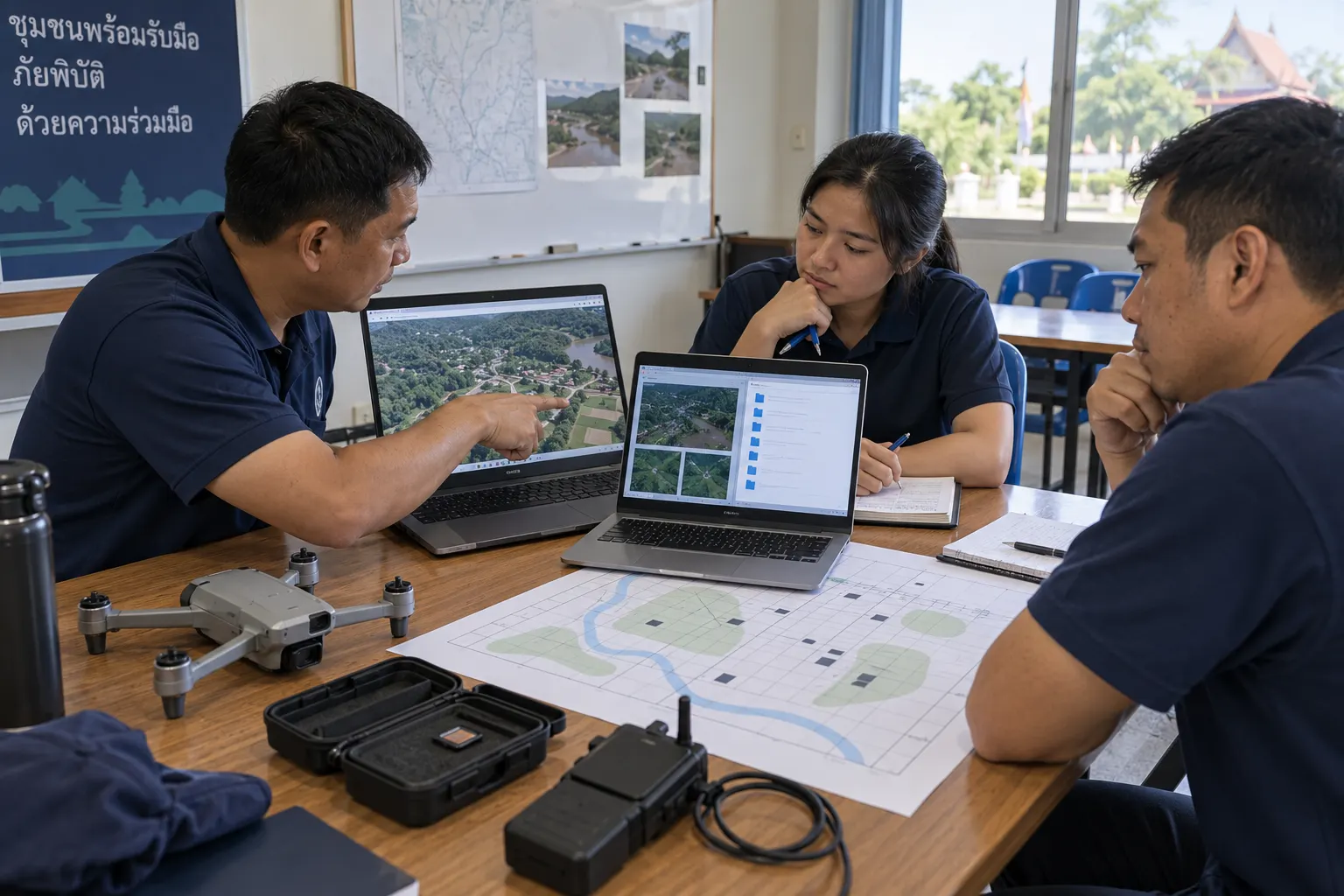
Start from the result the recipient needs
The search coordinator needs data of the version that matches the plan and has not expired, with enough detail to arrange follow-up checks. Reducing the data size reduces the time in the formula, but the recipient may lose context needed for the search, so the minimum meaningful data and the method of review with the recipient must be agreed before choosing the data package. Acceptance by the program and receipt by a person are different levels of evidence.
Choose B Read the task and choose the kit, O Plan resources or D Check the change and the evidence . All three use the same case; you can also read the foundations in M07 Search and M10 Communications alongside.
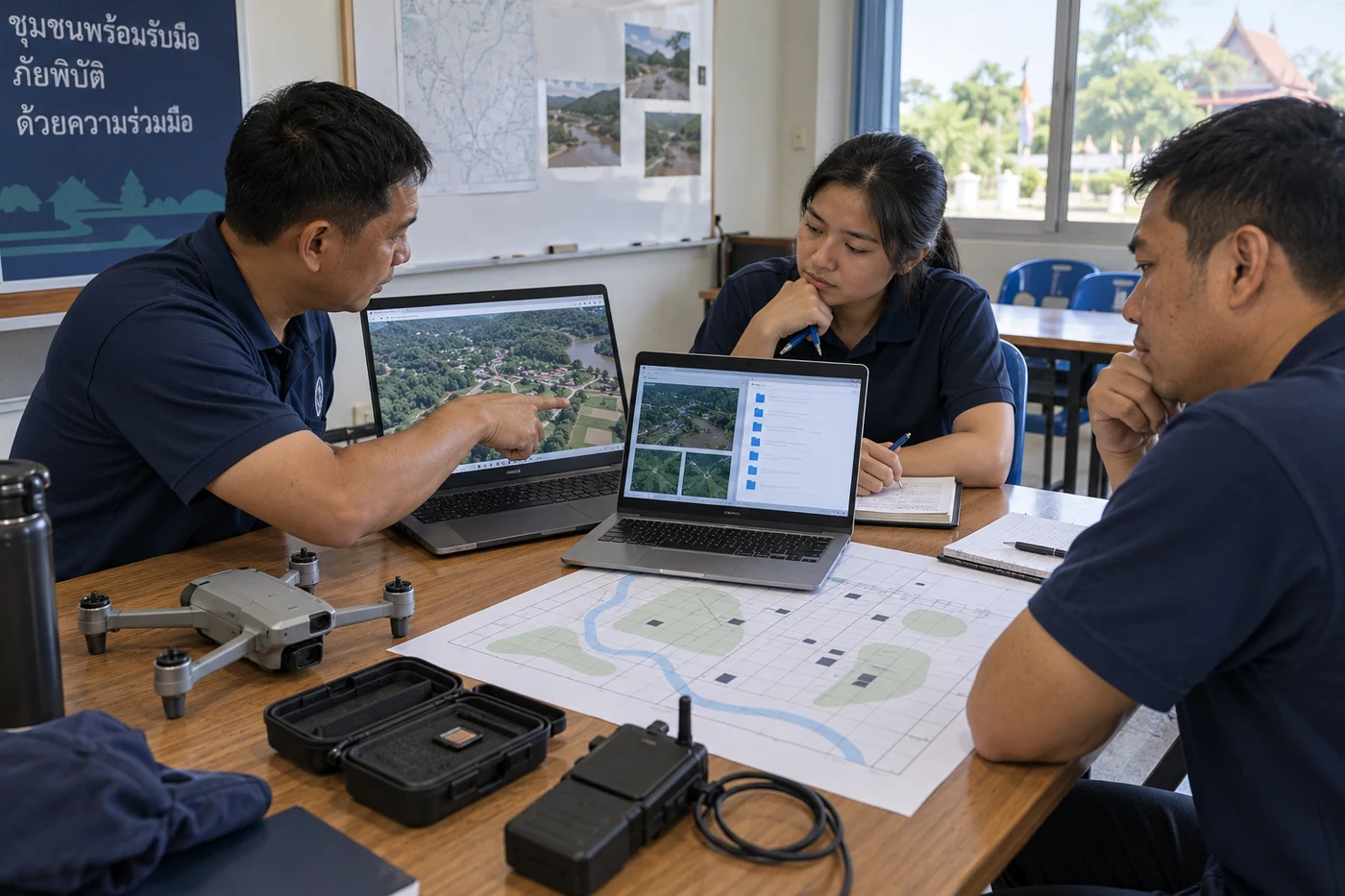
AI image to explain the context only; it is not the equipment used in the fixture or evidence of compatibility. Open the full-size context image
Baseline, change, and what the formula can tell
Every parameter is synthetic data, version p4-toy-1, using an assumed bitrate of 256000 bit/s and an ideal serialization time = bytes × 8 ÷ bitrate. DATA01, of size 2 MiB (2097152 bytes), gives 65.536 s . Since the data is already 10 s old, its age on reaching the destination is 75.536 s , which exceeds the deadline_age of 30 s but is still below the TTL of 120 s, so deadline_missed is expected.
DATA02 assumes the data is reduced to 128 KiB (131072 bytes), giving 4.096 s and an age of 14.096 s , so it is numeric_fit by the model only; this does not prove that the detail retains the same meaning. DATA03 offline must be held even though the nominal timing is the same. DATA04 uses PLAN0 instead of PLAN1 and must be stale_plan. DATA05 starts at an age of 26 s with 128000 bytes taking 4 s, reaching an age of 30 s, equal to TTL 30 , and must be expired; being equal to the deadline may still be in time, but being equal to the TTL means it has expired.
DATA06 has a null bitrate and must be unknown; do not guess that it is fast enough. DATA07 restores the baseline parameters of DATA01. The decision order is unknown → offline_hold → stale_plan → expired → deadline_missed → numeric_fit. Every row is an independent case, not a queue or a real connection. The formula excludes queueing overhead, retries, processing and human review time, so it does not replace a measured latency.
Source and version of every parameter value: the author composed them for teaching on 12 October 2026 (B.E. 2569) in fixture.json version p4-toy-1 . There are no parameters from a manufacturer. The figures and expected results in this chapter are explanatory calculations, not results from a program that has been run.
The interface ledger and the resources that still need to be requested
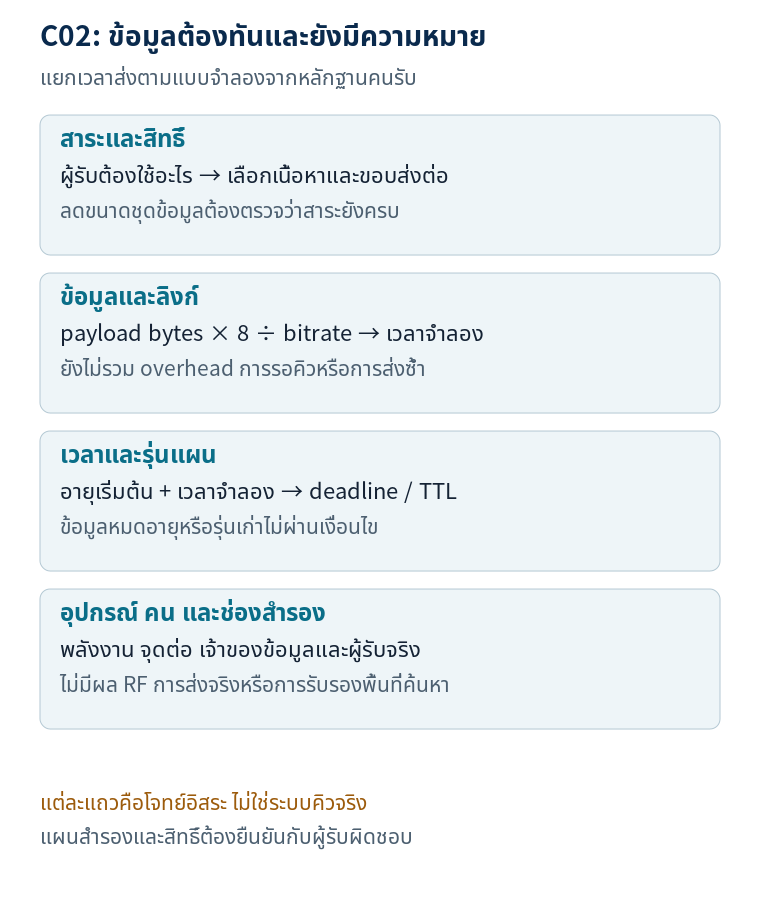
Open the full-size interface diagram
Scroll the table horizontally to see every column. When the table has keyboard focus, use the left or right arrow keys
| Aspect/resource | Baseline data → proposal | Source/unknowns | Role and check |
|---|---|---|---|
| mechanical: mount/antenna enclosure | unknown → unknown | No hardware yet | D: request the manual before considering a real kit |
| electrical: power/connector | unknown → unknown | No hardware yet | D: do not experiment further from this figure |
| data: payload/plan | 2097152 bytes;PLAN1 → 131072 bytes;PLAN1 | authored p4-toy-1 DATA01/DATA02 | B: the recipient reviews the detail that is still needed |
| time: age/rate/deadline/TTL | 10;256000;30;120 → 10;256000;30;120 | authored p4-toy-1 seconds bits/s | D: review DATA05 equality and DATA06 unknown |
| connection: connected/receiver | true;receiver unknown → true;receiver unknown | authored boolean; NOT_CONFIRMED receiver | O: review DATA03 and request evidence from the real recipient |
| mass_cg: total mass/CG | unknown → unknown | No real kit | D: request the complete list and the version boundary |
| energy: power/battery | unknown → unknown | No measurement | O: request a budget and a backup plan |
| constraints: permissions/search QC | unknown → unknown | NOT_CONFIRMED / NOT_RUN | O: the authority reviews the plan and the disclosure boundary |
B/O/D in the table are the proposed owners of the practice work; no real person has yet been assigned, owner_status=not_assigned. A value that is unknown is not zero; the model manual, measurement evidence, inspection method or permission confirmation must be requested from the responsible party before deciding on a real kit. There is no radio signal, real network, person's coordinates, search finding, recipient confirmation or area marked clear; receipt NOT_CONFIRMED.
Predict before running, then check the evidence before concluding
Scroll the table horizontally to see every column. When the table has keyboard focus, use the left or right arrow keys
| Case | disposition expected before the run | metrics expected |
|---|---|---|
| DATA01 | deadline_missed | {"serialization_s":65.536,"arrival_age_s":75.536} |
| DATA02 | numeric_fit | {"serialization_s":4.096,"arrival_age_s":14.096} |
| DATA03 | offline_hold | {"serialization_s":4.096,"arrival_age_s":14.096} |
| DATA04 | stale_plan | {"serialization_s":4.096,"arrival_age_s":14.096} |
| DATA05 | expired | {"serialization_s":4,"arrival_age_s":30} |
| DATA06 | unknown | {"serialization_s":null,"arrival_age_s":null} |
| DATA07 | deadline_missed | {"serialization_s":65.536,"arrival_age_s":75.536} |
Boundaries to understand: arrival_age = deadline_age is still in time if the earlier conditions pass; arrival_age >= TTL is expired; a 0 bitrate is rejected; a null bitrate is unknown. These boundaries are teaching rules, not an operating envelope. Read the C02 test plan and the complete lab contract before using the program.
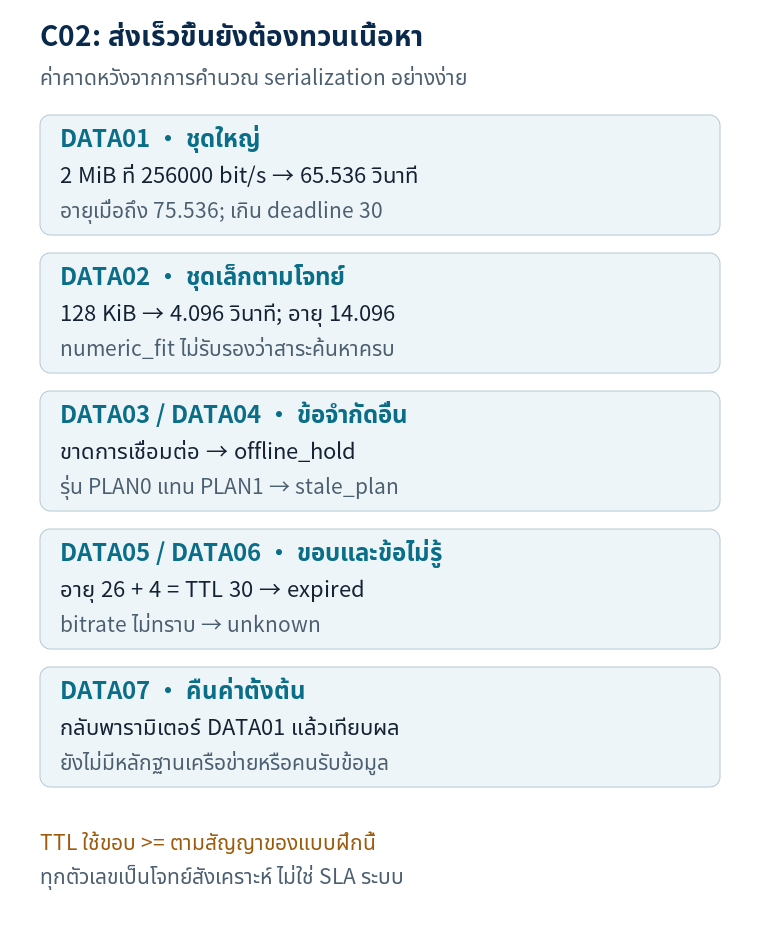
Open the full-size evidence diagram
- Keep the baseline requirements, fixture and script, with versions and SHA-256, before editing. The hash is used to compare bytes and does not confirm the identity of the author.
- Record the expected results and the reason for choosing the change before running. Keep the raw stdout, the command, the time, the Python version and the exit code of your own work.
- Compare the disposition and metrics of every case with expected; distinguish errors in the formula from errors in the input. Do not edit expected merely to make it match the actual result.
- Re-run the same input and compare the output bytes; then restore a copy of the baseline fixture, compare the hash and run again. Check the baseline/rollback pair without counting case_id.
- Keep v0/v1 under the same outcome ID, with the review comments, replies, reasons for changes and retest. If not yet run, set actual=NOT_RUN and do not fill expected values into results.csv.
Author evidence: host_calculation The author ran Python 3.14.3 on 12 October 2026 at 16:20:43 UTC; it matched expected in all 17 cases, re-running gave the same output bytes, and all three baseline-restore pairs matched. Read the raw results, the host record and hashes and this case's results . The author's results are in the host record; for content status and open items, see the overview page . For hardware/flight/RF/field the status is NOT_RUN; permissions/receiver=NOT_CONFIRMED; learner=NOT_RUN. Passing numeric_fit does not certify safety, legality, accuracy or detection. The author's results are not evidence that learners can do it.
Do the work for your role and review KSEC
K = Knowledge, S = Skills, E = Ethics, C = Character. Record the status of each ID as NOT_RUN before starting, then use meets / needs_revision / insufficient_evidence with reasons and real evidence. The pass criteria require a work product that matches the code and can be checked; a missing Ethics/Character result is not offset by averaging with calculated scores. Learners must resubmit under the same ID when the evidence is insufficient.
B: Beginner
K baseline: can tell UAV from UAS and identify the recipient of the results; review the fundamentals then name one person, one piece of equipment and one data item S baseline: can read units and separate observations from conclusions; review observation then write what is known and what is still pending
Baseline check before starting: write one K baseline answer and one S baseline example. If you cannot yet do so, read the links to fill in the baseline, then submit new answers before doing the work for this role.
Make a one-page brief: the recipient, the question and the deliverable; compare the baseline with the proposal using the same criteria, and explain which numerical results help the recipient's work and which do not yet. Use the same C02 case; do not change the task in order to pass without recording it. Correct the statement “numeric_fit therefore means it reached the team and the whole search area”, while limiting personal data to what is necessary.
Scroll the table horizontally to see every column. When the table has keyboard focus, use the left or right arrow keys
| Outcome code | KSEC | Checks and evidence that must be seen | Before/after work product |
|---|---|---|---|
| APP-C02-B-K01 | Knowledge | Explain the recipient's task and the reasons for choosing the baseline/proposal, with at least two limitations of the model | B-K-v0 → B-K-v1 under the same ID |
| APP-C02-B-S01 | Skills | Calculate the main example with units, then choose the proposal or hold, citing the case_id and complete criteria | B-S-v0 → B-S-v1 under the same ID |
| APP-C02-B-E01 | Ethics | Correct claims that exceed the evidence in the specific case, and identify the data or permissions that still need to be requested | B-E-v0 → B-E-v1 under the same ID |
| APP-C02-B-C01 | Character | Keep brief v0/v1, review comments, replies, reasons for changes, the responsible parties to be assigned and the conditions for review | B-C-v0 → B-C-v1 under the same ID |
O: Operator/Planner
K baseline: know the role of the recipient and the decision-maker who halts the work; review mission brief then identify your duties in this case S baseline: can produce a requested/confirmed ledger; review kit and resource selection then write one resource request
Baseline check before starting: write one K baseline answer and one S baseline example. If you cannot yet do so, read the links to fill in the baseline, then submit new answers before doing the work for this role.
Make a resource plan: people/skills, time, tools, storage, power, budget, permissions and backup plan. Tie each request to the person who confirms it, the acknowledgement evidence, the open items and the deliverable the recipient needs. Use the same C02 case; do not change the task in order to pass without recording it. The field for the real operator's name remains not_assigned; do not treat a role name as confirmed.
Scroll the table horizontally to see every column. When the table has keyboard focus, use the left or right arrow keys
| Outcome code | KSEC | Checks and evidence that must be seen | Before/after work product |
|---|---|---|---|
| APP-C02-O-K01 | Knowledge | Explain the impact of the change on time, data, energy and the recipient, separating synthetic data from real resources | O-K-v0 → O-K-v1 under the same ID |
| APP-C02-O-S01 | Skills | Complete the interface ledger and the resource plan, including the responsible persons in each role, requested/confirmed, hold points and backup methods | O-S-v0 → O-S-v1 under the same ID |
| APP-C02-O-E01 | Ethics | Hold work whose permissions/compatibility/recipient are not yet confirmed, and do not turn numeric_fit into permission to operate | O-E-v0 → O-E-v1 under the same ID |
| APP-C02-O-C01 | Character | Keep plan v0/v1, reasons for changes, comments and replies, together with a list of notifications to users of the old version and the persons responsible for open items | O-C-v0 → O-C-v1 under the same ID |
D: Developer/Customizer
K baseline: know how systems connect and the effects of changing components; review integration then link the change to the interfaces on both sides S baseline: can separate expected/actual and make a copy of the baseline; review testing then write one case with actual NOT_RUN before experimenting
Baseline check before starting: write one K baseline answer and one S baseline example. If you cannot yet do so, read the links to fill in the baseline, then submit new answers before doing the work for this role.
Check the contract and interfaces, record expected before running, keep the version/hash/script/fixture/raw results, check every scenario in the case and replay from the same input; then restore a copy of the baseline and compare the results. Keep a discrepancy log and a separate hardware-check plan. Use the same C02 case; do not change the task in order to pass without recording it. The author's host results are an example of evidence, not a learner's work; learners must run and record their own work before their skills can be assessed.
Scroll the table horizontally to see every column. When the table has keyboard focus, use the left or right arrow keys
| Outcome code | KSEC | Checks and evidence that must be seen | Before/after work product |
|---|---|---|---|
| APP-C02-D-K01 | Knowledge | Explain the formula, the boundaries, the meaning of null and the changed interface, without citing results from rounding of numbers | D-K-v0 → D-K-v1 under the same ID |
| APP-C02-D-S01 | Skills | Show expected/actual separately with source/input hashes, time, command, exit code and the replay/rollback results, or keep NOT_RUN if not yet run | D-S-v0 → D-S-v1 under the same ID |
| APP-C02-D-E01 | Ethics | Disclose limitations, do not fabricate actual/learner/hardware results, and reject an incorrect fixture instead of filling in missing values | D-E-v0 → D-E-v1 under the same ID |
| APP-C02-D-C01 | Character | Keep change-record v0/v1, review comments, replies, reasons for changes, retest results and baseline-restore evidence under the same outcome ID | D-C-v0 → D-C-v1 under the same ID |
CLO/PLO are still left blank, pending_design. Use the curriculum mapping and KSEC record to link evidence; the existence of codes does not certify the curriculum.
Downloads and next steps
- Requirements and the 12-code rubric
- The interfaces.csv ledger
- Change record and baseline restore
- Test plan with expected results
- Actual results (results.csv)
- Usage steps (readme)
Use calculator.py, fixture.json, expected.csv and the lab readme together. The program calculates locally only; no additional runtime is added to the website.
Start from the requirements for your own role and fill in the unknowns in interfaces before running. Return to M07 Search and M10 Communications to review the delivery of results to the recipient. The P3 criteria are still pending_field_review; specialist=not_assigned. P5 only prepares a trial set; there are no real learners yet and no results are filled in on their behalf. CPX-Sim remains on hold.