M07 Search support: from the task scope to the points that need follow-up
Choose methods and resources to support a search, separating outstanding areas, suspicious points, the review queue and confirmed results, with KSEC and worksheets for three roles
What decision does the recipient need the data for?
The responsible search coordinator needs the scope that cannot yet be answered and the points that should be checked next, with provenance, time, verifiable position, and the requested work Drone data helps propose options and arrange follow-up work. Confirming people, access to the area and rescue decisions must go through the processes of the responsible parties; thermal colours, AI flags or a recipient's name are not used in place of a confirmed result.
Choose B Beginner to write a brief and compare options, O Operator/planner to arrange people, resources, sectors, queue and handover, or D Developer/tuner to propose requirements and a test plan. All three use TRAIN-SAR-01, authored by the author. There are no original images, real coordinates, flight routes, flight results, ground results, AI/validator results or real learner results.
Before studying, you should be able to distinguish the whole UAS, payload, observations versus conclusions and time/position . The worksheets are done at a desk with text and CSV, so no drone is needed. This readiness to learn is separate from the people, real kit, site conditions, weather, link, rights and permissions of a real mission.
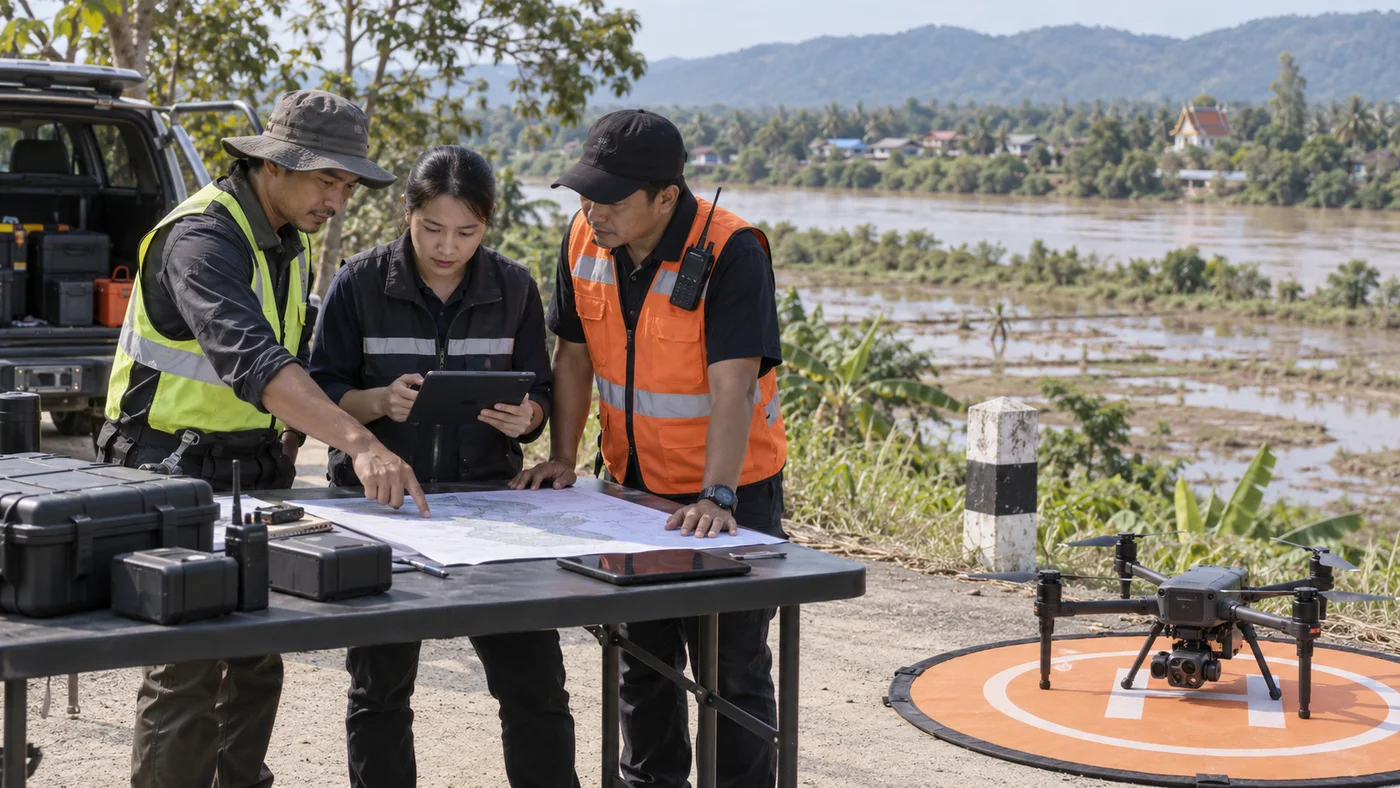
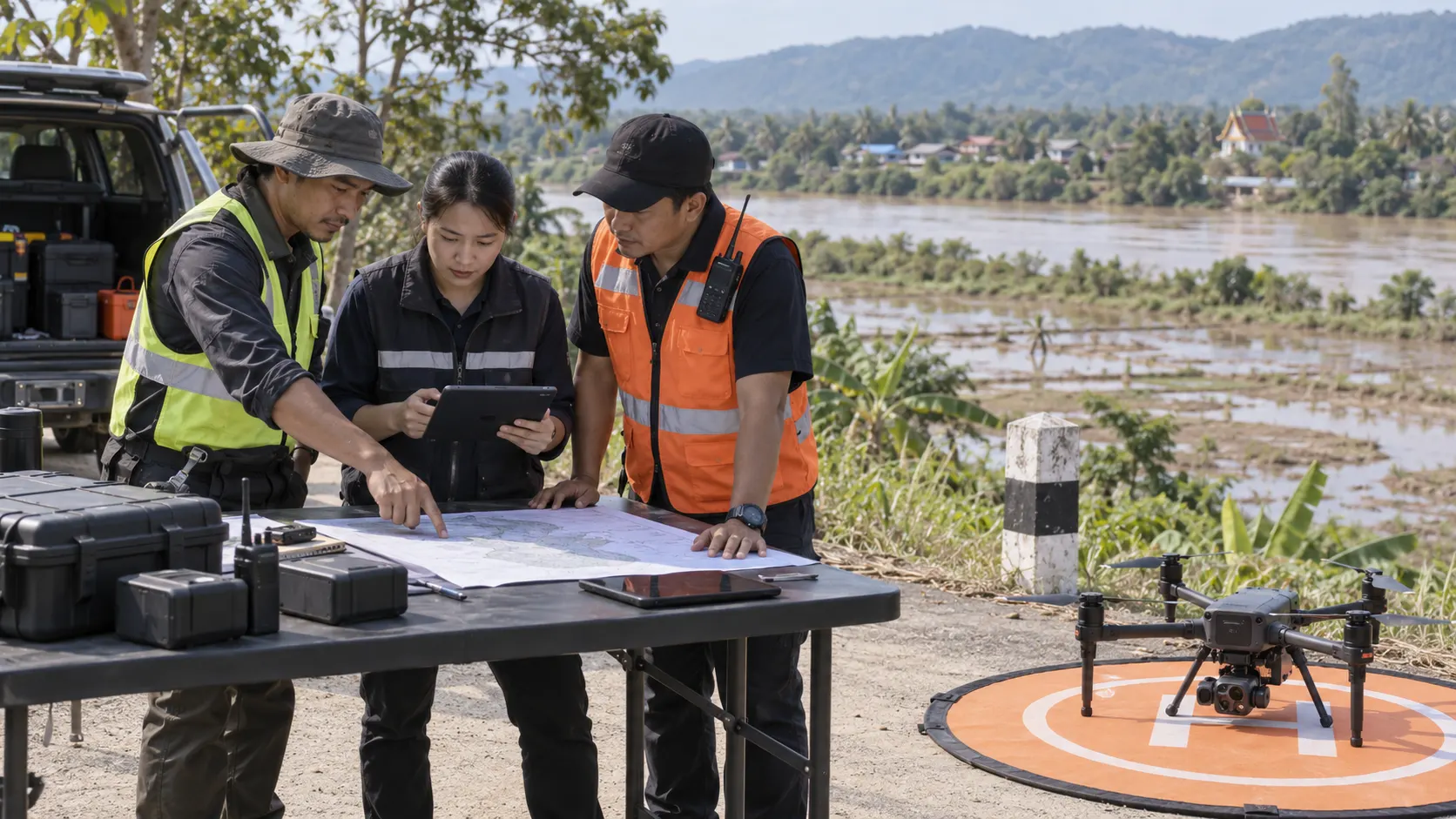
Image created with AI to explain the context; it is not TRAIN-SAR-01 or the original images of S01–S06 Open the full-size context image
Define the request, scope and priority before choosing tools
Agree on the recipient's responsibility, question, area scope, time period and the snapshot used as reference. State who sets the search priority and takes over the work. Existing data from authorised parties, the area context and access restrictions are things to request; do not assume that because an aircraft is ready it should fly immediately. If new data still cannot answer the question, have the recipient review the priority/method rather than merely adding more images.
Separate search-support which sends observations and outstanding items, from rescue decision which requires a responsible person, confirming evidence and ground methods suited to the incident. If obscuring parts or the kit do not support the question, choose existing data, a ground check where permitted, a team with a suitable method, or keep the item on hold/unknown, without prescribing hazardous access methods in place of the responsible agency.
Compare aircraft, sensors and methods against the same criteria
A multirotor is an option when the task needs the viewing angle changed or the target part re-checked, and the area/real kit supports it. A fixed-wing may suit a wide work boundary where the collection and take-off/landing methods meet the task. A VTOL may suit cases in which both vertical take-off/landing and a wide work pattern are justified, provided that mode transitions and the real model's manual are checked. Flight range, endurance or detection range are not ranked as generic platform values.
RGB gives visible context, while thermal adds heat-signal information that must be reviewed together with the context. DJI's solution example describes using the camera together with sending positions to the team, but this is the manufacturer's description, not an independent result for our kit, so it is used as a source of questions for checking compatibility, people and communications, and product figures are not used as evidence of readiness for the job.
Scroll the table horizontally to see every column. When the table has keyboard focus, use the left or right arrow keys.
| Shared criteria | A: RGB + ground methods where permitted | B: A + thermal when the kit, people and methods support it |
|---|---|---|
| Coverage and obscured parts | Record the parts seen, the angles, the time and the parts not seen; a large number of images does not equal coverage | Adding thermal does not open up the parts behind obstructions; keep the existing registry/unknown |
| Endurance and work cycles | Check the real kit: payload, battery, charging/spares, work cycles and manual limitations | Check the effect of the camera/mounting kit/power/mass/CG on real work cycles; do not use generic values |
| Data conditions | Light, sharpness, angle, contrast, weather and access must answer the question | Add thermal conditions according to the manual and the context; warm objects/reflections may need review |
| Operator and review burden | The collector, the image/position reviewer, the queue manager and the recipient must have duties | More data and interpretation work require users/reviewers suited to the method; do not assume it makes the queue faster |
| Link and recipient | Check that files arrive, the time, a backup channel and read-back of the task | Check the added data formats, syncing and sending burden; receiving a file is not accepting the task or confirming a person |
| Whole-life cost | Aircraft, camera, battery, charging/repair, people, ground, QA, software/license/storage, and handover until the data is usable | Total cost of A plus the mounting kit, thermal training/maintenance review, and time; do not fabricate prices |
| Limits and fallback | Obscured parts / inaccessible / insufficient data: let the recipient choose a ground method, existing data or hold | If additional people, methods, manuals or resources are not yet confirmed, use a supported alternative or keep on hold |
FLIR explains the limitations of walls, glass and trees Thermal cameras cannot see through walls or trunks, and glass/reflections can make what is read differ from what lies behind the surface. Not seeing a signal in an obscured part is therefore not a confirmed result of no one being there. The abstract of the AOS paper in Nature identifies the problem of occlusion in forests and studies combining images from multiple angles. We read only the abstract, do not cite the method/results of the full paper, and the learners' kit does not include an AOS system.
People, resources and requests for mutual aid must have evidence
The plan must have the request recipient/coordinator, the owner of the area and the data, the person responsible for flying, pilots and assistants according to the plan, the image/position reviewer, the queue manager, the ground verifier and the custodian. Separate roles from names that are not yet confirmed. Check the aircraft/payload, battery/charging, ground equipment, redundant link/backup channel, take-off/landing area, weather and resources so that the work reaches a result the recipient can use.
For mutual aid, record what was requested, the requester, the resource owner, the person with authority to confirm, the acknowledgement evidence, the time limit and the conditions. A request is not an acceptance. If it is not yet confirmed, keep it pending and hold the work that depends on that resource, with the work owner who follows up and the alternatives; do not change a name in the plan to available yourself. Read the baseline aviation law then have the responsible person check the area rights, airspace, permissions and requirements of the actual day/job before operating.
If modifying the kit or adding a camera, check the compatible mount/interfaces, power, mass/CG, trigger/time sync, the position-identification method and error, the file format/software, and the real model's manual. Keep the baseline/config before changing. Define a controlled reference target, the method and the checker according to the question, including rollback tests and re-checking after restoring. There are no trial/calibration results in this chapter. NIST on emergency-response systems separates system capability from user proficiency, which is why tasks/variables should be defined before results are checked; this lesson is not used as a credential
Six steps and reasons to hold or repeat
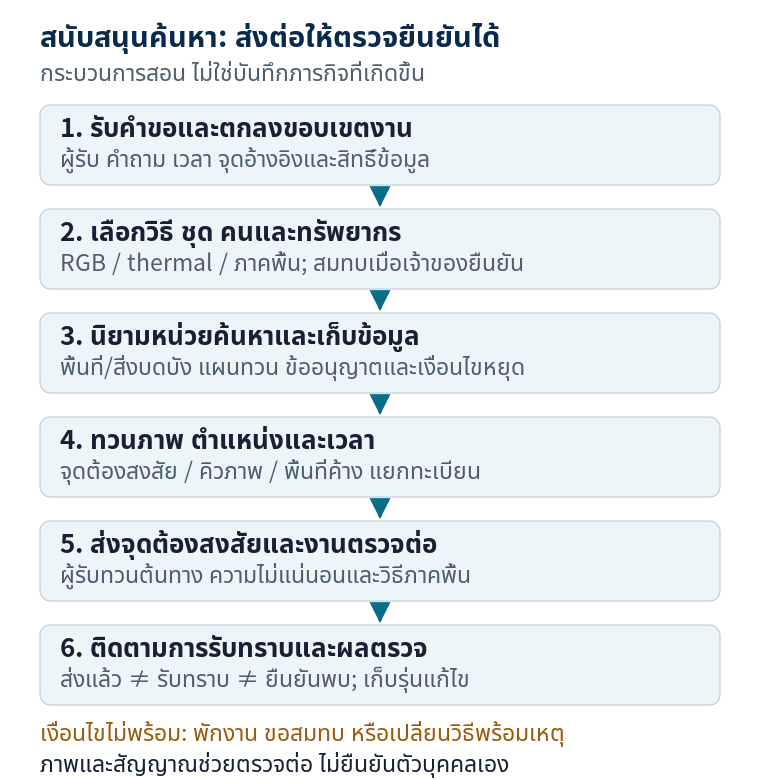
The diagram is a teaching process proposed by the author, not a rescue unit's SOP Open the full-size process diagram
Focus the table and use the left or right arrow keys to scroll through the work, owners and reasons to hold
| Step | Results required and who is responsible | When to hold / repeat / use another method |
|---|---|---|
| 1 Receive the request | Recipient's responsibility, question, area/time boundary, search priority, rights and the criteria for accepting data must be agreed | If the question/recipient/rights are unclear, ask for confirmation before choosing a method |
| 2 Choose the method and resources | A/B/ground, people, kit, manual, battery, link, permissions and mutual aid confirmed by the owner | If people/kit/weather/link/rights do not support it, keep the work that depends on it on hold and use a permitted alternative |
| 3 Define sectors and collect | The person keeps a registry separating open / obscured / not yet collected parts, the source of position and time; no routes are created in the exercise | If conditions/methods do not support it or parts are obscured, keep unknown and ask the responsible party for a new method |
| 4 Review image, position, time | The reviewer and the queue manager separate candidate/flag/reference from review status | If raw/provenance/position/time is missing or the queue is backlogged, keep hold and request evidence; do not fill in values to make it pass |
| 5 Send points and outstanding items | Named recipient, requested task, data version, reason/boundary/rights, owner and the evidence to be sent back | If the data is not yet sufficient for operational handover, send only the outstanding items/requests; do not dispatch from a teaching flag |
| 6 Follow up and correct | Evidence of sent/received/acknowledged/ground_verified kept separate, with a correction version log | If the task is not yet accepted / not yet checked, keep pending; if a result is wrong, notify the recipient and review after correction |
A repeat must have a reason connected to the question, a new condition, and a method/people/rights confirmed by the responsible parties; do not repeat flights to fix every gap. NIST Level 4 workload/scenarios presents camera tasks and scenarios defined so that they can be reviewed/scored. We use the idea of defining tasks and controlled references, do not take lane distances/time limits as mission values, and did not set up a NIST test lane.
TRAIN-SAR-01: two registries that answer different questions
The scenario is authored for a flood-affected rural riverbank, using the snapshot 2026-10-11T10:20:00+07:00 . There are no raw images, real coordinates/geometry, field results or AI inference. The status, time, reference review and flag are author_provided_teaching_assumption throughout, and every media_status=not_supplied and ground_status=not_performed
The sector registry shows the scope of work while the candidate registry shows the items and the review work Having two records in A does not make it two sectors; E has no record but must still be shown.
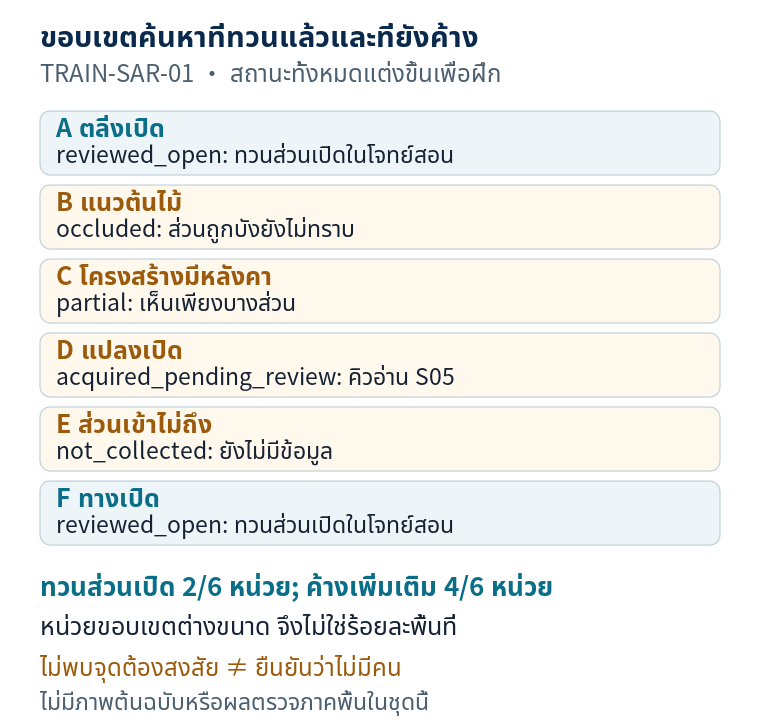
The diagram is drawn from the teaching assumptions A–F; it is not a map or a flight footprint Open the full-size coverage diagram
Focus the table and use the left or right arrow keys to scroll through the status and the outstanding work
| Sector | Hypothetical context | Status at the snapshot | Meaning boundary and follow-up work |
|---|---|---|---|
| A | Open riverbank edge | reviewed_open | The open part was reviewed per the teaching scenario; S01 is still a provisional candidate; not clear |
| B | Tree line | occluded | Obscured part, unknown; request a permitted inspection method and review the S03 location/source |
| C | Roofed structures | partial | Keep the unseen part unknown even though S04 proposes no candidate |
| D | Open yard | acquired_pending_review | Hypothetical data still awaiting review; S05 must stay in the queue |
| E | Patch that cannot be accessed in the scenario | not_collected | No record is not a negative result; open a task / another method or keep on hold |
| F | Open path | reviewed_open | The boundary of the open part per the teaching scenario; S06 proposes no candidate; does not confirm that nobody is there |
A/F = 2/6 workload units reviewed_open; B/C/D/E = 4/6 need further work The units are of unequal size and no area is computed; this figure is not a percentage of area searched_complete/cleared or a probability of finding a person.
Six items and the review order, for which the reasons must be opened
All times in the cells below are on 2026-10-11 and +07:00; confirmed_teaching is a teaching status; there are no real object coordinates. Using the aircraft's GNSS alone does not equal the object's position; the source/method/error, consistent time and review by the real kit's method must be requested.
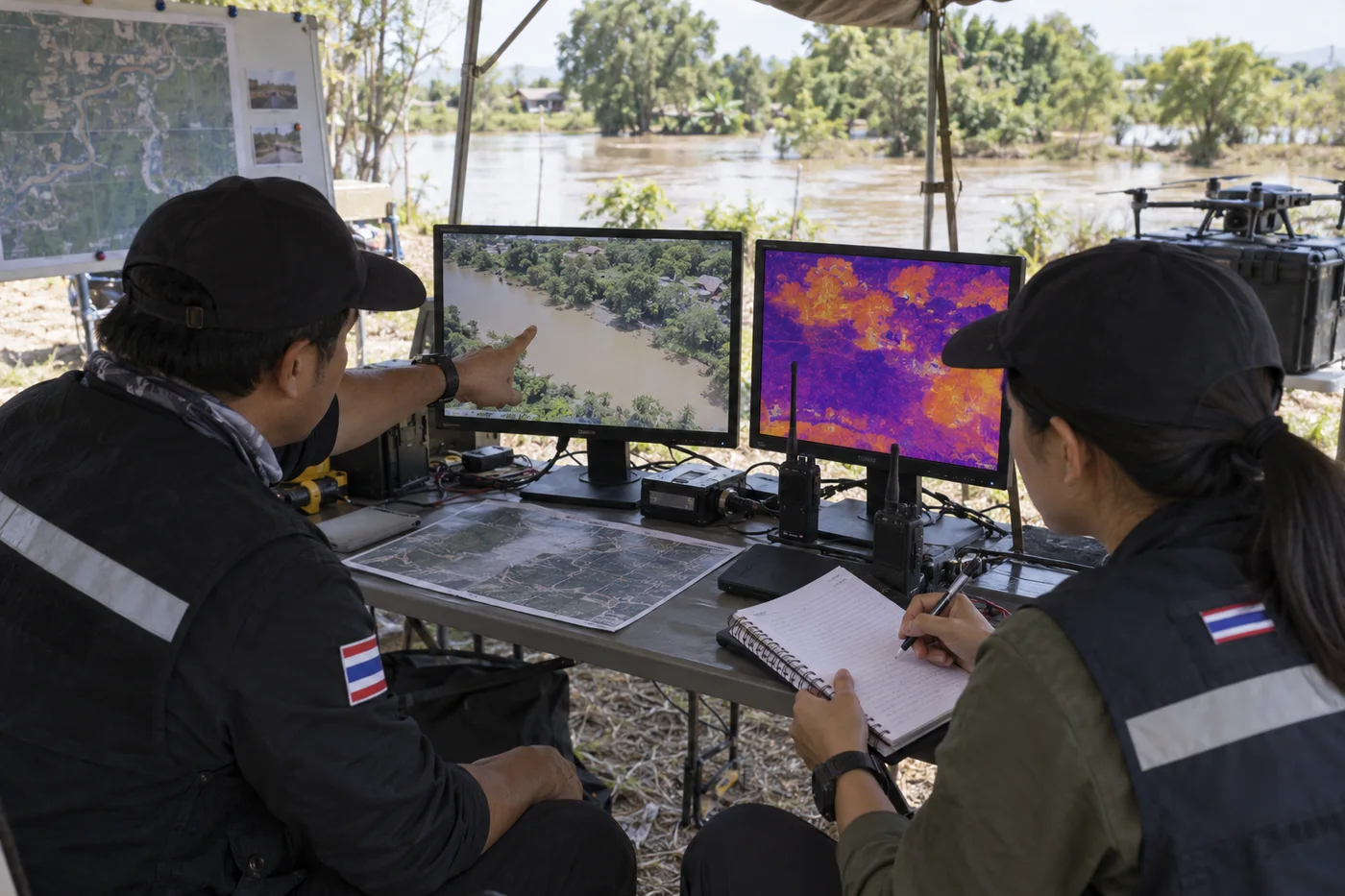
Image created with AI to explain the review; it is not an AI results screen or raw media of the fixture Open the full-size review image
Focus the table and use the left or right arrow keys to scroll through the review times and the labels that the author assumed
| ID / sector / sensor | capture / receive / review | location / review_state | authored reference / flag | Next work and claim boundary |
|---|---|---|---|---|
| S01 / A / RGB+thermal | 10:00 / 10:06 / 10:09 | confirmed_teaching / pending_ground | person / flag | Provisional candidate; request raw/location review before a real ground handover; not a found person |
| S02 / A / thermal | 10:02 / 10:06 / 10:10 | confirmed_teaching / rejected_teaching | non_person / flag | The author defined a warm object, with no pixel test; rejected per the teaching scenario; not a field clear |
| S03 / B / thermal | 10:04 / 10:08 / 10:12 | unconfirmed / needs_location_review | person / no_flag | Tabletop FN from an authored reference; request location/source/obscured part; not the discovery of an actual miss |
| S04 / C / RGB | 10:06 / 10:10 / 10:13 | confirmed_teaching / no_candidate_teaching | non_person / no_flag | No candidate in the teaching scenario; C is still partial |
| S05 / D / RGB+thermal | 10:08 / 10:14 / blank | confirmed_teaching / pending_image_review | person / flag | Image-review queue; do not fill in a review/confirmation time and do not yet send it as a person found |
| S06 / F / RGB | 10:10 / 10:15 / 10:18 | confirmed_teaching / no_candidate_teaching | non_person / no_flag | No candidate in the teaching scenario; does not confirm that nobody is in F |
Propose to the recipient to consider S01 provisional/raw / location, S03 location/source and S05 queue review, with the owner/evidence requested. This order is a learning task whose reasons must be explained; it is not a dispatch command/SOP or the SLA of a real team. No row has a ground result, and no person is confirmed found.
Coverage, detection and time use different denominators
Pair one authored reference object per row with an authored flag, for teaching TP/FP/FN/TN only. S05 is still counted as TP in the arithmetic even while image review is pending because the author-written reference/flag are kept separate from the queue; there is no inference or measured ability to detect real people in this kit.
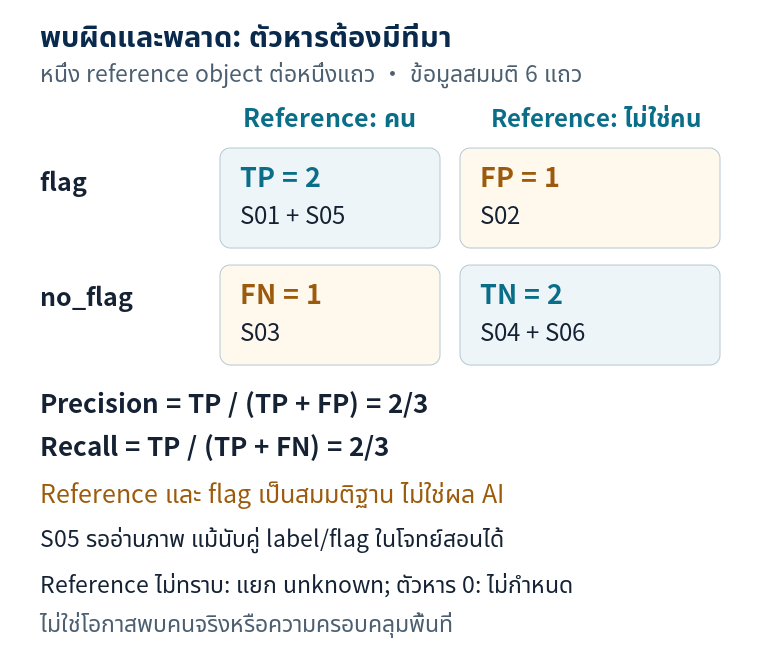
The diagram is the arithmetic of six items written by the author; ground status is not used to fill in a reference Open the full-size detection diagram
Focus the table and use the left or right arrow keys to scroll through the formulas, boundaries and unknowns
| Subject counted | Fixture answer | Boundary to preserve |
|---|---|---|
| Sector workload | reviewed_open 2/6; 4/6 need further work | Not equal areas / clear or reference objects |
| Authored detection | TP 2 S01/S05; FP 1 S02; FN 1 S03; TN 2 S04/S06 | Not actual inference / field performance or confirmed persons |
| Precision / recall | 2/(2+1)=2/3 in both formulas | This labelled authored subset; not the probability of detection of the area |
| Missing reference mutation | Remove S03: unknown 1, labelled 5, TP 2, FP 1, FN 0, TN 2; precision 2/3, recall 2/2 | Keep S03 and B; the denominator changes, which does not mean the system is better; do not fill in a label with ground data that does not exist |
| Zero denominator | undefined, with the reason and the labelled/unknown counts | Do not fill in 0; if every reference is missing, unknown 6, labelled 0 |
| S01 latency | capture→review 9; receive→review 3 minutes | Collection/arrival/review times are separate; no confirmation |
| S02 / S03 latency | 8/4 and 8/4 minutes | Per the time assumptions; not a review duration measured from start to end of the work |
| S04 / S06 latency | 7/3 and 8/3 minutes | Does not mean the whole sector was reviewed or that ground confirmation has been done |
| S05 queue | backlog 1; receive 10:14→snapshot 10:20, waiting 6 minutes | Review is blank, so neither latency value exists yet; do not fill in 0; no review duration/confirmation |
The time of confirmation must come from the responsible recipient's process, with the time recorded separately; do not use received/reviewed or a score as the confirmation time. The fixture has none yet.
Handing work to the responsible person, and tracking status with evidence
Handover must link the case/sector/record, the data version/snapshot, the sensor/provenance and media status, the source/method/error of the position, capture/receive/review/timezone, the reason for suspicion/limitations/unknown, and the requested task, owner and evidence to be sent back. The named recipient is the person who will take on the work whereas sent/received/acknowledged/ground_verified are events that each need evidence at their own step.
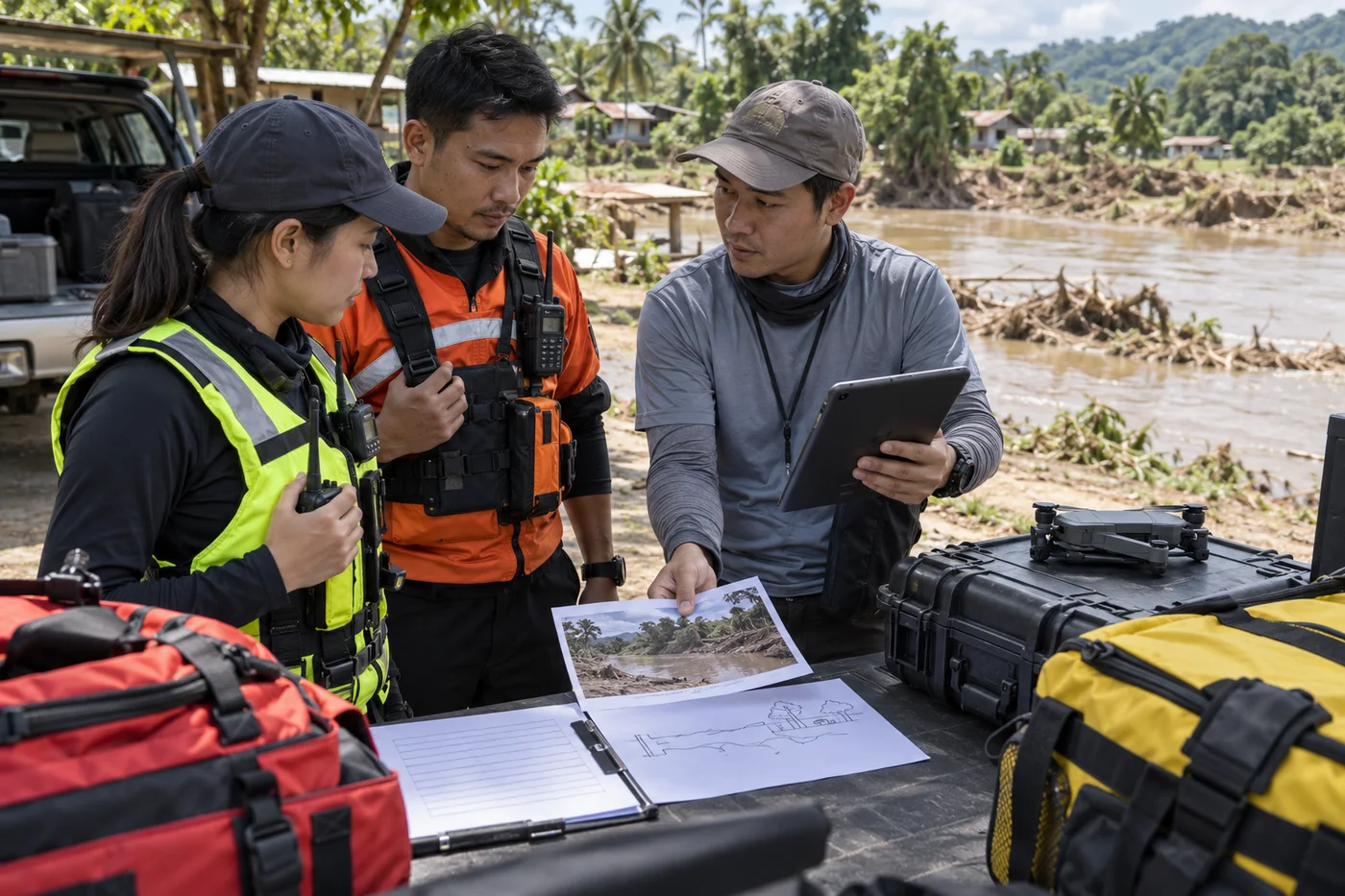
Image created with AI to explain handover; there is no evidence of task acceptance / ground verification for TRAIN-SAR-01 Open the full-size handover image
Focus the table and use the left or right arrow keys to scroll through the evidence for the task-acceptance statuses
| Status | Evidence required | What cannot yet be inferred |
|---|---|---|
| sent | Which package version was sent, to whom, by which channel and when | Cannot know whether the recipient got the file or accepted the task |
| received | The recipient received that version of the data, with evidence/time | Does not confirm understanding and acceptance of the task according to its boundary |
| acknowledged | The responsible recipient confirms understanding of / accepts the requested task and its boundary | Not yet a verification of a person or a rescue result |
| ground_verified | The responsible recipient records the method, result, boundary, source and time of the confirmation | Do not fill in from thermal/AI/review time; every fixture row is not_performed |
In the teaching set there is no real evidence of sent/received/acknowledged for the package, even though there is a received_at that is hypothetical, for the image-review data. These two contexts must be kept separate. Keep the private package for authorised people as needed. A public copy must be checked for rights and reduced of personal/coordinate/unnecessary media data before release. Record the redaction, the reason, the reviewer and the version. Do not create names/hashes for raw media that does not exist. Keep before–after corrections, comments/replies, the recipients who must be notified, and the owner/evidence/re-check conditions of outstanding items.
KSEC: readiness to learn, activities and evidence
K = Knowledge, S = Skills, E = Ethics, C = Character. Uses 12 fixed IDs according to the shared KSEC framework . Each ID has priorKnowledge/priorSkill, a goal, an activity, evidence and criteria. E/C use decisions / accepting comments / corrections observed in the activity, and do not judge virtue or permanent personality. Readiness to learn is not a certification of readiness to fly or rescue. CLO/PLO are still blank: pending_design
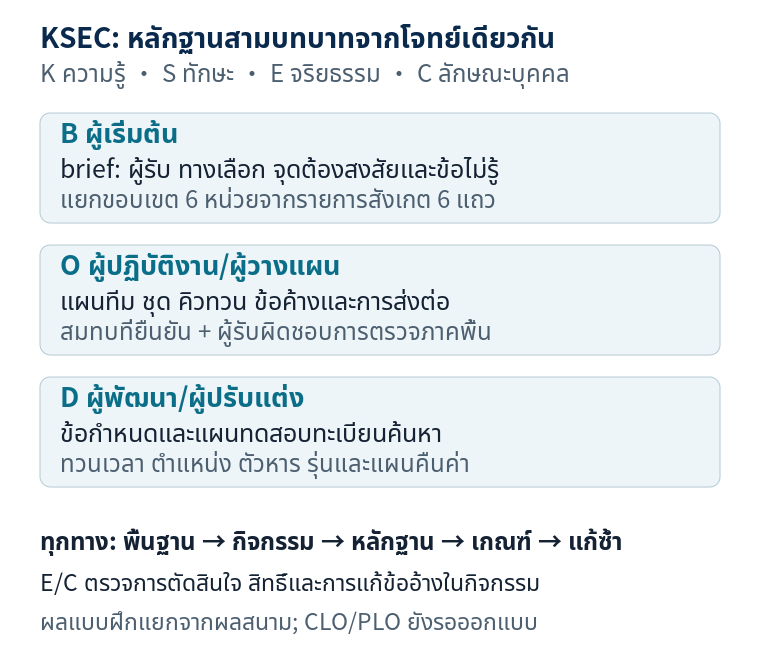
The diagram is used to check that the activities/deliverables are traceable to the IDs; it is not a learner result Open the full-size KSEC diagram
B Beginner: write a brief that preserves the unknowns
Do Worksheet B from the six items: a one-page brief with recipient / question / area-time boundary, the 7 criteria for A/B and a ground alternative, the two registries, the three numerical topics, answers when asked to confirm a person / clear / post everything, and B-v0/B-v1 with replies to comments. Use rubric and learning record
Focus the table and use the left or right arrow keys to scroll through the prerequisites, goals, evidence and per-ID examples
| ID | priorKnowledge / priorSkill and bridging work | Goal, activity and evidence | Criteria and examples: has evidence / needs revision |
|---|---|---|---|
| APP-M07-B-K01 | Knows UAS/RGB/thermal/observation; can explain the request; review Basics and sensor limits then explain a hot spot | Explains the recipient, question, boundary of use and A/B/ground; brief + 7-criteria table | Has: “add thermal when the method/people support it; obscured parts remain unknown”; needs revision: “thermal always confirms a person” |
| APP-M07-B-S01 | Knows ID/sector/timezone; can read the table / subtract times; review time/position then do S01 | Organises 6 sectors / 6 records and calculates separately; two registries / formulas / denominators | Has: 2/6 + 4/6 units, TP 2 / FP 1 / FN 1 / TN 2, S05 queue 6, no latency; needs revision: “2/6 of the area is clear” / latency 0 |
| APP-M07-B-E01 | Knows hypothetical / real / rights; can correct a claim; readiness: corrects “AI found two people”; review Observations and handover then submit a new sentence | Decides to use/share with reasons for one scenario; corrected claim + private/public request | Has: withdraws found/clear, requests raw/location/rights before use; needs revision: fabricates ground / automatically discloses coordinates |
| APP-M07-B-C01 | Knows versions/duties; can keep before–after and answer comments; readiness: accepts one comment; review teamwork and read back the task | Answers every comment and assigns outstanding work; B-v0/B-v1/change / owner log | Has: revises the queue with reasons, S05 has an owner/evidence/review; needs revision: deletes v0 or says only “will check” |
Before the main task, fill in the prerequisites and the bridging work for each ID, and then re-check. The expected result for B is not an answer to who was found but a brief that the recipient can continue checking. Debrief: which unknown changes the choice of A/B/ground, and can the person taking over see the reason for the fix from the versions?
O Operator/planner: plan the work through to the recipient
Do Worksheet O: A/B/the real-kit ledger to be requested, a six-step plan with people/battery/link/rights, request / confirmation for mutual aid, sector/candidate/queue, a versioned private/public package/redaction, and O-v0/O-v1. Every outstanding item must have an owner, the evidence requested and a re-check condition. A plan that is written down is not treated as people/kit being ready.
Focus the table and use the left or right arrow keys to scroll through the per-ID criteria for the planner
| ID | priorKnowledge / priorSkill and bridging work | Goal, activity and evidence | Criteria and examples: has evidence / needs revision |
|---|---|---|---|
| APP-M07-O-K01 | Knows mission/aircraft/sensor/method; can compare shared criteria; review selection and site then compare A/B | Compares 7 criteria and 3 platforms with conditions; A/B + manual/compatibility ledger | Has: coverage/endurance/conditions/review/link/cost/limits-fallback with the requested kit evidence; needs revision: preset range / universal camera |
| APP-M07-O-S01 | Knows registry/queue/roles/time; can place reviewers / subtract times; review brief and time-location then place S03/S05 | Lays out six steps with owner/resource/hold; two registries / queue / handover | Has: S01 raw/location, S03 source, S05 queue, B/C/D/E further work; needs revision: dispatching from confirmed_teaching, or a recipient's name treated as ack |
| APP-M07-O-E01 | Knows rights / evidence boundaries / task acceptance; can select the necessary data; readiness: makes a private/public example; review evidence and handover | Sends a package that preserves unknowns according to rights; private/public + redaction log | Has: clearly no raw/ground, no confirmation time yet, public awaits review/reduction; needs revision: fabricates a raw hash / hides incomplete / posts coordinates |
| APP-M07-O-C01 | Knows resource authority/versions; can request mutual aid / follow replies; readiness: accepts the comment that a team name is not an acknowledgement; review teamwork | Tracks mutual aid and answers every comment; O-v0/O-v1/request / confirmation-owner log | Has: owner confirmed with evidence, or pending/hold/fallback; needs revision: available from a request |
Debrief: if the aircraft exists but the review queue is backlogged, which proposal reduces what the recipient has to guess? Which work is held because the mutual-aid team does not respond? How does the received_atof image review differ from the evidence that the package recipient received it? Use the answers in the worksheet and then have the successor read back the plan / outstanding items.
D Developer/tuner: propose the checker without posing as run results
Do Worksheet D , which has the input contract, R01–R08, D01–D18/subcases and complete expected results; actual is not_run for every case ; there is no validator/component or AI inference. Submit v0 as a flawed proposal that counts a flag as a person / no_flag as clear, fills pending latency with 0 and treats a missing reference as non_person; have v1 separate the two registries, the three numeric axes and the reasons for hold/unknown.
Focus the table and use the left or right arrow keys to scroll through the requirements linked to the test matrix
| Requirement | What v1 must preserve | Test groups in the worksheet |
|---|---|---|
| R01 Identity/provenance | Unique ID/case/sector/schema/origin clear; duplicates/conflicts do not increase the count and carry a reason | D01–D07, D13 |
| R02 Time | Parse date/offset; order capture≤receive≤review≤snapshot; review may be blank for pending; do not fill in values | D01–D10 |
| R03 Coverage | Sector registry independent of objects/flags; keep B/C/D/E, and an E with no record is not area/clear | D01–D06, D13–D14 |
| R04 Candidate/location/media | flag/reference/review/location/raw/ground kept separate; source/method/error must be reviewed; no found from teaching | D01–D06, D10, D12, D14 |
| R05 Detection arithmetic | Authored labels separated from review unknown; keep the rows / labelled count; zero denominator is undefined | D01–D06, D11–D12, D15 |
| R06 Time/queue/handover | Two kinds of latency when valid times exist; pending uses queue age; sent/received/ack/ground kept separate | D01–D06, D10, D16 |
| R07 Rights/untrusted data | private/public review/redaction; text/CSV is data: words in an observation are not executed or auto-fetched | D14, D17 |
| R08 Version/rollback | Input/schema/rules/config/output before–after; every issue has a reply, the owner, a stale notification and a re-check after restoring | D18 |
The matrix separates the normal S01–S06 into six rows, then covers duplicates / time parse / timezone / missing / future / order / pending blank, missing reference, FP/FN, sector conflict / wrong case, unknown location / raw absent, zero denominator, queue age versus latency, privacy / untrusted data, and version / rollback. No SOP/SLA/model confidence is fabricated. Keep D-v0/D-v1 and the issues before–after. A trigger on a wrong result means hold; restore only a known-reviewed version that supports the input, or keep it on hold, notify the recipient and schedule a recheck of D01–D06+D11+D14+D15+D17+failed subcases. The actual remains not_run.
Focus the table and use the left or right arrow keys to scroll through the per-ID criteria for the developer
| ID | priorKnowledge / priorSkill and bridging work | Goal, activity and evidence | Criteria and examples: has evidence / needs revision |
|---|---|---|---|
| APP-M07-D-K01 | Knows schema/state/requirement/sensor; can explain the contract/reason; review testing and sensor limits then separate the reference | Explains v0→v1 and R01–R08; input/output/reasons + scope | Has: two registries / three metrics, authored labels not real pixels/ground; needs revision: flag as found / metadata as pixel verified |
| APP-M07-D-S01 | Knows timestamps/denominators; can turn a mutation into expected; review integration and time-location then write the missing reference | Completes D01–D18/subcases linked to R01–R08; expected/actual matrix | Has: normal 6 and complete failure cases, expected correct, actual not_run; needs revision: unknown lost, fills in time / zero denominator, or claims a pass |
| APP-M07-D-E01 | Knows evidence levels / rights / untrusted data; can withdraw a claim / export; readiness: corrects “v1 tested / can be made public”; review evidence | Separates proposal / result / rights; claim scope / private-public / untrusted plan | Has: proposal only, no validator/flight/ground/learner/calibration results, text treated as data; needs revision: “v1 passes every case” or a CSV that commands data sending |
| APP-M07-D-C01 | Knows baseline/version/rollback; can keep issues / before–after; readiness: opens an issue on a wrong denominator; review teamwork | Every comment has a reply and can be restored / re-reviewed; D-v0/D-v1/input/schema/rules/config/output log | Has: trigger to hold / restore / check known-reviewed or hold, notify stale and recheck; needs revision: overwrites history / restores the wrong v0 and then declares ready |
Debrief: how does a missing reference change the denominator but not the coverage? After rollback, who must receive the correction? What reference / time / position and manual must be controlled when adjusting the camera, without passing off test results as ours? Use expected to review the design; do not write that the test plan is a run result.
Check the work and carry on
Download the readme / field contract, CSV, rubric / detailed answers, KSEC record and curriculum mapping Each path's worksheet is usable on its own, with the scenario data, instructions, deliverable fields, expected results, answers and debrief.
Assess the 4 IDs of the path as evidence meets criteria / needs more practice / no evidence yet with the file/section, reviewer, date and version. A solo learner states self-review / awaiting a reviewer. Keep before–after, answer every comment with evidence or the reason for keeping it, and give outstanding work an owner / what must be requested / a re-check condition. KSEC results do not certify a system, camera, operator or readiness for a real mission.
Link to Search and rescue, sensor limitations, the evidence report and M06 Situation assessment while preserving the time / coverage / confirmation / rights boundaries of each case
Practise the search task intake from assessment data in S1: three-mission handoff diagram: a suspicious point must have a responsible party who checks and reports back before it is interpreted as a confirmed result or a logistics need.
When several requests use the same imaging kit and team, try the M06/M07/M09 shared-resource practice card to send the missing position/recipient information to the responsible person, then prioritise by new evidence without promising the team twice.
Sources and the boundaries actually read
- FLIR: thermal and obstructions: read the HTML sections on walls/glass/trees and the environment; not a test result of the camera model that will be used
- Nature: Search and rescue with airborne optical sectioning: read only the accessible abstract; the full paper is not cited, and the figures from that work are not taken as results for this kit
- NIST: Performance of Emergency Response Robots: read the Summary/Technical Idea/Research Plan; did not read the full ASTM standards or carry out certification
- NIST: Level 4 Obstructed Lanes and Scorable Scenarios: read the workload/metrics and example scenarios; no lane/time for real work is set
- DJI Enterprise: Search and Rescue: read the solution / coordinate-share workflow; it has the manufacturer's boundary; product numbers are not used and nothing is ranked
Sources checked on 11 October 2026. The case, data, activities/criteria and six-step process are the author's teaching design. These sources are not the origin of the six records, and FEMA/PubMed, which were not read sufficiently, are not cited. There are no flight/camera/AI/validator/ground/learner results in this round.
Continue with C02 Search data kit to calculate data size against time, review the offline plan version and TTL, along with the outstanding question of whether the reduced data is still enough for the recipient to arrange work. Being on time in the formula does not confirm that people received it or that the search area was complete.