S3 Inspecting hard-to-reach structures: what a sharp enough image can answer
A tabletop case study linking M04/M05/C01 to practise separating readable images from missing data, referral to a reviewer, and the evidence gate before images are used for quantity measurement
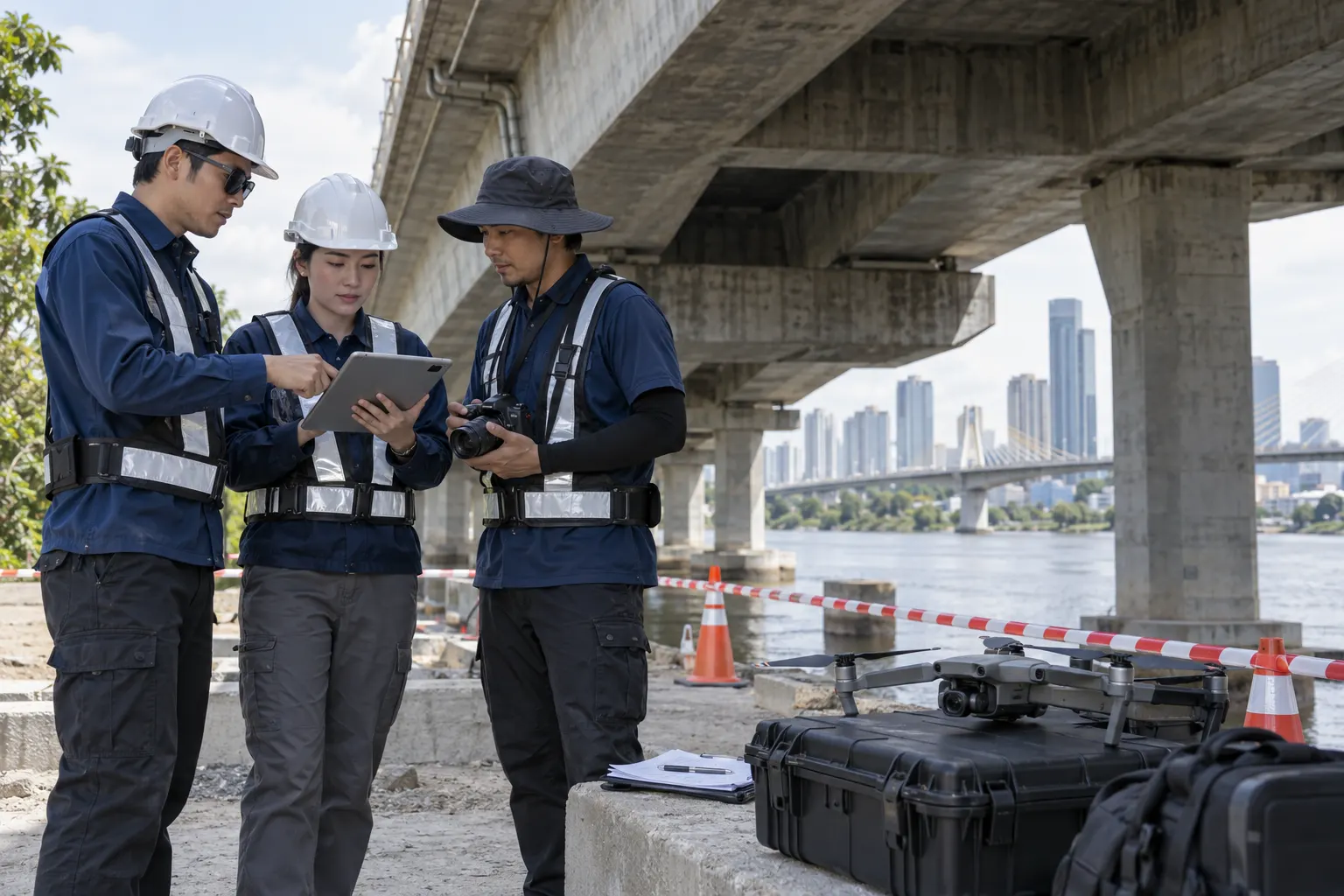
The recipient's question: with the images in hand, what should be checked next?
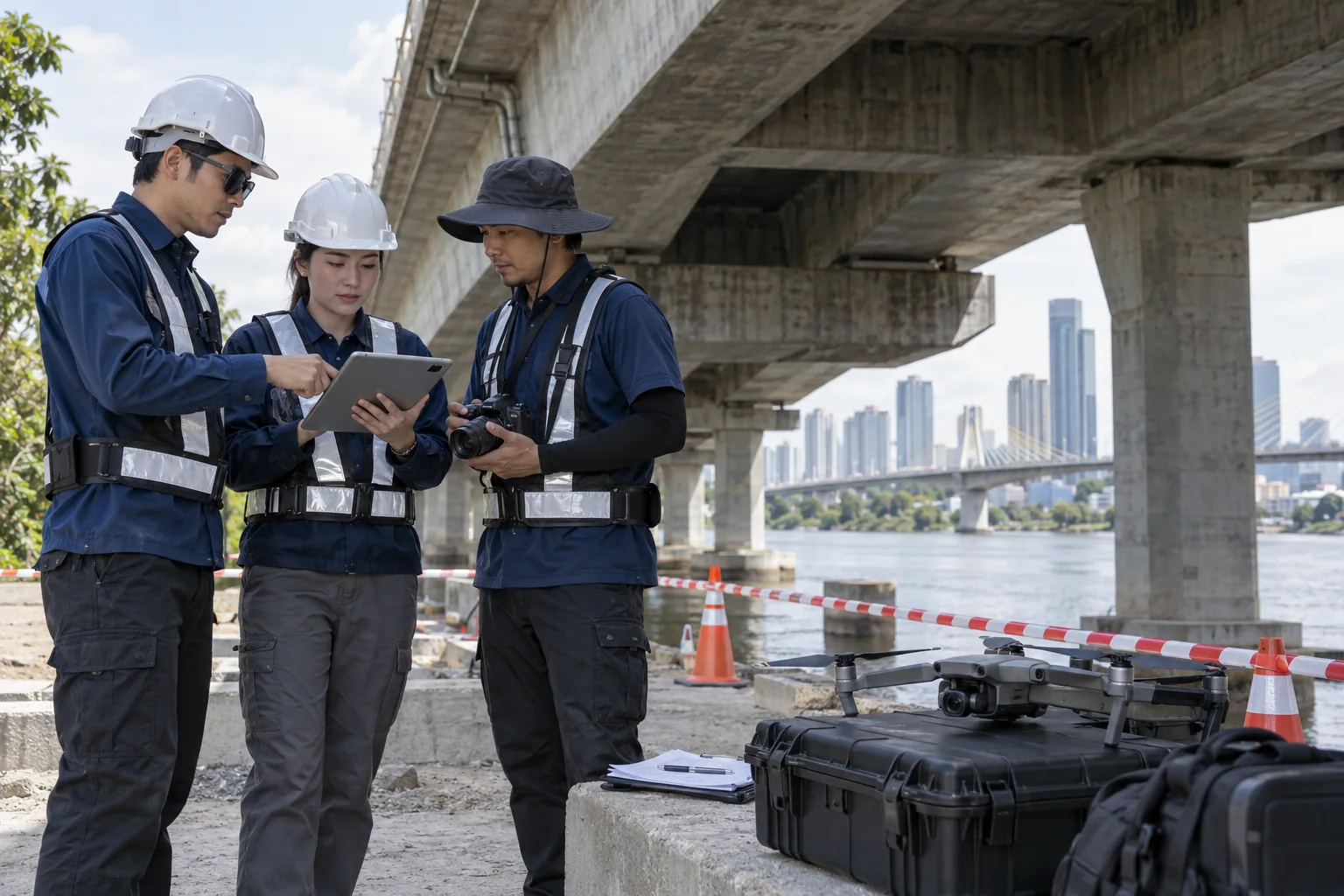
Image created for teaching shows the planning context. It is not an image of R01–R13, a real bridge-inspection image, or evidence that the equipment shown has passed testing. Open the full-size context image
INSPECTOR_ROLE is the recipient (hypothetical) of request REQ-CSS-01: “Before 2026-10-13T15:00:00+07:00 help compile a ledger of images of the hard-to-access parts, state which images are readable or what is still missing, and propose points/methods for further inspection.” TRAIN-CSS-01 There are 14 image-description rows across ASSET-A, MEMBER-A to MEMBER-F and the image slots VIEW-1 to VIEW-9. All of the codes are paper reference slots; view_id is the target image slot, whereas angle_class is the actual angle of the row; there are no world coordinates. Rounds E0 and E1 are used to teach before–after comparison, but there are no source images for any row. What can be submitted is a ledger of observations and outstanding items, not a verdict on condition, strength or safety.
Download scenario.csv, expected.csv and the readme with the CSS-RULE-v1 rule. scenario is fabricated data; expected is the author's answer guide not the result of a run, of learners, or of a real check. The status of the chapter and the practice kit is P3 pending_field_review, subject-matter reviewer not_assigned, P5 B/O/D 0/0/0 NOT_RUN, CLO/PLO pending_design. CPX-Sim remains on hold.
Why drone images are a supplementary tool
M04 Condition Inspection teaches linking images to the asset's component, the angle, the time and the unknowns; M05 Construction Monitoring reminds learners to keep the comparison baseline and the plan version; C01 Condition-inspection camera kit separates the sampling/storage numbers from actually seeing the detail. The S3 case brings these three matters together: even if the aircraft reaches the spot and gets a sharp image, the original angle may still not be comparable, the size may not be measurable, or it may not be known which part of the structure it shows.
FHWA Q313-1/Q313-2 states, for bridge inspection under the US system that technology is used as a supplement and does not replace the inspector (claim S-01), that UAS does not replace touch/tapping methods, and that lighting is a consideration (claim S-02). NIST Aerial Drone Tests shows skill-level topics and obstacle test lanes, including a link to a Sensor Test Lane whose destination page is still under preparation; so there are as yet no structural-image criteria from that page to borrow (claims N-01, N-02, S-03; the four-layer separation in the chapter is the compiler's own framework). MnDOT 2015 is a historical example of an experiment in collecting bridge-inspection images in the US, and reports the limitations of underside photography with the model used (claim S-04); it is not an experimental result of this case. FAA/NBIS are not Thai law and no field threshold value from these sources has been moved over to serve as a criterion of the problem. Before real work, the responsible persons must review Thai rules, rights of access/flight, and the equipment and inspection methods suited to that asset.
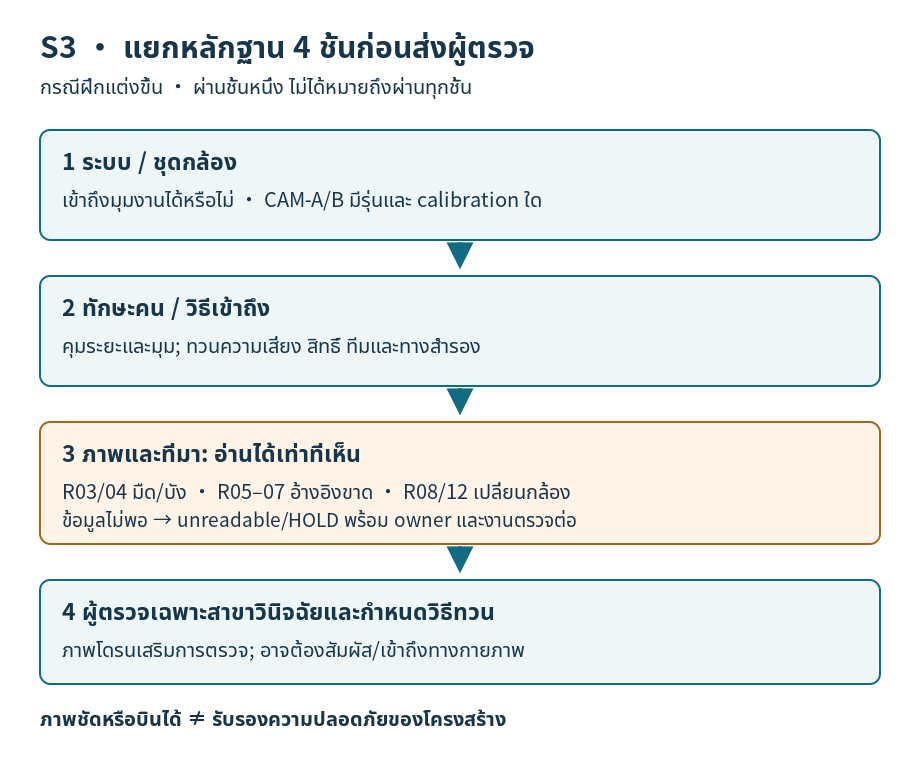
Diagram description: the capability of the drone kit, the skills of the people, readable images and a diagnosis are different kinds of evidence. A sharp image or a successful flight does not rise to a certification of the structure. Open the full-size four-layer diagram
Start from the method of answering the request, not from choosing a drone
Scroll the table horizontally to see every column. When the table has keyboard focus, use the left or right arrow keys.
| Method | What it may be able to answer | Conditions and reasons to pause |
|---|---|---|
| Existing images that carry usage rights | E0 context and points that must be re-collected | R01/R11/R13 do not cover the whole structure; the part, angle, time and camera model must be known |
| Ground inspector / access equipment | Re-check points that are dark, obscured, or may need a physical inspection | People, access method and rights are still requested; the person responsible must define the safety measures |
| Other teams/services | Image angles or inspection methods that the existing kit cannot provide | Not yet confirmed until the resource owner responds, together with the scope of work |
| Drone, when the real conditions are complete | Some image angles with metadata to send to the reviewer | The manual of the real model, and people/area/air/signal/rights/lighting/obstructions/data collection, must be checked; images do not replace a diagnosis |
O must compare a multirotor, or another kit that actually exists, against the take-off/landing area, the approach path, the underside of the structure, signal/lighting control, and a lens/camera that supports the required angle. The fixture contains no real performance parameters; do not infer from illustrative images that any model can photograph under a bridge or may fly legally. The options of not flying and of sending a request for more data/access methods are results that are honest to the task.
Choose the method of collecting evidence under the structure before choosing the drone kit
Sub-problem TRAIN-CSS-ACCESS-01 is a fabricated scenario card, separate from the 14 S3 rows: the inspector wants to see the underside of part of a hypothetical bridge deck, but there are as yet no source images, void dimensions, lighting, wind/water conditions, signal channels, team standing positions or real permissions. The aim is to write the method whose feasibility should be checked next, and the reasons to hold rather than choosing a model and claiming that it works. FHWA-HRT-21-086 explains how upward-looking capability, lighting, GNSS loss and camera position affect work under bridges (S-05); FHWA-HRT-21-083 shows a case in which access to team standing positions and coordination with the site owner changed how images could be collected (S-06). Both sources are US work and do not endorse this area or this training kit, and FHWA Q313-2 also states that UAS images do not replace tactile inspection where it is necessary
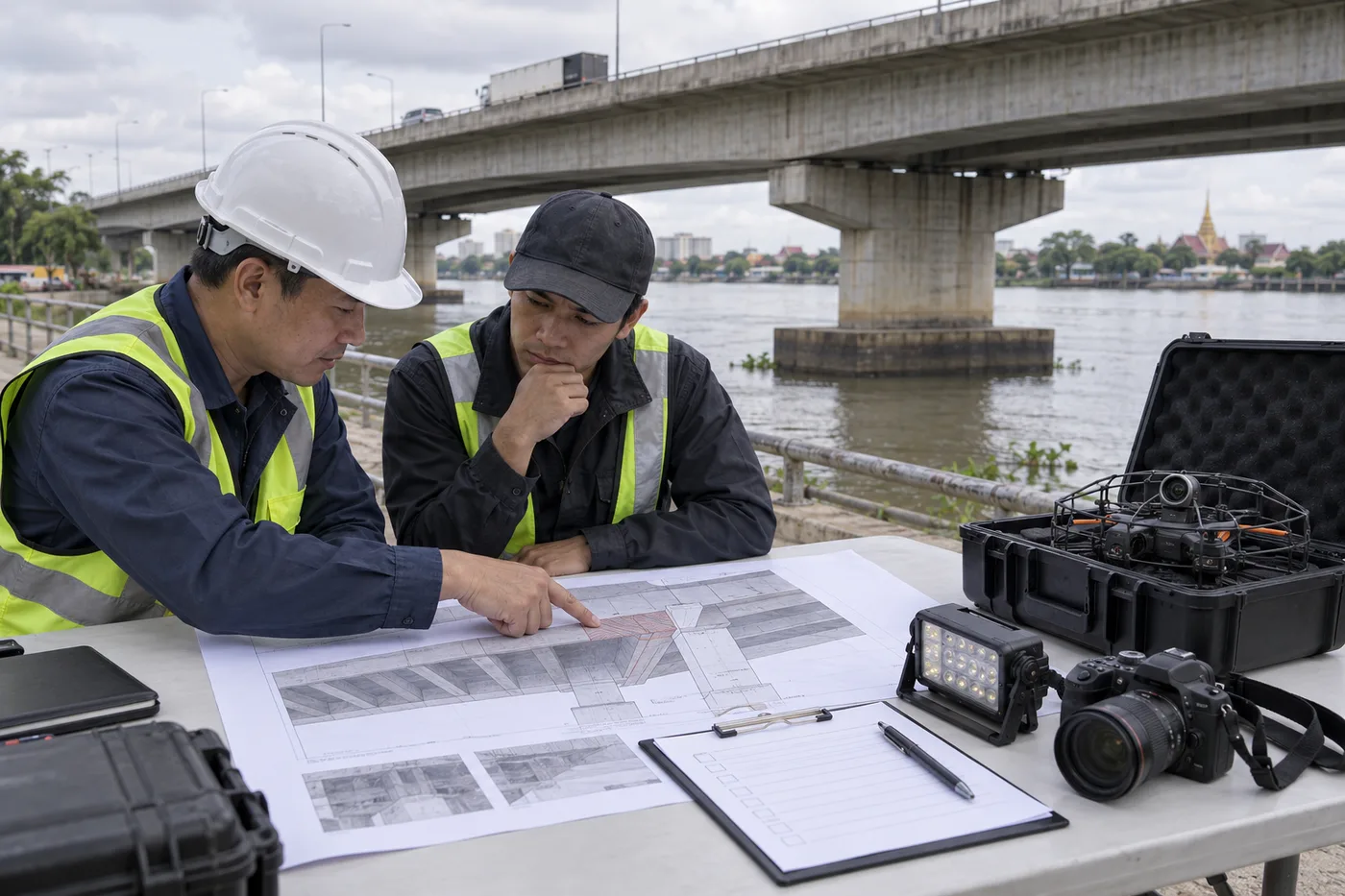
Image created for teaching is a planning scene, not the condition of the S3 bridge nor evidence that the drone shown can be used under a bridge Open the full-size context image
Scroll the table horizontally to see every column. When the table has keyboard focus, use the left or right arrow keys.
| Question on the practice card | Method to compare first | Evidence gate and what can be written |
|---|---|---|
| A: the side surface may be visible from the ground, but rights are not yet confirmed | Existing images that carry usage rights, a ground camera, or a drone | Request images/metadata, access rights and angle criteria from the inspector first; a drone is not yet needed because the problem has not yet shown a data gap |
| B: the underside is dark and some angles are obscured | An access method chosen by the inspector, a ground camera/lights, or a drone kit that can prove its viewing angle | hold_method: check the camera's upward angle, lighting, visibility of the airframe/control channel when GNSS degrades, the real kit, the people and the fallback plan; adding a cage/lights is not an endorsement |
| C: the point behind a beam is completely obscured in the available images | The inspector specifies an access method or another tool for seeing that point | unseen: do not write that no defect was found, and do not add coverage from images taken at other angles |
| D: the recipient wants confirmation by touch/tapping | A qualified inspector determines the physical inspection method | refer_to_qualified_inspector: drone images are only supporting data; the request is not closed by images |
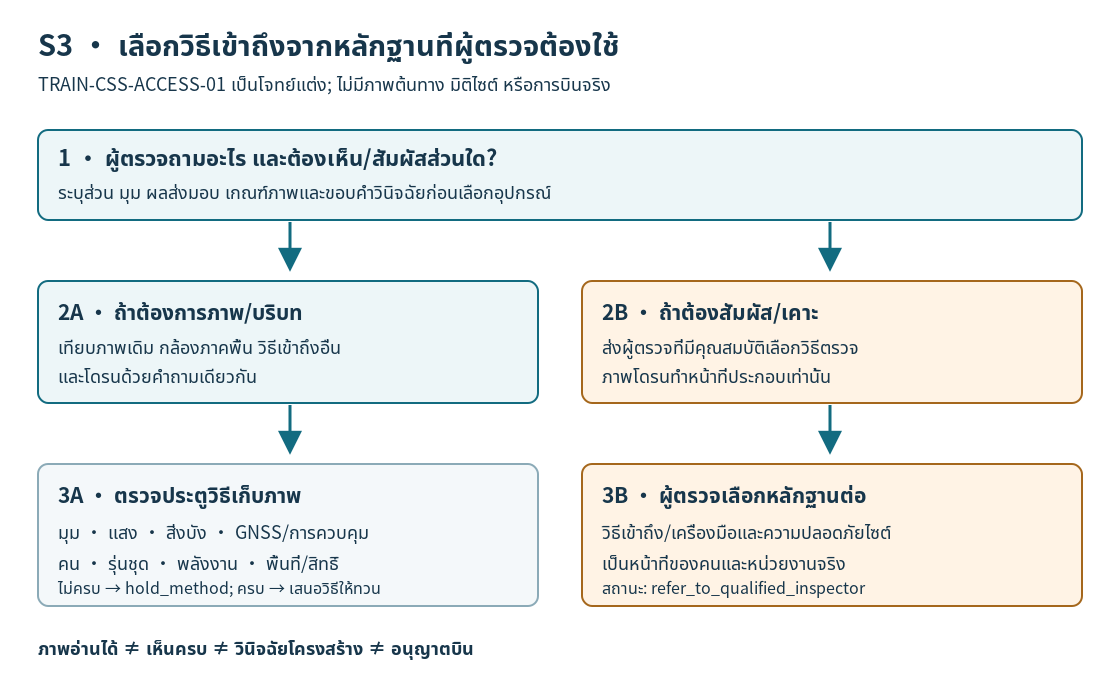
Diagram description: angle/light/control data that is not yet proven goes to hold_method; tactile work is sent to a qualified inspector; passing the image-collection method gate is not yet a diagnostic result or permission to fly Open the full-size method-selection chart
If a drone is considered, have the responsible person compare the image task to be seen against: a camera that can tilt up/look upward, lighting, obstructions, control when GNSS/signal degrade, the standing point of the operator/observer, weight and energy after adding equipment, people/training, and the rights for the area/airspace. Any information for which there is no evidence from the exact kit model should be kept as unknown and then other methods should be compared. The kit and resource selection chapter gives a framework for comparing cost/people/evidence; checking permissions in Thailand must use the current requirements and the responsible persons, and FAA/NBIS must not be used in their place
Use the practice card and access-method record form with the original S3 KSEC: B separate “cannot be seen” from “not found”, and explain image work versus tactile work (APP-CSS-B-K/S/E/C01); O make a table of methods/resources/owners of outstanding items and fallback plans (APP-CSS-O-K/S/E/C01); D make a contract that forces collection of the angle, camera/model, lighting, GNSS/position status, and unseen with a negative test so that no conclusion is drawn when an important field is missing (APP-CSS-D-K/S/E/C01). This is an additional design activity, not a learner result or a site inspection; use the original S3 rubric and do not add codes
Read the 14 rows without deleting the parts that cannot be seen
The teaching rule CSS-RULE-v1 check rights, image quality, angle, scale/position, then look at the camera contract. unknown is not zero or the word “not found”. R08/v0 and R08/v1 are the same version history at different revisions; v0 must still be kept. CAM-A/CAL-A-v1 is a baseline metadata pair, which is hypothetical, while CAM-B/unknown has no calibration evidence in the problem yet. The figure of 14 rows is a check of the completeness of fabricated data, not the coverage of a real bridge.
Scroll the table horizontally to see every column. When the table has keyboard focus, use the left or right arrow keys.
| Row | Answer guide | Limitations and next work |
|---|---|---|
| R01 / R11 / R13 | baseline_context |
E0 images are for comparing only specific patches/angles; not a certified result |
| R02 / R10 | candidate_review |
The description is enough to send to a reviewer for re-checking; R02 differs in colour, R10 has a visible mark, but the cause/condition is not yet known |
| R03 / R04 | unreadable_light / unreadable_occlusion |
Dark or obscured by pipes/shadow; “unreadable” is not “no abnormality found” |
| R05 / R06 / R07 | hold_angle / hold_scale / hold_location |
R05 oblique_B differs from R13 normal_A even though the image slots match, lacks scale, or the part and position are unknown; do not compare, measure or point out spots yourself |
| R08/v0 → v1 | history_superseded → hold_camera_change |
Re-shot more clearly, but CAM-B still has unknown calibration; keep v0 and do not convert sharpness into a pass |
| R09 / R12 | hold_rights / hold_camera_change |
R09: the right to forward is unknown; R12 is an image taken after the camera change that still cannot be compared with CAM-A |
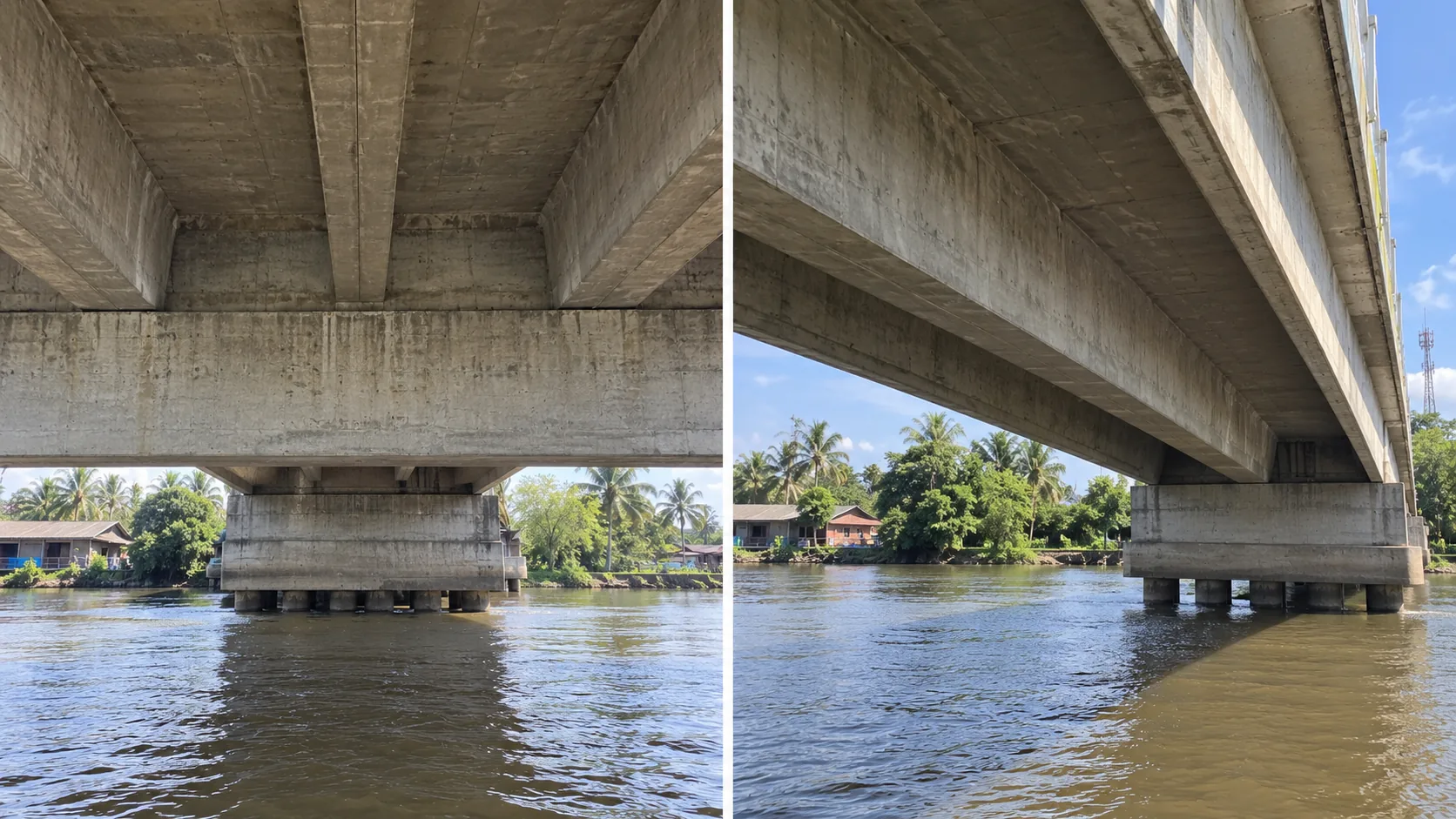
Image created for teaching : the two panels help in thinking only about frontal versus oblique angles. They are not source images of R13/R05, do not confirm that they show the same patch, and are not used to indicate any change of material. There is no scale or position data for real measurement. Open the full-size angle comparison image
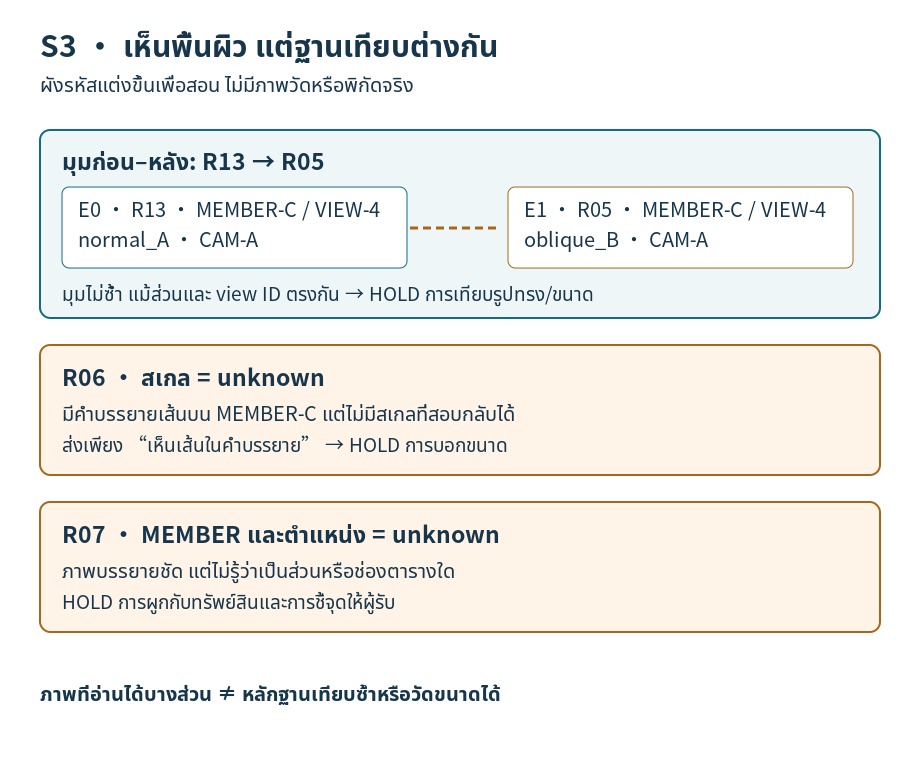
Diagram description: VIEW-4 is a planned image slot, not a confirmation that the angles are equal. R13/E0 normal_A and R05/E1 oblique_B therefore have their comparison put on hold; R06 cannot be used to measure size, and R07 cannot be tied to a part of the asset. Open the full-size angle and reference-data diagram
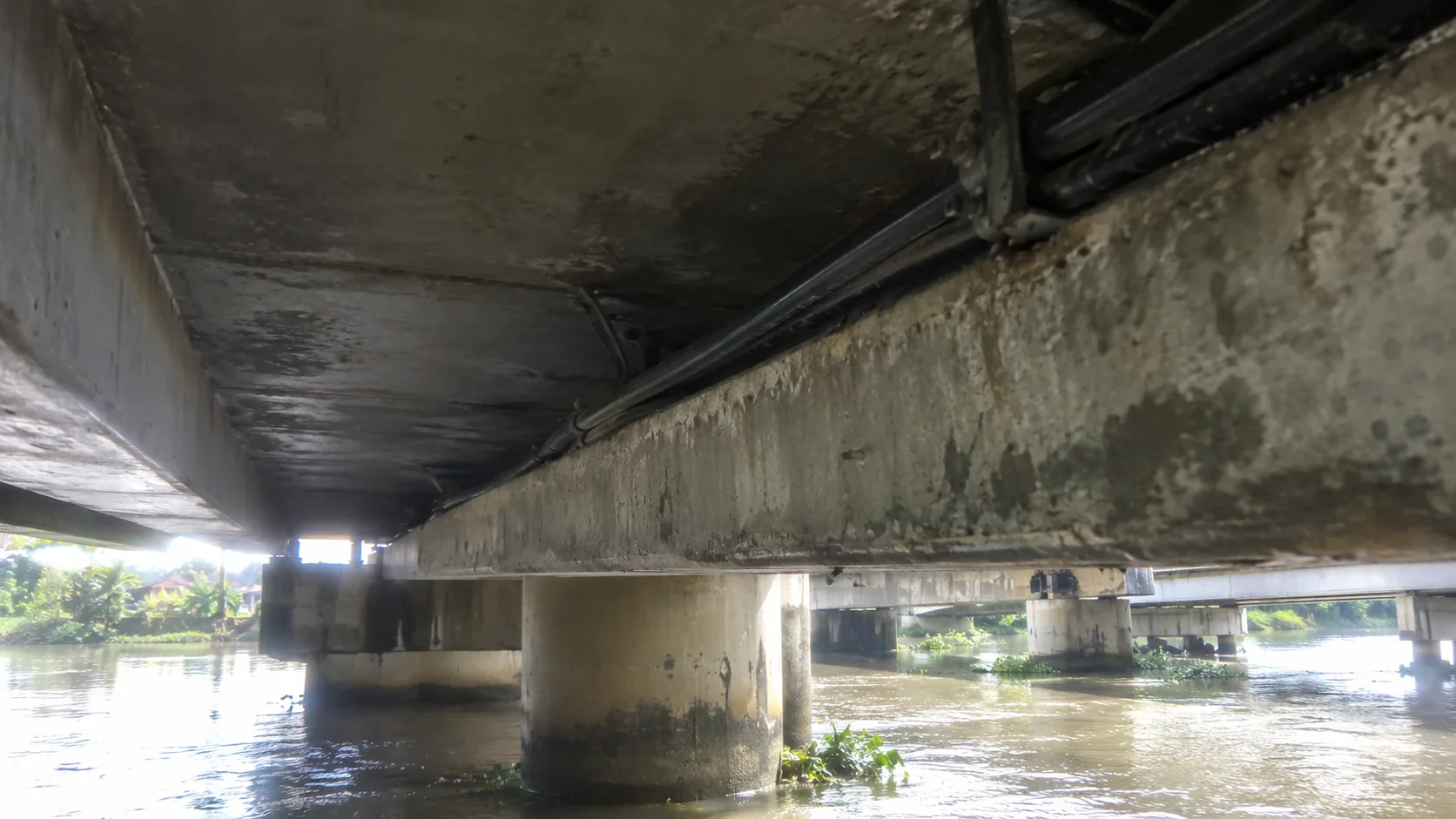
Image created for teaching helps in recalling only uneven lighting and obstructions; it is not the R03/R04 files, a before–after image, or evidence of a defect/safety. Material edges and shadows in the image are not enough to state the size, the real position or the cause. Open the full-size lighting and obstruction image
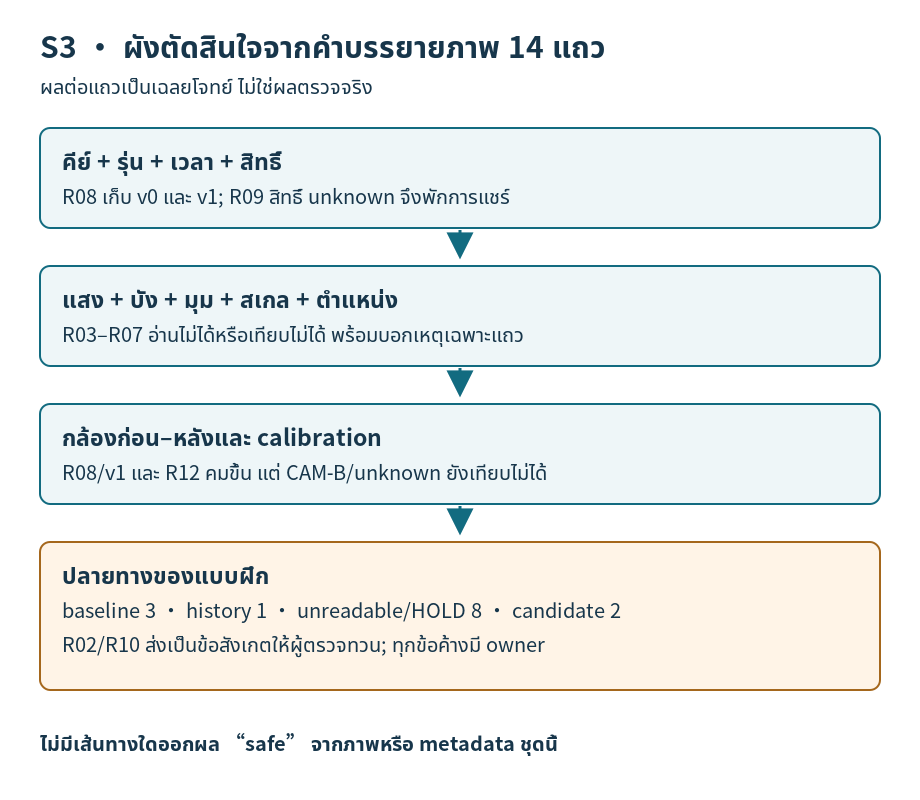
Diagram description: the answer separates 3 baseline, 1 history, 8 unreadable/HOLD and 2 candidates that still need to be reviewed by the inspector. The chart has no “safe” status. Open the full-size data-gate chart
When there is a request to use condition-inspection images to compare construction work
A new request may ask, “Can this image tell us the increased quantity of work yet?” Separate the deliverables before reusing the old files: a ledger of what is seen for the structural reviewer to re-check, geometry/quantity results with defined edges and units, and acceptance results under the contract are three different decisions. FHWA NBIS Q313-1/2 positions UAS as a supplementary tool for bridge inspectors in a US context; FHWA Construction Quantity Estimation describes quantitative data work that must take into account position referencing and processing. The chart and evidence gate that follow are the compiler's lesson design and not FHWA acceptance procedures or Thai rules.
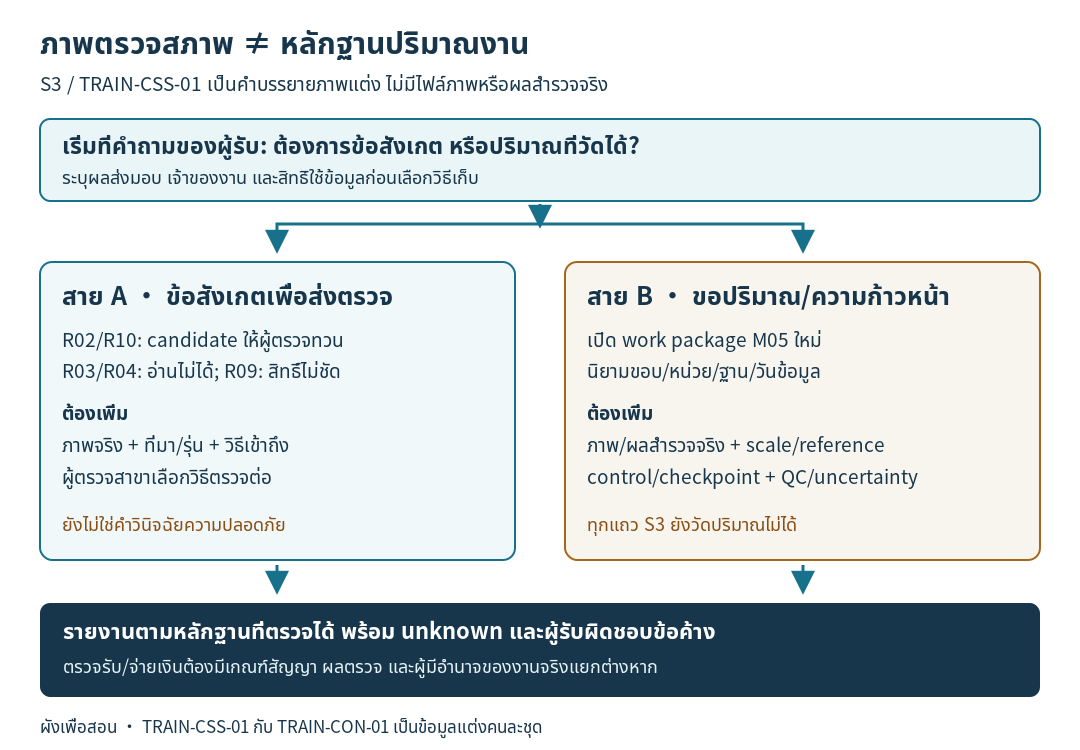
Diagram description: the left side sends Observations to a qualified inspector who chooses the review method; the right side must define the measurement job and check the real data before reporting quantities. Both paths still have separate decision authority and criteria belonging to the work owner. Open the full-size chart of the evidence seam
Scroll the table horizontally to see every column. When the table has keyboard focus, use the left or right arrow keys.
| Question from the recipient | What TRAIN-CSS-01 can provide |
Evidence/owner still to be added |
|---|---|---|
| “Which points should be checked further?” | R02/R10 are candidate_review from fabricated descriptions; R03/R04 are unreadable, R09's right to send is still unknown |
Collect real source images and metadata when permitted; a subject-matter reviewer re-checks the points, access methods and limitations before giving an opinion |
| “By how many units / what volume has it changed?” | cannot yet be answered for any row: there are no source images, no real scale/reference coordinates, no measured edges, no control/checkpoint results and no uncertainty | Open a new M05 work package: the recipient defines the work boundary, units/quantity basis, baseline/data date and horizontal–vertical reference system; the survey team proposes a ground or drone method and independent QC checks |
| “Is the work safe / can it be accepted or paid?” | No result regardless of which rows are readable or are candidates | The inspector/supervisor and the persons with real authority over the work must consider other inspection methods, measurement results that meet the criteria, contract terms and rights; this lesson sets no criteria in their place |
In problem S3, R05 does not match R13's angle, R06 has no scale, R07's position is unknown, and R08/v1 and R12 changed to CAM-B, whose calibration is not known. So the phrase “the image is clearer” or candidate_review must not be converted into “increased quantity”, even if the work owner wants a quick answer. If there is a real measurement request, record a new request and keep the original/version of S3; do not fill the missing values in the original CSV. TRAIN-CON-01 of M05 is another, separately fabricated fixture not a continuation of the data of TRAIN-CSS-01 and there are no field-measurement results to join or compute together.
Continue the KSEC practice from the existing criteria (not yet learner results): B: separate R02/R05/R06/R07 into “send to the inspector”, “hold to collect more” or “measurable”, then explain K the difference between the deliverables, and E not citing values that do not exist. O: write a brief for a new measurement request, stating the recipient, edges/units/baseline/data date, survey resources and hold points (S) together with a record of who is responsible for the outstanding items (C). D: write a negative test so that the system rejects quantity output when raw media, scale/reference, checkpoints or the camera contract are missing, and keep the old version for rollback (S/E/C). Use the KSEC and S3 rubric together with the M05 worksheet; this activity refers to the existing codes and adds no new KSEC outcomes or pass results.
The three KSEC groups' paths
All three groups use the same scenario but produce different deliverables. Read the rubric by code before checking your own work; the APP-CSS-* codes are new because the rows, the lighting and angle criteria, and CAM-B of this case differ from the M04/C01 outcomes tied to the original fixture. Pass results under the original codes are not used in place of one another. K = knowledge, S = skills, E = ethics, C = character observed from the work produced. Readiness to learn is not the same as readiness for the field.
B · Beginner: ledger of what is seen / not known
Prerequisites: know the part/angle of an image and can read record_id/revision in the CSV; if not ready, review M04 and observations versus conclusions. K explains the limitations of six kinds of image (APP-CSS-B-K01); S makes a brief and a table of source_row 2–15 (APP-CSS-B-S01); E does not say safe/damaged and does not share R09 (APP-CSS-B-E01); C keeps v0/v1 and comments with an owner (APP-CSS-B-C01). Download worksheet B.
O · Operator: access plan and image criteria
Prerequisites: can make a brief and a requested/confirmed ledger, and knows that the subject-matter reviewer determines the inspection method. K separates the system/people/image/reviewer gates (APP-CSS-O-K01); S compares four methods and plans seven phases against the image criteria before the work (APP-CSS-O-S01); E holds images/rights that are not yet sufficient (APP-CSS-O-E01); C keeps plan v0/v1 and follows up on the comments on R03/R08/R09 (APP-CSS-O-C01). Download worksheet O.
D · Developer: contract and rollback
Prerequisites: can read the time/version/unknown, separate expected from actual, and make a baseline; if not ready, review C01 camera kit and testing. K designs a contract for images/camera/rights/limitations (APP-CSS-D-K01); S tests baseline/mutation/before–after/rollback with real run results (APP-CSS-D-S01); E does not fabricate images/calibration or send R09 (APP-CSS-D-E01); C keeps an issue/reviewer log and the retest results after rollback (APP-CSS-D-C01). Download worksheet D.
What can be sent, and what the reviewer must still decide
Practice package REQ-CSS-01 must contain request/scope/alternatives/observation/unknowns/decision_limit/handoff. State E0/E1, the asset/member/view codes, source/revision, CAM-A/B, the 14 dispositions, training_only/unknown, the owner of the outstanding items and the review time. Start the handoff as not_sent; there is no evidence of actual sending, receipt or acknowledgement. The descriptions/readable images may be only an issue for a qualified inspector to choose the next inspection method which may include physical access. Do not use a hypothetical structure or AI images to announce real results.
The claim register with the usage limits for S3 is in research/drone-applications-case-studies-source-register.md in the repository. The US sources give the idea of separating roles and limitations; they did not check these fabricated data or approve a Thai curriculum. P3/P5 and CLO/PLO remain open as per the status above.