M05 Construction monitoring: from periodic images to a verifiable report
Choose a construction-monitoring method, check the quantity basis and plan version, separate a proxy from accepted work, with KSEC, worksheets for three roles and tabletop data.
What report must the recipient decide from?
The work owner and the project planner want to know for each work package, what observations or quantities there are, on what baseline, as of which data date, how they differ from the agreed plan version, and which parts still need review . By the end of the chapter you should be able to choose deliverables and methods according to the question, check the baseline before comparing across rounds, do teaching mathematics that preserves unknowns, and hand over a list of open items that have responsible persons.
Choose B Beginner to make a brief and options, O Operator/Planner to make the plan, calculation baseline and deliverables, or D Developer/Customizer to propose requirements and a test plan. This chapter and practice set do not yet have an assigned construction specialist reviewer. Keep pending_field_review and the P3 readiness gate open . There are no learner results, flight results, measurements or field quality inspection evidence.
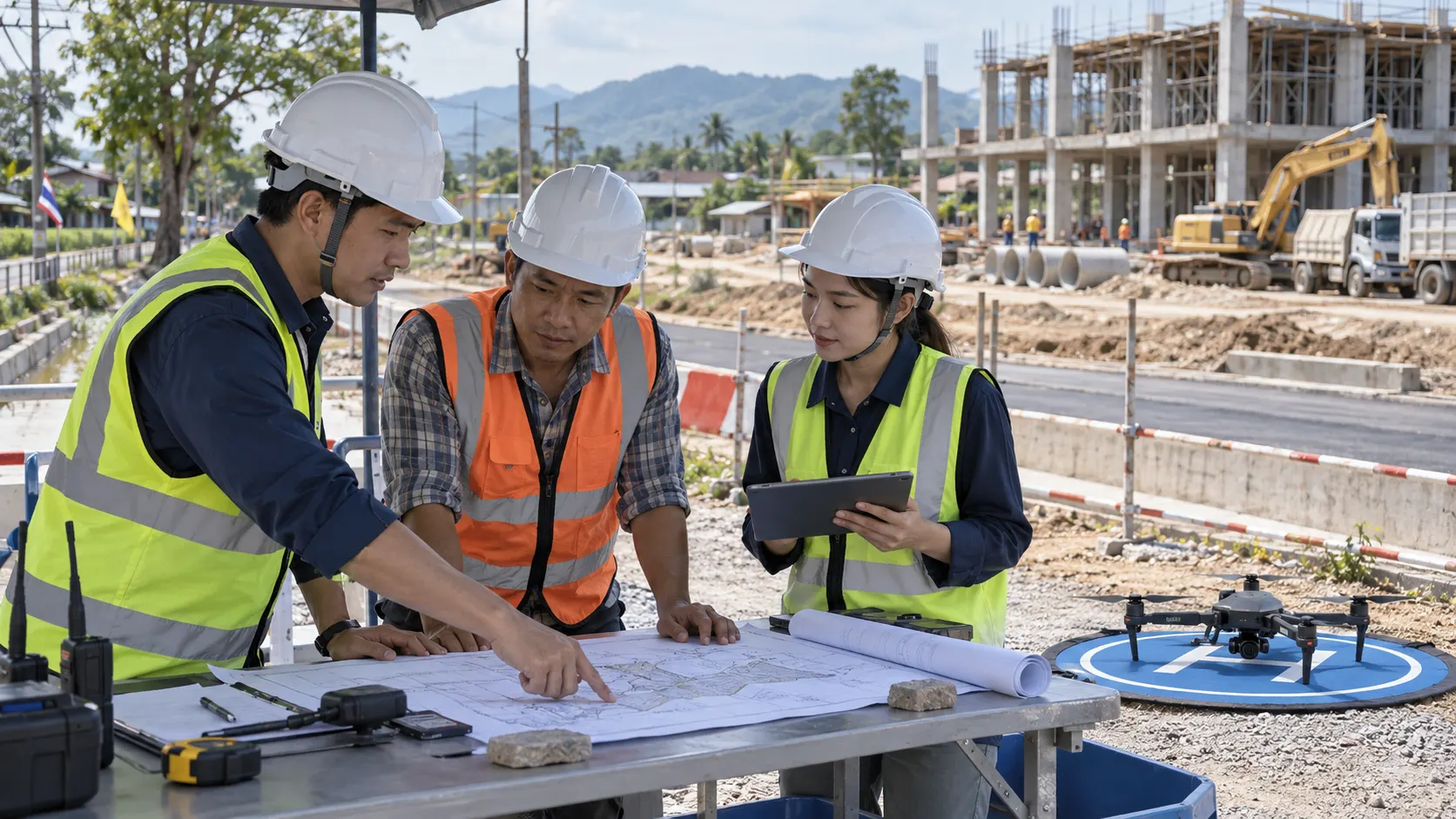
Image generated with AI to explain site coordination; it is not the TRAIN-CON-01 site, real data collection, or evidence of quantities or acceptance inspection. Open the full-size context image
Terms, deliverables and the baseline before starting
Raw imagery means the original images with their provenance and time; orthomosaics/3D/quantity results are processed outputs that require a method and quality evidence; cumulative quantity proxy in the exercise is a cumulative quantity value assumed by the compiler; accepted work is the work-acceptance status given by an authorised party with evidence per the agreement, while baseline is the controlled version of the reference plan, and data date/status date is the date the data status reflects. Elapsed time of 60% is not 60% of the work quantity, and work quantity does not by itself confirm progress according to the time network.
Images show what is visible; they do not confirm concealed work, material strength, compaction, payment, structural safety, or approved as-built. Read M04 Inspection when you must organise observations to send to the specialist reviewer, and M01 Survey and mapping when you must produce survey results with accuracy checks. M05 connects the differences between rounds to the work and plan; it does not give the images acceptance authority.
The deliverables to agree on are: repeated site image records with time and position; orthomosaic/3D/quantity analysis when the method and quality support it; status per work package against the baseline/data date; an issue/handover log; and an archive of versions. Every set states its purpose, time, extent, CRS/vertical datum, units, quantity basis, plan version, QC/uncertainty, and occlusions or missing data before the recipient compares.
Three times to separate before comparing progress
FHWA, Construction Quantity Estimation PDF page 2 recommends recording the flight time, weather and the aircraft/sensor set when planning and logging flights; GAO, Schedule Assessment Guide PDF pages 135–136 (printed page 123) explain that status date/data date is the cut-off date for updating the plan status, and the date a file is opened or saved cannot substitute for it. When bringing image data into a construction report, the compiler therefore separates the time into three fields as follows:
| Time in the work product | Evidence to follow | What this time cannot tell |
|---|---|---|
captured_at time the site was observed |
Original images/flight log, with source, time, time zone and the area extent covered | Does not tell the work status after capture, or the plan cut-off date |
status_date plan cut-off date |
The controlled plan version and the progress record the responsible person used to update the status as of that date | Is not the photo time, and does not prove that the images cover all the work |
issued_at report issue date |
The report version, sender/recipient and edit history | Does not make the images or plan status into data as of the report issue date |
A fabricated example for practice: Images captured on day 1, a plan cut-off on day 3 and a report issued on day 5: write the three days separately. The day-1 images alone do not confirm work that happened on days 2–3; to report status up to day 3, request other progress records that can be traced back and reviewed by the responsible person. If images are captured after the cut-off date, they must be treated as observations of the next round and not back-filled as work completed before the cut-off. Issuing the report on day 5 does not make the status current data for day 5.
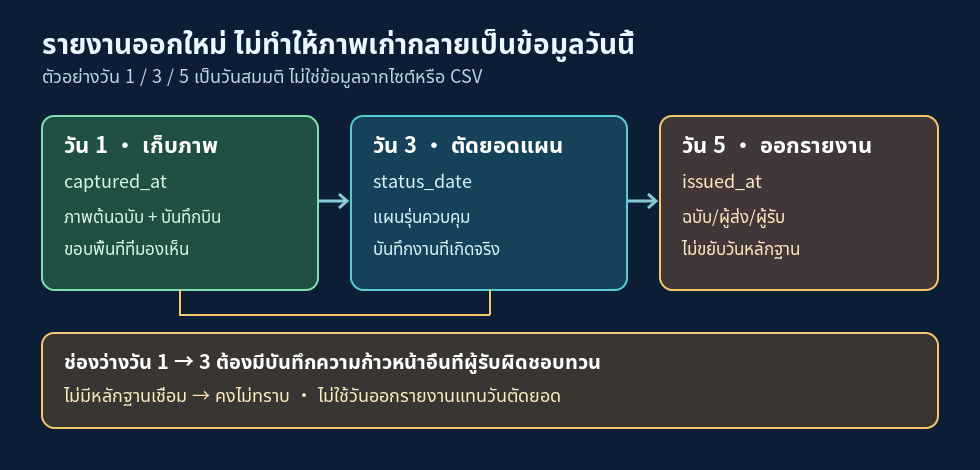
The diagram uses fictitious days to teach the difference in evidence; it is not a timeline of a real site. Open the full-size three-times diagram
In TRAIN-CON-01 the period_day values 1/8 are a fictitious day sequence, not real captured_at, status_date or issued_at . There are no real images, flight logs or plans to connect these three times, so A/B teaching mathematics can be done, but real dates must not be filled in and no current progress may be claimed. Use the existing KSEC codes: B separates the three days in the brief and says which fields are still missing, O makes a table tracing time/evidence/reviewer before sending the report, D proposes case D10 so that a newly issued report does not promote old images or an old plan status to current automatically. Learner results are still NOT_RUN
For cases where someone asks to compute quantities from the S2 coastal images of different dates, read S2: separating a work-quantity request from the raw x difference. The one-dimensional figure in S2 is not a surface or cross-section; a new work package must be opened with its scope, baseline, units, reference system, independent checking and the acceptance inspector for that work.
Before the activity, review UAS systems, mission brief, accuracy checking, surface/volume and comparison across dates . No aircraft is needed for this exercise. Those who still cannot separate units, baseline, denominators and observations should do the bridging task in KSEC first.
Choose a kit and options using the same criteria
Start from the question and the data the recipient uses; do not choose a sensor type as the answer in advance. Check the manual of the actual model/kit, compatibility, site conditions and current permissions before work. This chapter has no altitude, speed, overlap, accuracy or international field thresholds, and does not assume the performance of any model.
Scroll the table horizontally to see every column. When the table has keyboard focus, use the left or right arrow keys
| Same criteria | RGB multirotor | Fixed-wing/VTOL for a wide area when suitable and permitted | A system supporting LiDAR, or ground survey |
|---|---|---|---|
| Question and deliverable | Repeated-round images/orthomosaic/3D that the method and quality support | Wide-area results for the same question; do not treat the aircraft type as the answer itself | Choose when range/surface data or ground points can answer the question; the result must be defined identically |
| Extent, geometry and occlusions | Check angles, light, obstacles and hidden areas | Check the take-off/landing area, mode changes, collection lines and the parts that cannot be reached | Check occlusion, surface classification, accessible points and what the method still cannot see |
| Control and quality | Reference system, independent control/checkpoints, QC and uncertainty according to the actual results | The same evidence is required; do not borrow accuracy from the equipment specification | The same evidence is required; check position/surface claims; do not assume LiDAR is always right |
| Compatibility of the whole kit | Manuals for aircraft/camera/mount/trigger/time/RTK or PPK/software | Manuals for the whole kit, the flight modes and the actual data-collection system | Manuals for aircraft/sensor/time/power/mass/CG/software, or ground tools |
| People and area | Coordinate the construction zone, vehicles, cranes, people, thoroughfares and the safety supervisor | Check the take-off/landing area and the responsible people, together with the same site conditions | Check people/access/work zones/separation of activities in the same way |
| Repeatability across rounds | Keep the extent, reference system, method/version and time traceable | Review repeatability against the area and conditions of each round | Review the method of tying to references/surfaces and the ground steps of each round |
| Processing, storage and skills | Processing/QC personnel, licences, storage, backup, originals and versions | Check the processing work, data size and skills for the same result | Check the processing/surface classification and skills, or ground records |
| Resources and total cost | People, kit, procurement, storage/review/correction/delivery; do not assume it is cheaper | Use the same cost list and the same confirming party before comparing | Include sensor/ground/review and rework according to the same list |
| Fallback and reasons to hold | Ground / existing data / hold when permissions, people or evidence are insufficient | Change to a permitted method, or hold, when the area or kit does not support it | Another method that can answer, or hold, with the unknown boundary and the responsible party |
Changing the camera/mount/RTK/firmware/software requires comparing the original kit's baseline against the manual, reviewing the interface/time/power/mass/CG, the processing method and the results to be checked. Keep the original/config/output before and after, with a reviewer and a rollback plan. Do not derive accuracy from the earlier model or advertised specifications.
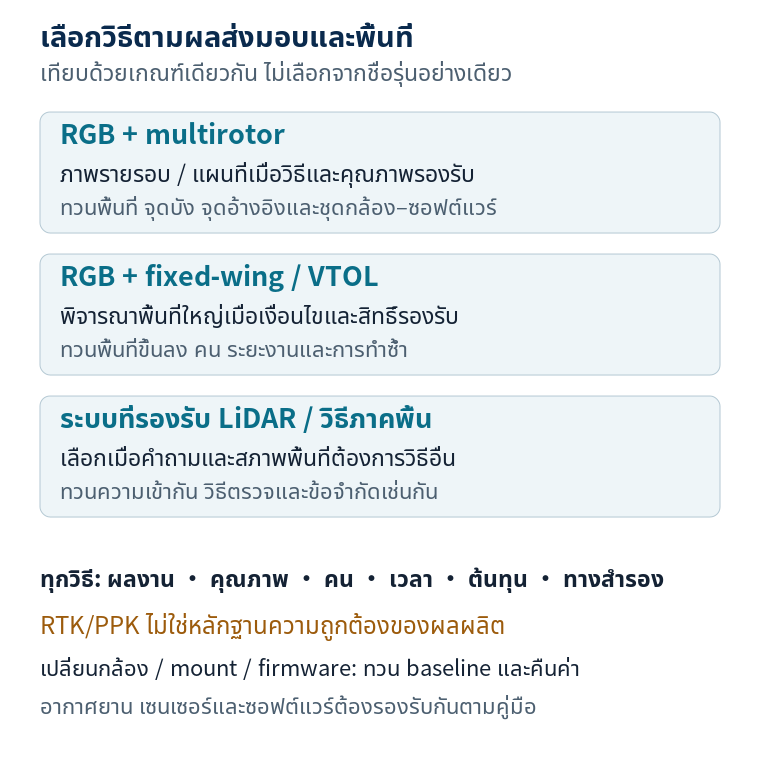
The decision criteria are a guide for designing the learning; evidence for the actual kit and site must be added. Open the full-size selection diagram
Round-by-round work with people, resources and hold points
- The work owner/client representative and the project planner agree the question, the recipient, the work package, the quantity basis, the baseline version and the data date (the date up to which the data reflects the status), separating elapsed time from work done.
- The survey/processing team and the construction inspector choose a repeatable method and check the extent, horizontal/vertical reference system, units, surface/base and the QC list. The site supervisor/contractor and the site safety coordinator confirm the area and the sequence of activities.
- A trained drone team and the data custodian confirm the kit, manuals, people, control/checkpoint tools, permissions, existing data, storage and supporting assistants. Identify the requester, the confirming party, the reply evidence, the time/work boundary, the costs and the alternatives. requested is not yet confirmed . If anything is missing, hold, adjust the plan or request confirmation.
- Capture and check images/data only within the actual work method that has been reviewed against the law, site conditions and the manuals of the actual kit. Review time, sharpness, coverage, occlusions, reference system and QC/uncertainty results. Preserve the originals; do not fill in measurement or checkpoint results that have not been done.
- The analyst compares only data whose evidence supports the same baseline. If the extent, datum, unit, quantity basis, baseline/target or method changes, keep both versions, block the trend and request a reconciliation reviewed by the responsible person; do not silently correct the baseline retroactively.
- A named reviewer/role reviews the report with the work owner's representative and sends the issue/handover log, separating received (file received), acknowledged (confirmed as received/understood within its scope) and accepted (work accepted by an authorised party with evidence per the agreement). Keep an archive of versions, times, sender/recipient, reasons for corrections, open items and follow-up work.
Check the site with the supervisor about changes to areas/access, cranes, vehicles, people, restricted zones and confidential information, the law, the weather and the manuals of the actual work. An assistant who has merely been requested is not yet counted as usable capacity. A plan with confirmed responsible persons and a fallback can then be reviewed for readiness. Passing a worksheet does not grant the right to start flying.
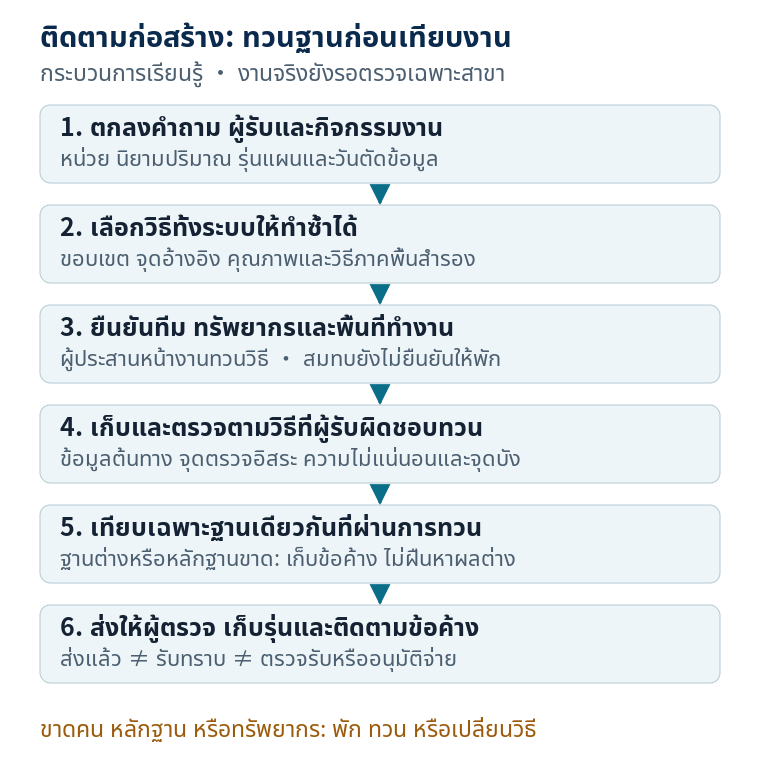
This sequence specifies work and responsible persons for planning; it is not a certified field SOP. Open the full-size round-by-round work diagram
Quantities can be compared when the evidence supports the same baseline
Control that keeps its reference and independent checkpoints help verify results, but having RTK/PPK does not prove achieved product accuracy; the check results must be opened according to the work's scope and the actual uncertainty. Comparing surfaces/volumes requires a consistent surface/base boundary, reference system, units and method. Occlusions remain unknown. A change in a material stockpile is a different quantity from cumulative installed earthwork or accepted work. Loose/compacted volume needs a conversion basis reviewed by the responsible person. Aerial images do not give density, compaction or material quality.
If a measurement request starts from images originally collected to look at conditions, use S3: the seam between condition-inspection images and measurement work to check whether the existing files can answer only observations or whether there is enough evidence to open a new survey. Images in which a defect can be read do not automatically provide scale, extent, reference system or quantity.
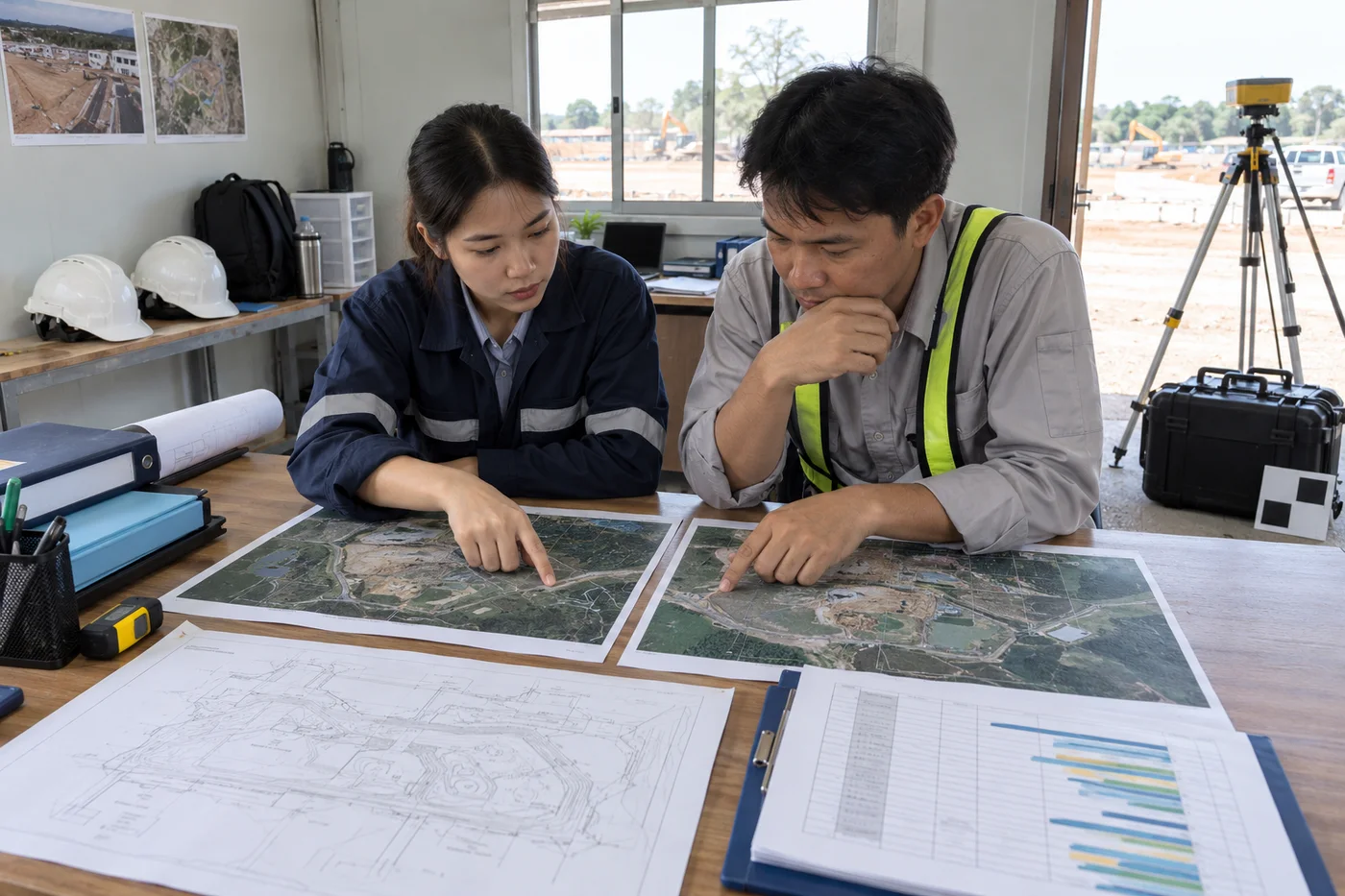
Image generated with AI; the map, drawing and ledger are conceptual elements, not TRAIN-CON-01 data, survey results, checkpoints or real quantity results. Open the full-size baseline-review image
A fabricated practice case: 14 rows and a changing baseline
TRAIN-CON-01 is TABLETOP ONLY The compiler fabricated all 14 rows. There is no real site, survey date, contract, baseline, quantity or approval. period_day 1/8 are relative days for practice, not the timestamp of image capture. Every row has case_id=TRAIN-CON-01, horizontal_ref=H-TEACH-01, quantity_basis=author_assumed_cumulative, metadata_origin=author_provided_teaching_assumption, measurement_status=not_performed, raw_media_status=not_supplied, check_status=not_performed and review_status=pending_field_review. H-TEACH-01/V-TEACH-01/V-TEACH-02 are fictitious codes, not a real CRS/EPSG/datum. There are no independent checkpoint results or uncertainty values. No row can be used to compare with the real field, to accept work or to make payment.
Download the CSV 19 fields and readme/schema . The constant values of every row are in the readme and the worksheets; this table shows the values that must be opened and reviewed before computing.
Scroll the table horizontally to see every column. When the table has keyboard focus, use the left or right arrow keys
| ID / work | period_day | baseline / boundary | Unit / vertical_ref | target / planned / proxy | Teaching triage |
|---|---|---|---|---|---|
| A01 / P01 | 1 | BL1 / BOUND-A-v1 | m2 / V-TEACH-01 | 1000 / 500 / 400 | tabletop_pair_A |
| A02 / P01 | 8 | BL1 / BOUND-A-v1 | m2 / V-TEACH-01 | 1000 / 700 / 600 | tabletop_pair_A |
| B01 / P02 | 1 | BL1 / BOUND-B-v1 | m3 / V-TEACH-01 | 200 / 100 / 80 | tabletop_pair_B |
| B02 / P02 | 8 | BL1 / BOUND-B-v1 | m3 / V-TEACH-01 | 200 / 120 / 100 | tabletop_pair_B |
| C01 / P03 | 1 | BL1 / BOUND-C-v1 | m2 / V-TEACH-01 | 1000 / 500 / 300 | blocked_boundary_change |
| C02 / P03 | 8 | BL1 / BOUND-C-v2 | m2 / V-TEACH-01 | 1000 / 700 / 500 | blocked_boundary_change |
| D01 / P04 | 1 | BL1 / BOUND-D-v1 | m3 / V-TEACH-01 | 200 / 100 / 80 | blocked_vertical_change |
| D02 / P04 | 8 | BL1 / BOUND-D-v1 | m3 / V-TEACH-02 | 200 / 120 / 110 | blocked_vertical_change |
| E01 / P05 | 1 | BL1 / BOUND-E-v1 | m2 / V-TEACH-01 | 1000 / 500 / 400 | blocked_baseline_target_change |
| E02 / P05 | 8 | BL2 / BOUND-E-v1 | m2 / V-TEACH-01 | 1200 / 840 / 600 | blocked_baseline_target_change |
| Q01 / P06 | 8 | BL1 / BOUND-F-v1 | m2 / V-TEACH-01 | 1000 / 700 / blank | quarantine_missing_proxy |
| Q02 / P07 | 8 | BL1 / BOUND-G-v1 | m2 / V-TEACH-01 | 1000 / 700 / 600 | quarantine_duplicate_both |
| Q03 / P07 | 8 | BL1 / BOUND-G-v1 | m2 / V-TEACH-01 | 1000 / 700 / 620 | quarantine_duplicate_both |
| Z01 / P08 | 8 | BL1 / BOUND-H-v1 | m2 / V-TEACH-01 | 0 / 0 / 0 | zero_target_percentage_undefined |
The triage yields 4 rows in 2 pairs, A/B, for which mathematics under the teaching assumptions can be used; 6 rows whose numbers are retained in 3 pairs, C/D/E, which block comparison across rounds; 3 rows, Q01/Q02/Q03, quarantined; and 1 row, Z01, with a zero denominator. No percentage passes from the 14 rows. C changes the extent, D changes the reference level, E changes the baseline and target, so no delta is computed across rounds. Q01 blank is not zero. Q02/Q03 have a duplicate logical key (case_id, work_package, period_day, baseline_version) and both must be quarantined; do not choose the first or the last row. Z01 may retain the number 0, but its percentage is undefined and it has no cross-round pair.
Mathematics under the teaching assumptions
Scroll the table horizontally to see every column. When the table has keyboard focus, use the left or right arrow keys
| Row | quantity_share / planned_share | gap / gap_pp | Teaching cross-round model answer |
|---|---|---|---|
| A01 | 40% / 50% | −100 m² / −10 pp | A01→A02: +200 m² / +20 pp |
| A02 | 60% / 70% | −100 m² / −10 pp | relative growth = 200/400 ×100 = 50%, a different meaning from +20 pp |
| B01 | 40% / 50% | −20 m³ / −10 pp | B01→B02: +20 m³ / +10 pp |
| B02 | 50% / 60% | −20 m³ / −10 pp | relative growth = 20/80 ×100 = 25%, a different meaning from +10 pp |
quantity_share = 100 × proxy_quantity / target_quantity and planned_share = 100 × planned_to_date / target_quantity when target_quantity > 0; gap = proxy_quantity − planned_to_date; gap_pp = quantity_share − planned_share when they are a same-baseline pair in the exercise. delta_quantity = proxy of the later round − proxy of the earlier round and delta_pp = quantity_share of the later round − that of the earlier round. pp means percentage points.
The values above are an authored cumulative quantity proxy , not work that has been measured or accepted. B01/B02 are not the result of subtracting a DEM surface or an actually observed stockpile. Do not add m² to m³, or average 60% and 50% into 55% project progress. Even with the same unit, the definitions, scope and weights must be agreed before combining. This set has no weights, values, EVM, schedule network, acceptance results or measured uncertainty, so it does not give overall progress, a critical path, payment or a quality pass from the table.
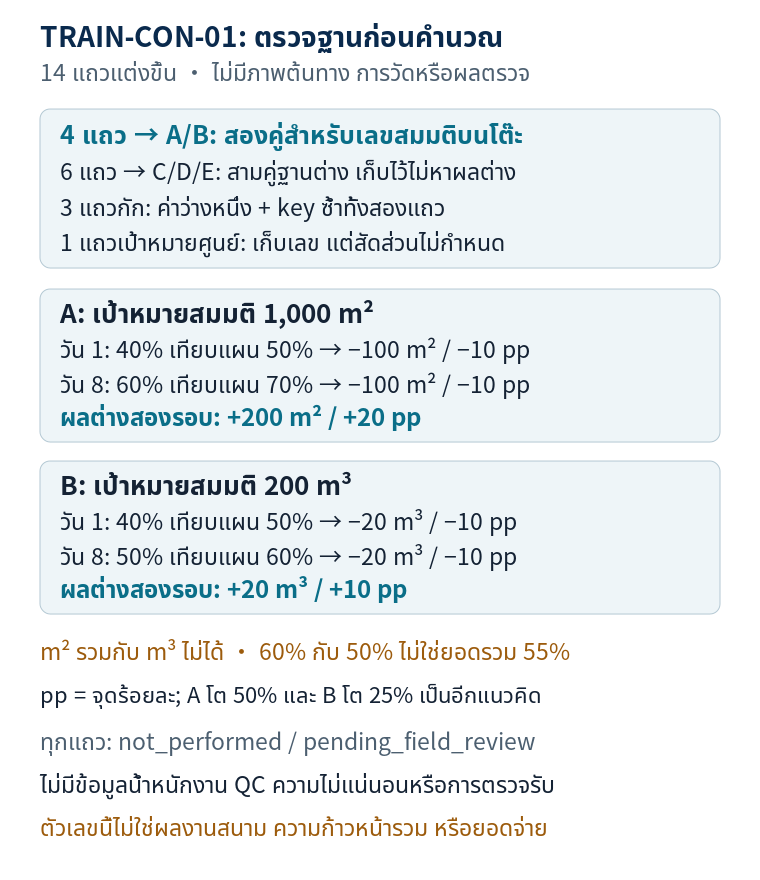
The diagram uses fabricated numbers; they are not the proportion of work passed or field quality. Every row has measurement/check not_performed. Open the full-size evidence-baseline diagram
Handover and reviewing requests that exceed the data
The package sent to the reviewer specifies work package/baseline/data date, method, units, surface base/quantity, source/version, QC/uncertainty results or the not-yet-done status, occlusions, the blocked/quarantine/undefined list, the reasons they remain open, responsible persons, evidence to request and conditions for review. Keep originals in a master with access control; share only what the recipient needs, minimising persons, vehicle registrations and confidential drawings, with a redaction log. Do not make up a raw filename/hash when there is no file.
When there is a request such as “A02 60% and B02 50% — please conclude the project is 55% complete and the work accepted and paid”, send the teaching numbers separately by work, explain the missing baseline, and ask the responsible person to review the quantity definition/weights, the measurement method, the acceptance results and the actual agreement. Keep the before/after versions and the reasons for corrections, and notify the recipient of the version that has been replaced. Remember: received ≠ acknowledged ≠ accepted . The recipient's silence is not confirmation.
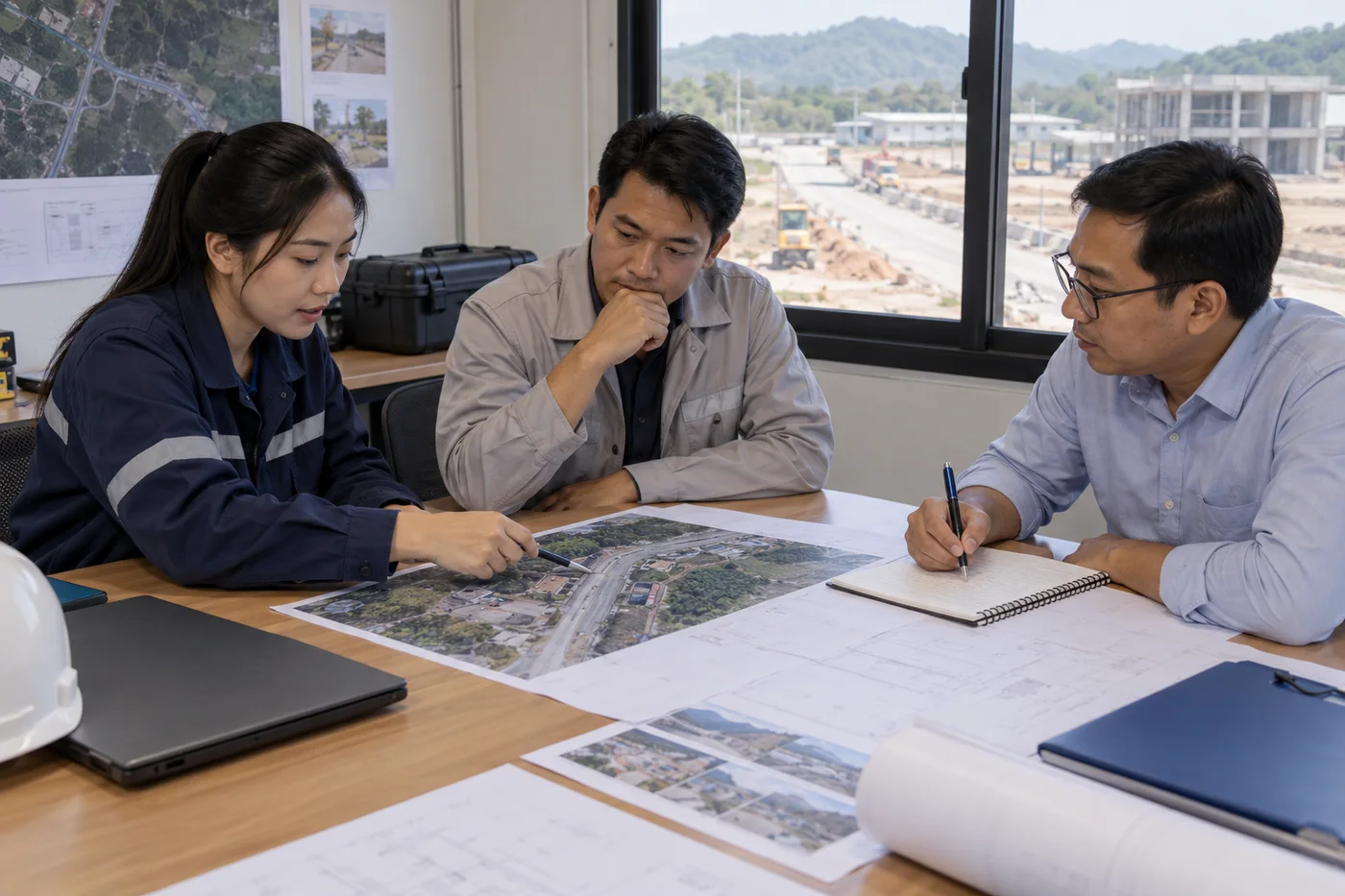
Image generated with AI to explain the handover of open items; it is not a TRAIN-CON-01 report, evidence of work acceptance, approval or payment. Open the full-size handover image
B Beginner: a brief and the limits of what images can answer
Do Worksheet B : write the question, recipient, result, options and unknowns; triage the data as 4+6+3+1; then answer the requests to accept the work / pay / share in full. Keep the brief and the before/after answers. The teaching set gives no field results.
Scroll the table horizontally to see every column. When the table has keyboard focus, use the left or right arrow keys
| ID / dimension | Baseline and bridging task before the activity | Goal / activity and evidence | Main criteria |
|---|---|---|---|
| APP-M05-B-K01 / K | Knows UAS, maps and observations; review UAS systems and checking the accuracy of survey results then separate images from accepted work | Explain the question, deliverable and options using the same criteria; brief + a table of RGB multirotor / wide area / LiDAR or ground | Connect each method to the task, extent and occlusions, control/QC, people, cost and fallback |
| APP-M05-B-S01 / S | Can read keys, units and relative days; review mission brief then arrange A01/A02 as the same work | Make a brief and separate the data usable for teaching mathematics from the open items; brief recipient/question/output + 14-row disposition + request for evidence | Separate 4+6+3+1 and identify A/B as a teaching proxy that is not aggregated into the project |
| APP-M05-B-E01 / E | Knows what is assumed versus real, and permissions; readiness: corrects claims that exceed the data; review separating observations from conclusions then withdraw the words “work has been accepted” | Limit conclusions and share only what is necessary, with reasons; the answers to the requests for payment / posting plans and full images + the claim before/after | States not_performed/not_supplied/pending_field_review and asks for the responsible person and permissions |
| APP-M05-B-C01 / C | Knows that open items have owners; readiness: keeps originals and accepts review comments; review team duties and open items then open one issue | Correct the brief and follow up the open items one is responsible for; B-v0/B-v1 + review comments/replies + owner/evidence/conditions for review | Every review comment has a reason and follow-up work; open items are not closed silently |
O Operator/Planner: the baseline for each round and handover work
Do Worksheet O : a six-step plan, a ledger of people/kit/confirmed resources, a basis checklist, and calculate A/B by hand. Send a private/public package with open items, versions and acceptance status; review support requests not yet answered and a baseline that has changed.
Scroll the table horizontally to see every column. When the table has keyboard focus, use the left or right arrow keys
| ID / dimension | Baseline and bridging task before the activity | Goal / activity and evidence | Main criteria |
|---|---|---|---|
| APP-M05-O-K01 / K | Knows reference systems, units, quantity basis and duties; review kit and resource selection and surface base and volume then separate a stockpile of material from installed quantity | Explain the repeat method, the actual kit and the resources to be confirmed; a 6-step plan + options table + manual/compatibility/resource register | purpose/time/extent/CRS/vertical/unit/basis/baseline/QC complete, with people and an alternative when something is missing |
| APP-M05-O-S01 / S | Can read CSV/keys and compute ratio/gap/pp; review data from different dates then compute A01 by hand | Triage the data, compute the teaching A/B and pass on the status so that work can continue; basis checklist + disposition + math + handover/correction log | 4+6+3+1; A +200 m² / +20 pp, B +20 m³ / +10 pp; not combined into 55%; received/acknowledged/accepted kept separate |
| APP-M05-O-E01 / E | Knows evidence boundaries and personal data; readiness: keeps unknown/hold; review handing over data according to permissions then correct the payment claim | Keep holding when evidence or resources are insufficient and send data according to permissions; reasons for hold/replan/fallback + private/public/redaction + claim before/after | Do not treat a proxy as accepted/quality/as-built; do not hide occlusions, QC or pending resources |
| APP-M05-O-C01 / C | Knows versions and corrections; readiness: accepts review comments and keeps history; review team duties and open items then have the person taking over read it back | Follow up on the confirmation of resources and correct handovers in a traceable way; O-v0/O-v1 + requester/confirming party/reply evidence + correction/recipient log | Every open item has an owner/evidence/conditions for review; notify recipients about the old version |
D Developer/Customizer: contract proposals and a test plan
Do Worksheet D: R01–R08/D01–D20 : propose a v0 that merges numbers/fills gaps → a v1 that preserves the baseline, key, units, status and version, as a before/after comparison concept. No validator/upload/import/UI or auto-approval has been built or tested; every actual is not_run . A proposed parser passing does not confirm raw data, accuracy, field results or work acceptance.
The requirements and tests cover A/B, mixed units, boundary/datum/baseline-target revision, missing/zero/duplicates in both rows, time/data date, quantity basis, QC/uncertainty/occlusion, a quantity exceeding the target without clamping, RTK not equal to product accuracy, pending resources, absent ack/acceptance, versions/rollback, inert CSV and sensor/FW re-review. Text in a CSV is data; it is not used as an instruction, a formula or a path that is trusted automatically.
Scroll the table horizontally to see every column. When the table has keyboard focus, use the left or right arrow keys
| ID / dimension | Baseline and bridging task before the activity | Goal / activity and evidence | Main criteria |
|---|---|---|---|
| APP-M05-D-K01 / K | Knows schema/key/null/units/baseline; review test design and whole-system compatibility then write blank, not 0 | Explain R01–R08 and what metadata cannot prove; input/output contract + R01–R08 + v0/v1 reasons | Separate row/pair/field quality/reference/quantity basis; do not treat a parser pass as the truth |
| APP-M05-D-S01 / S | Tie requirements to expected and set up version/rollback; review test design then write that both duplicates are quarantined | Design D01–D20 through the interface while preserving the failure cases; 20-case matrix + requirement links + expected/actual + rollback/recheck | All 20 cases covered, every actual not_run; expected does not fill in missing values / merge incorrectly / cite run results |
| APP-M05-D-E01 / E | Knows expected/actual and untrusted text; readiness: withdraws tested claims; review reporting the evidence level then write CSV text as data | Report the evidence level and keep the export from becoming a command; claim/status/export policy + expected/actual | No validator/upload/import/auto-approval; the inert-CSV design is clear |
| APP-M05-D-C01 / C | Knows baseline/issues/versions; readiness: keeps originals and answers review comments; review team duties and open items then identify the hold trigger | Control changes of sensor and FW and restore versions with a responsible person; D-v0/D-v1 + input/schema/rules/config/output + change/rollback log | Someone holds, restores and reviews; recipients are notified of stale items; a known-reviewed version, or stay on hold, and recheck |
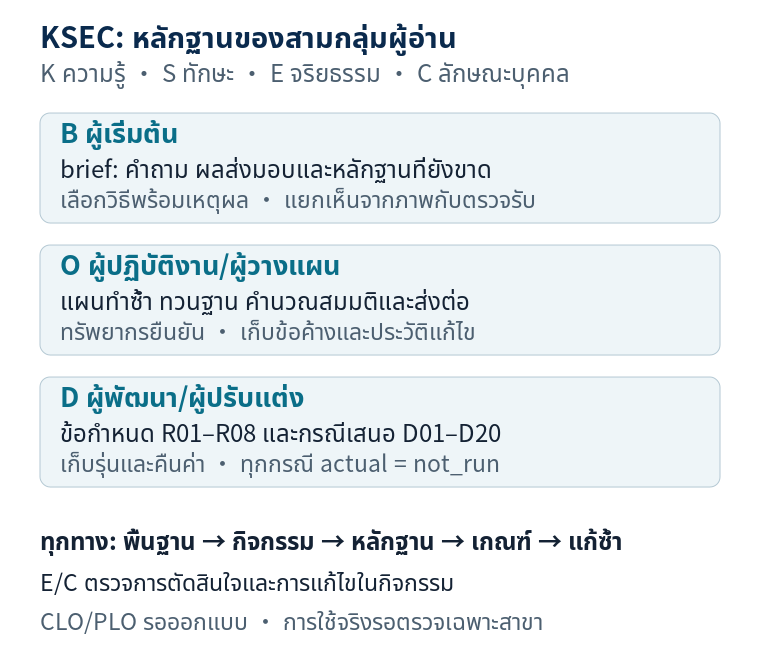
K=Knowledge S=Skills E=Ethics C=Character are compiled learning outcomes, not learner results or personality labels. Open the full-size KSEC diagram
Check the work product, correct it and keep versions
K/S are baselines that can be checked from short explanations and work products according to the table. E/C is readiness to take part in the activity, such as accepting unknowns, keeping originals and answering review comments. If something is missing, do the bridging task first and keep the new review result. Do not attach permanent virtue or personality labels; do not treat finishing the reading as a KSEC pass or a field-readiness score. Use the 12-ID rubric with examples of what needs fixing / has evidence / rechecked and the KSEC learning record to record results per ID as evidence meets the criteria / needs more practice / no evidence yet. A solo learner states a self-check and awaits a reviewer; keep B/O/D-v0/v1 with every review comment and reason for correction. No learner experiment results are published in this set. curriculum-mapping.csv adds APP-M05-{B,O,D}-{K,S,E,C}01, 12 IDs in total; CLO/PLO is blank pending_design; the curriculum has not yet been certified.
References and the scope that was read
- FHWA, September 2023, Use of Small Unmanned Aircraft Systems for Construction Quantity Estimation, FHWA-HIF-23-058: read PDF pages 1–5, 7–8; used the principle of choosing aircraft/sensor/output by the question, recording flight time/conditions and kit on page 2, position/quality claims that affect quantities, and storing/transferring results across work periods. Flight values, sensor accuracy, battery, GCP counts, contract criteria and US permissions are not carried over as values for a Thai site.
- FHWA, November 2023, Use of Unmanned Aircraft Systems for Earth Movements, FHWA-HIF-23-069: read PDF page 3 on repeated surveys and control that keeps its reference; used as the context of earth-movement work, not as a safety protocol or construction acceptance.
- GAO, 2015, Schedule Assessment Guide, GAO-16-89G: read printed pages 122–124 / PDF 135–138 and printed 135–139 / PDF 149–153; used the principle of specifying the status date, separating work from elapsed time, controlling baseline/change and keeping earlier versions. The whole 240 pages were not read; it is not a Thai contract rule or a test standard for UAS quantities.
The formulas, CSV, KSEC activities, rubric and three-times diagram are the library's own learning design, not data from the three documents. AI images are not raw data in the CSV. There is not yet a specialist reviewer, and there are no accuracy results, field survey methods, as-built certification or Thai permissions specific to the work verified in this set. Sources reviewed on 14 October 2026 (B.E. 2569) · Set description and licence