Activity guide: drones for public safety
Align readings, activities, deliverables and assessment. Use this as a teaching-preparation plan and adjust timings after trialling with learners.
Instructor guide · awaiting a real teaching trial
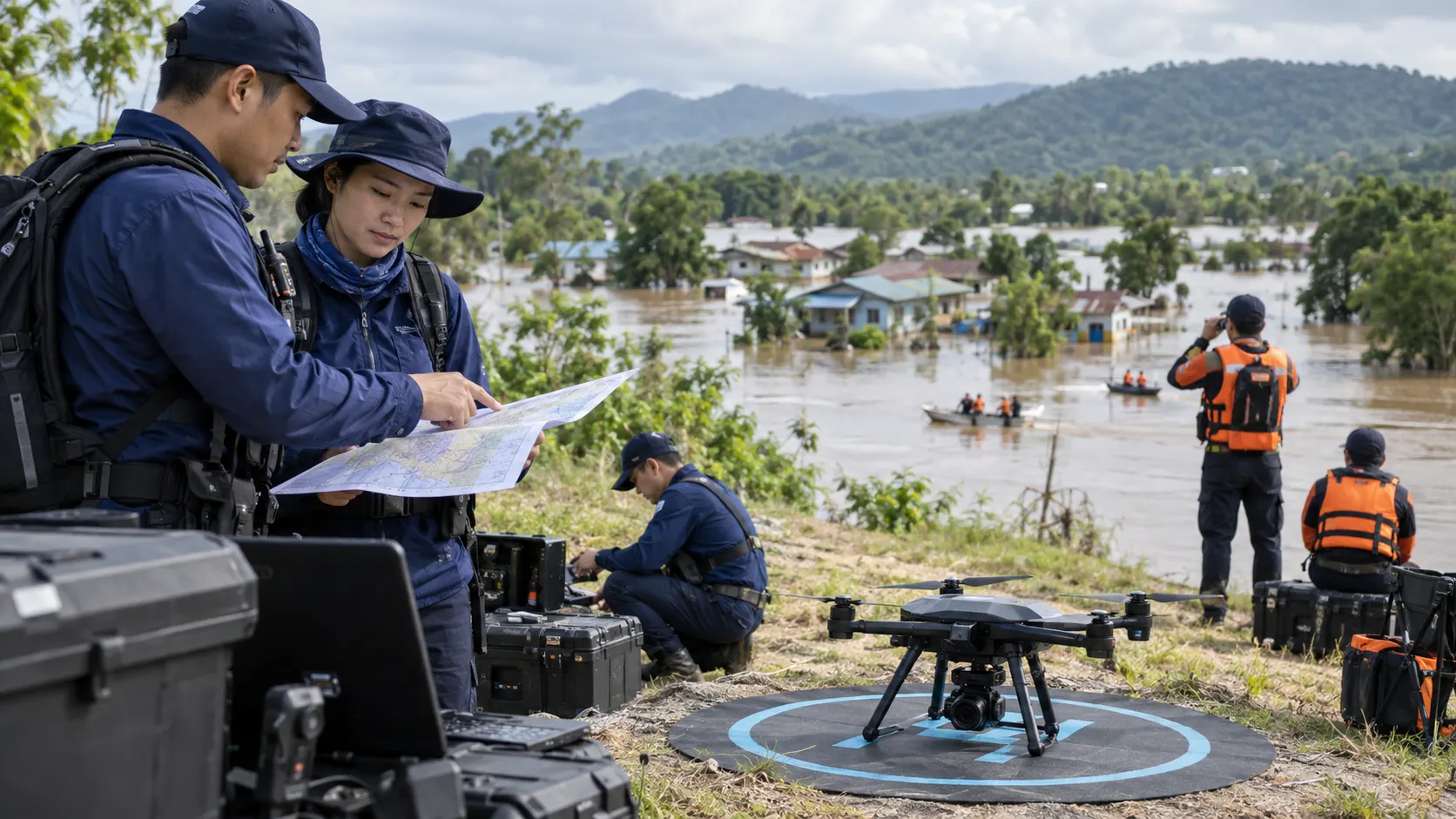
Align readings, activities, deliverables and assessment. Use this as a teaching-preparation plan and adjust timings after trialling with learners.
Preparation before the course opens
- Check learners' prior knowledge and computers, download the practice kit and test the commands in the same environment as the classroom.
- Separate readings/PC work from activities that require installing a framework or using real equipment stations, and assign responsibilities before setting the practice date.
- Prepare examples whose usage rights can be checked, schedule breaks outside the net class hours, and announce the deliverable criteria in advance.
- Use draft scores as information for adjusting teaching; do not issue professional certificates for reading the website or submitting a CSV.
Public Safety, foundation level
Before class: able to use maps and basic CSV files; a drone is not required for the tabletop exercise
Combined deliverable: mission-request SOP, incident map and data handover package from a tabletop exercise
16 net class hours, plus 60 minutes of separate pre-class preparation
G01 · Law and roles · 60 minutes
Open the chapter and worksheet →
Explain 15 min · Hands-on practice 30 min · Review/reflection 15 min
Use the 60-minute core chapter within this time; do not add the time twice
Ask before revealing the model answer: Which information is a condition of this mission, and which information cannot yet be used for decisions?
Evidence to check: all 4 aspects covered; every conclusion has a source ID or is marked as awaiting confirmation
G02 · Risk and teamwork · 60 minutes
Open the chapter and worksheet →
Explain 15 min · Hands-on practice 30 min · Review/reflection 15 min
Use the 60-minute core chapter within this time; do not add the time twice
Ask before revealing the model answer: What new information would make you change your decision?
Evidence to check: at least 3 risks; each item has an owner and a review condition
G03 · Governance and the data lifecycle · 60 minutes
Open the chapter and worksheet →
Explain 15 min · Hands-on practice 30 min · Review/reflection 15 min
Use the 60-minute core chapter within this time; do not add the time twice
Ask before revealing the model answer: Who needs to see the original, and who can use reduced-detail data?
Evidence to check: the owner and retention/deletion of every dataset are specified; unconfirmed legal exceptions are clearly shown
G04 · Systems and evidence of work · 60 minutes
Open the chapter and worksheet →
Explain 15 min · Hands-on practice 30 min · Review/reflection 15 min
Use 30 minutes of the core chapter and 30 minutes of additional activity within this time; do not add the time twice
Add 5 system requirements for this track, have a peer separate verification from validation, link test methods and evidence to the system version, then fix requirements that cannot be measured before testing
Ask before revealing the model answer: Which simulator results still cannot be used to validate real hardware?
Evidence to check: at least 5 measurable requirements; units, versions and limitations specified
G05 · Image quality and AI evaluation · 60 minutes
Open the chapter and worksheet →
Explain 15 min · Hands-on practice 30 min · Review/reflection 15 min
Use the 60-minute core chapter within this time; do not add the time twice
Ask before revealing the model answer: In this case, is missing a target or raising a false alarm more harmful, and why?
Evidence to check: correct examples of false positives/negatives given; metrics and limitations specified
P01 · Team setup and incident-coordination SOP · 180 minutes
Open the chapter and worksheet →
Explain 45 min · Hands-on practice 105 min · Review/reflection 30 min
At the advanced level, add two requests competing for the same resources; prioritise them by the outputs the recipients need and report constraints back
Ask before revealing the model answer: Who uses the output, and whom do you notify when the information is insufficient?
Evidence to check: requester/recipient/data controller/termination conditions all specified; mutual understanding confirmed
P02 · Imagery and maps supporting incidents · 180 minutes
Open the chapter and worksheet →
Explain 45 min · Hands-on practice 105 min · Review/reflection 30 min
At the advanced level, import the checked CSV into QGIS via the existing mapping chapter, set the CRS according to the source, and check reference locations without publishing real victims' data
Ask before revealing the model answer: What in this image still needs confirmation from another source?
Evidence to check: no item with wrong coordinates/time from the planted error set slips through as confirmed data
P03 · Preserving evidence and handing over data · 120 minutes
Open the chapter and worksheet →
Explain 30 min · Hands-on practice 75 min · Review/reflection 15 min
At the advanced level, have a receiving team check the ZIP against the manifest without seeing the sender's steps, then practise handling revised versions without overwriting the original
Ask before revealing the model answer: When hashes differ, how will you stop and investigate?
Evidence to check: file hashes match the manifest; original source, copies, sender/recipient and redacted data all specified
P04 · Exercise and lessons learned · 180 minutes
Open the chapter and worksheet →
Explain 45 min · Hands-on practice 105 min · Review/reflection 30 min
At the advanced level, add conflicting requests and late-arriving data, swap roles and rehearse again, using the same criteria for a fair comparison
Ask before revealing the model answer: Was the slower result caused by the data, the tools or the coordination?
Evidence to check: all planted errors in the practice kit detected; every learner can explain their own decisions
Assessing the combined deliverable
- Wrong/ambiguous data are not elevated to confirmed data
- Roles and data recipients are clearly separated
- Originals and reduced-detail data are not mixed
Draft rubric: accuracy 30, traceable evidence 30, reasoning and limitations 25, communication 15, total 100; draft target 75 with every critical criterion passed. Two instructors should trial-score the same piece of work and adjust criteria they interpret differently.
Public Safety, advanced level
Before class: has a basic data handover package that meets the criteria and can explain coordinate/time checks
Combined deliverable: a multi-incident scenario with injects, together with a custody log and after-action report
24 net class hours, plus 120 minutes of separate pre-class preparation
G02 · Risk and teamwork · 60 minutes
Open the chapter and worksheet →
Explain 15 min · Hands-on practice 30 min · Review/reflection 15 min
Use the 60-minute core chapter within this time; do not add the time twice
Ask before revealing the model answer: What new information would make you change your decision?
Evidence to check: at least 3 risks; each item has an owner and a review condition
G03 · Governance and the data lifecycle · 60 minutes
Open the chapter and worksheet →
Explain 15 min · Hands-on practice 30 min · Review/reflection 15 min
Use the 60-minute core chapter within this time; do not add the time twice
Ask before revealing the model answer: Who needs to see the original, and who can use reduced-detail data?
Evidence to check: the owner and retention/deletion of every dataset are specified; unconfirmed legal exceptions are clearly shown
G05 · Image quality and AI evaluation · 120 minutes
Open the chapter and worksheet →
Explain 30 min · Hands-on practice 75 min · Review/reflection 15 min
Use 60 minutes of the core chapter and 60 minutes of additional activity within this time; do not add the time twice
Add quality checks of images with usage rights and discuss false positives/false negatives for the mission, compare thresholds on validation, and record the reasoning before opening test
Ask before revealing the model answer: In this case, is missing a target or raising a false alarm more harmful, and why?
Evidence to check: correct examples of false positives/negatives given; metrics and limitations specified
P01 · Team setup and incident-coordination SOP · 120 minutes
Open the chapter and worksheet →
Explain 30 min · Hands-on practice 75 min · Review/reflection 15 min
At the advanced level, add two requests competing for the same resources; prioritise them by the outputs the recipients need and report constraints back
Ask before revealing the model answer: Who uses the output, and whom do you notify when the information is insufficient?
Evidence to check: requester/recipient/data controller/termination conditions all specified; mutual understanding confirmed
P02 · Imagery and maps supporting incidents · 420 minutes
Open the chapter and worksheet →
Explain 105 min · Hands-on practice 240 min · Review/reflection 75 min
At the advanced level, import the checked CSV into QGIS via the existing mapping chapter, set the CRS according to the source, and check reference locations without publishing real victims' data
Ask before revealing the model answer: What in this image still needs confirmation from another source?
Evidence to check: no item with wrong coordinates/time from the planted error set slips through as confirmed data
P03 · Preserving evidence and handing over data · 240 minutes
Open the chapter and worksheet →
Explain 60 min · Hands-on practice 135 min · Review/reflection 45 min
At the advanced level, have a receiving team check the ZIP against the manifest without seeing the sender's steps, then practise handling revised versions without overwriting the original
Ask before revealing the model answer: When hashes differ, how will you stop and investigate?
Evidence to check: file hashes match the manifest; original source, copies, sender/recipient and redacted data all specified
P04 · Exercise and lessons learned · 420 minutes
Open the chapter and worksheet →
Explain 105 min · Hands-on practice 240 min · Review/reflection 75 min
At the advanced level, add conflicting requests and late-arriving data, swap roles and rehearse again, using the same criteria for a fair comparison
Ask before revealing the model answer: Was the slower result caused by the data, the tools or the coordination?
Evidence to check: all planted errors in the practice kit detected; every learner can explain their own decisions
Assessing the combined deliverable
- Warnings are issued when data affect decisions
- Hash/manifest checks and handover records are complete
- Every member can explain their own reasoning
Draft rubric: accuracy 30, traceable evidence 30, reasoning and limitations 25, communication 15, total 100; draft target 75 with every critical criterion passed. Two instructors should trial-score the same piece of work and adjust criteria they interpret differently.
Collect results and adjust the next round
Separate the time learners actually spent, sticking points, instructor assistance and work completed independently. Do not combine satisfaction with performance results into a single score.
Open the trial course kit and record results →