Activity guide: BVLOS and risk assessment
Align readings, activities, deliverables and assessment. Use as a teaching preparation plan and adjust the timing after trialling it with students.
Instructor guide · Awaiting a real teaching trial
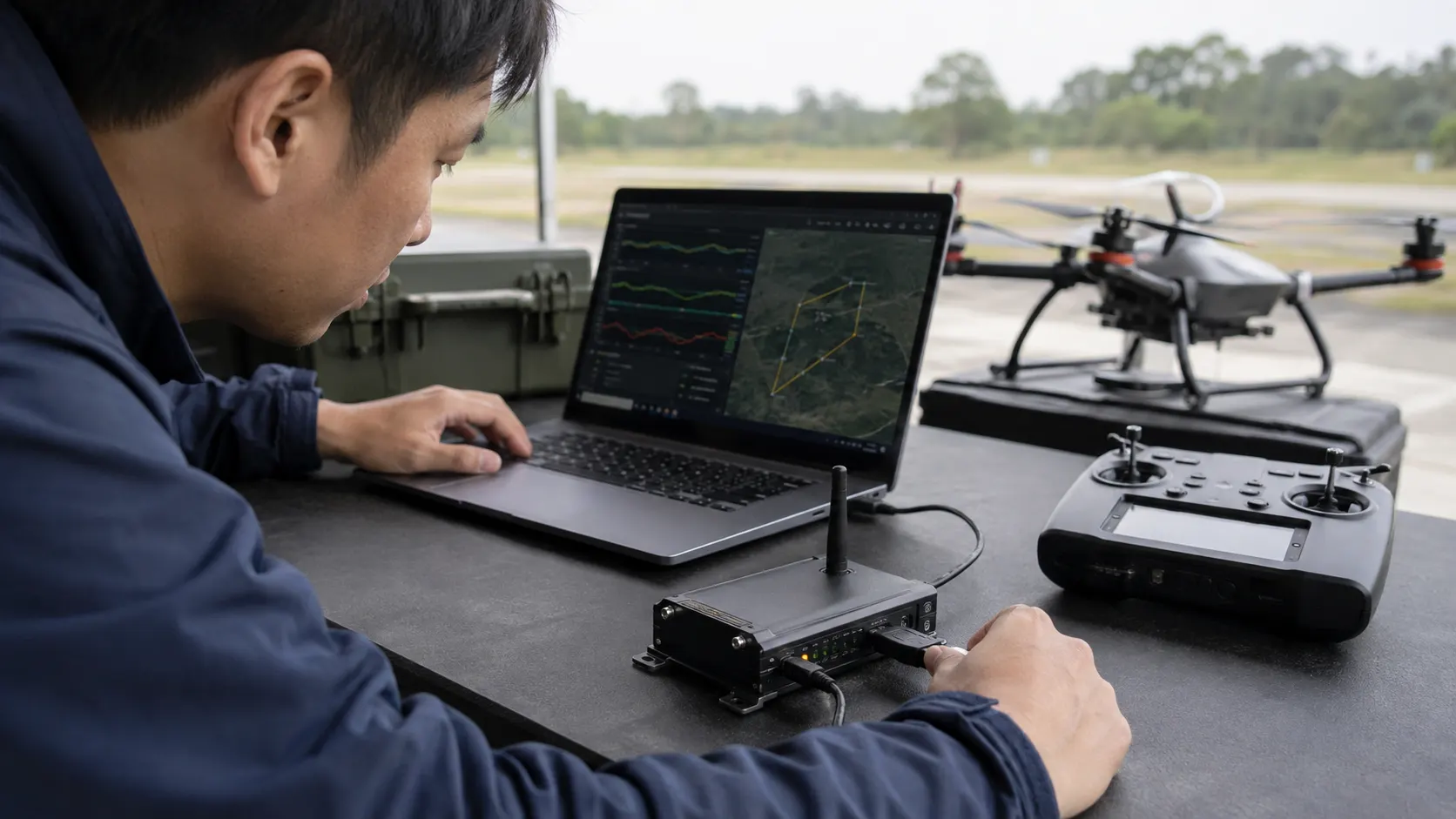
Align readings, activities, deliverables and assessment. Use as a teaching preparation plan and adjust the timing after trialling it with students.
Preparation before the course opens
- Check students' prior knowledge and their computers. Download the practice sets and try the commands in the same environment as the classroom.
- Separate readings/PC work from activities that require installing a framework or using real equipment stations, and assign responsibilities before setting practice dates.
- Prepare examples whose licensing can be checked, schedule breaks outside the net learning hours, and announce the deliverable criteria in advance.
- Use draft scores as information for adjusting teaching; do not issue professional certificates for reading the website or submitting a CSV.
BVLOS and risk assessment
Before the course: able to read coordinates, maps, weather, drone systems and basic requirements; uses hypothetical cases on a PC
Combined deliverable: a hypothetical mission and risk file with an evidence matrix and the issues still missing
24 net learning hours, with 180 minutes of pre-course preparation counted separately
G01 · Law and roles · 120 minutes
Open the lesson and worksheet →
Explanation 30 minutes · Hands-on practice 75 minutes · Review/reflection 15 minutes
Use the 60-minute core lesson within this time plus a 60-minute additional activity; do not count the time twice
Add a comparison of two missions: check where the conditions relating to people, aircraft, area and training provider differ. Have students find the original sources, record the dates, and have peers check any conclusions that go beyond the evidence.
Ask before opening the answer guide: Which information is a condition of this mission, and which information cannot yet be used to make a decision?
Evidence to check: all 4 aspects covered; every conclusion has a source ID or is marked as awaiting confirmation
G02 · Risk and teamwork · 120 minutes
Open the lesson and worksheet →
Explanation 30 minutes · Hands-on practice 75 minutes · Review/reflection 15 minutes
Use the 60-minute core lesson within this time plus a 60-minute additional activity; do not count the time twice
Inject events with inconsistent data and time pressure. Rotate the decision maker, the read-back person and the observer. Collect each person's reasoning, then review how the risk mitigations work.
Ask before opening the answer guide: What new information would make you change your decision?
Evidence to check: at least 3 risks; each item has an owner and a review condition
G04 · Systems and evidence of work · 120 minutes
Open the lesson and worksheet →
Explanation 30 minutes · Hands-on practice 75 minutes · Review/reflection 15 minutes
Use the 30-minute core lesson within this time plus a 90-minute additional activity; do not count the time twice
Add 5 system requirements for this track. Have peers separate verification from validation, link test methods and evidence to the system version, and then fix unmeasurable requirements before testing.
Ask before opening the answer guide: Which simulator results still cannot be used to confirm real hardware?
Evidence to check: at least 5 measurable requirements; units, versions and limitations stated
B01 · Defining the concept of operations · 240 minutes
Open the lesson and worksheet →
Explanation 60 minutes · Hands-on practice 135 minutes · Review/reflection 45 minutes
Change the mission time or the use of the area, then check which conclusions must be reassessed before submitting the concept for expert review.
Ask before opening the answer guide: What lies outside the scope that this plan does not yet cover?
Evidence to check: includes a map, scope, owners, data sources and assumptions; not presented as an authorisation
B02 · Evidence-based risk assessment · 360 minutes
Open the lesson and worksheet →
Explanation 90 minutes · Hands-on practice 210 minutes · Review/reflection 60 minutes
Have another team of students try to find cases where the mitigations do not work, then correct the evidence or limit the scope of the claims in a traceable way.
Ask before opening the answer guide: Through what mechanism does this mitigation reduce risk, and what evidence is there?
Evidence to check: every mitigation has evidence or a gap; risk classes are not assigned by guesswork; a SORA worksheet must be reviewed by an expert before use
B03 · C2 and abnormal events in simulation · 240 minutes
Open the lesson and worksheet →
Explanation 60 minutes · Hands-on practice 135 minutes · Review/reflection 45 minutes
The instructor adds a returning heartbeat or delayed data. Students design a recovery rule before testing and explain the results that have not yet been verified.
Ask before opening the answer guide: Is object detection imagery alone sufficient as DAA?
Evidence to check: record the parameter version, conditions and results for at least 2 scenarios; state the scope of inference
B04 · Reviewing the file and explaining limitations · 240 minutes
Open the lesson and worksheet →
Explanation 60 minutes · Hands-on practice 135 minutes · Review/reflection 45 minutes
Hold a mock review between two teams. Presenters explain the evidence by opening the actual files, and changes to conclusions after questioning are recorded.
Ask before opening the answer guide: As a reviewer, what additional evidence would you request first?
Evidence to check: key conclusions are traceable; open issues have owners; no claim of having obtained flight authorisation
Assessing the combined deliverable
- Do not convert simulation results into an authorisation or certification
- Do not assign risk classes without sources and evidence
- Correctly separate C2, payload data and DAA
Draft rubric: correctness 30, traceable evidence 30, reasoning and limitations 25, communication 15, total 100; draft target 75 with all key criteria met. Two instructors should trial-score the same piece of work and adjust criteria that they interpret differently.
Collect results and adjust the next round
Separate the time students actually spent, sticking points, help from the instructor and work completed independently. Do not combine satisfaction with performance results into a single score.
Open the teaching trial set and results log →